Researchers at Cornell University have achieved a long-standing goal in electronics by creating a dielectric material that combines very low energy loss with strong electrical tunability.
The achievement comes after 17 years of research involving scientists from several leading institutions. The result opens new opportunities for wireless communications, radar systems, satellites, and future quantum technologies.
The research team published its findings in Nature Electronics. The study brings together experts in materials science, physics, electrical engineering, and advanced measurement technology. Their work solves a challenge that scientists have tried to overcome for more than two decades.
A dielectric is a material that stores electrical energy without allowing electric current to flow through it. These materials are essential in electronic devices because they help control electric fields and microwave signals. Better dielectric materials improve the speed, efficiency, and performance of communication systems.
For many years, engineers faced a difficult tradeoff when designing these materials. A dielectric could either change its electrical properties when voltage was applied or keep energy loss very low during operation. Achieving both properties together remained one of the biggest challenges in microwave electronics.
That challenge became important as wireless technology continued to evolve. Modern communication systems demand faster signal processing while reducing energy waste. Meeting both requirements depends heavily on advanced materials.
The research effort traces back to 1999 when scientists launched a federal program to search for improved microwave materials. Most research groups focused on a well-known material, barium strontium titanate. A team led by Cornell University Professor Darrell Schlom chose a completely different path.
Instead of following the popular approach, the researchers investigated layered crystal materials known as Ruddlesden-Popper thin films. Many experts believed these materials offered little practical value. They were known for low microwave energy loss but were not expected to provide electrical tunability.
READ ALSO: Applied Materials Unveils New AI Chipmaking Systems to Speed Up DRAM and 3D Packaging
Scientists based this belief on the materials’ crystal symmetry. According to accepted theories, their atomic arrangement prevented them from responding strongly to applied voltage. That made them appear unsuitable for commercial electronic devices.
Even with these doubts, Schlom’s group continued studying the materials for years. The team believed there was still more to learn about their unusual structure. Their persistence eventually led to an unexpected discovery.
A major turning point arrived in 2009 during experiments performed by graduate student Nate Orloff at the University of Maryland. Orloff was testing thin-film samples that Schlom had provided. He had developed a new method for measuring dielectric properties over a broad range of microwave frequencies.
Late one evening, one measurement produced surprising results on his computer screen. The supposedly untunable material appeared to respond to an applied electric field. The result challenged years of scientific understanding.
The material examined during those tests was a layered crystal, strontium titanium oxide (Sr₄Ti₃O₁₀). It belongs to the Ruddlesden-Popper family of materials. The measurements suggested that these crystals possessed hidden electrical behavior.
Although the finding attracted scientific interest, it did not immediately solve the problem. Tunability appeared only when electricity moved laterally through the thin film. Most practical microwave devices require electricity to move vertically through the material instead.
That difference is important because compact electronic components depend on vertical electric fields. Devices such as voltage-controlled capacitors use this arrangement to save space and improve performance. The original material could not meet those practical design needs.
The team published its early findings and continued searching for a better solution. Rather than abandoning the project, the researchers looked for ways to redesign the crystal itself. Their goal was to keep the extremely low energy loss while enabling practical tunability.
Another important contribution came from theoretical calculations performed by Cornell researcher Craig Fennie. His work suggested that changing the internal symmetry of certain Ruddlesden-Popper compounds might unlock the desired electrical behavior. The prediction encouraged the team to explore an entirely new design strategy.
The researchers focused on compounds containing barium, strontium, titanium, and oxygen. Computer models indicated that carefully modifying the crystal structure would alter how atoms interact. Those predictions became the foundation for the next phase of the project.
READ ALSO: Germany Cancels €10B F126 Frigate Deal, Orders MEKO A-200 Ships to Meet NATO Demands
Working with collaborators from several universities and research laboratories, the scientists engineered a redesigned material. They inserted thin rock-salt layers at carefully controlled positions inside the crystal. This small structural change altered the material’s behavior under an electric field.
The redesigned crystal preserved its excellent low-loss performance. At the same time, it gained the vertical electrical response needed for practical electronic devices. This combination had remained out of reach for decades.
Early laboratory testing produced encouraging signs. Measurements showed that the material displayed out-of-plane ferroelectricity. In simple terms, the atoms inside the crystal shifted in response to voltage, creating the desired electrical behavior.
Ferroelectric materials possess tiny electric dipoles that can change direction when voltage is applied. This property allows engineers to tune electrical performance. It also enables more flexible electronic components.
Although these early experiments confirmed the new crystal design, one major challenge remained. The team still needed to prove that the material maintained its low energy loss at microwave frequencies. Those frequencies are the ones used in wireless communication systems.
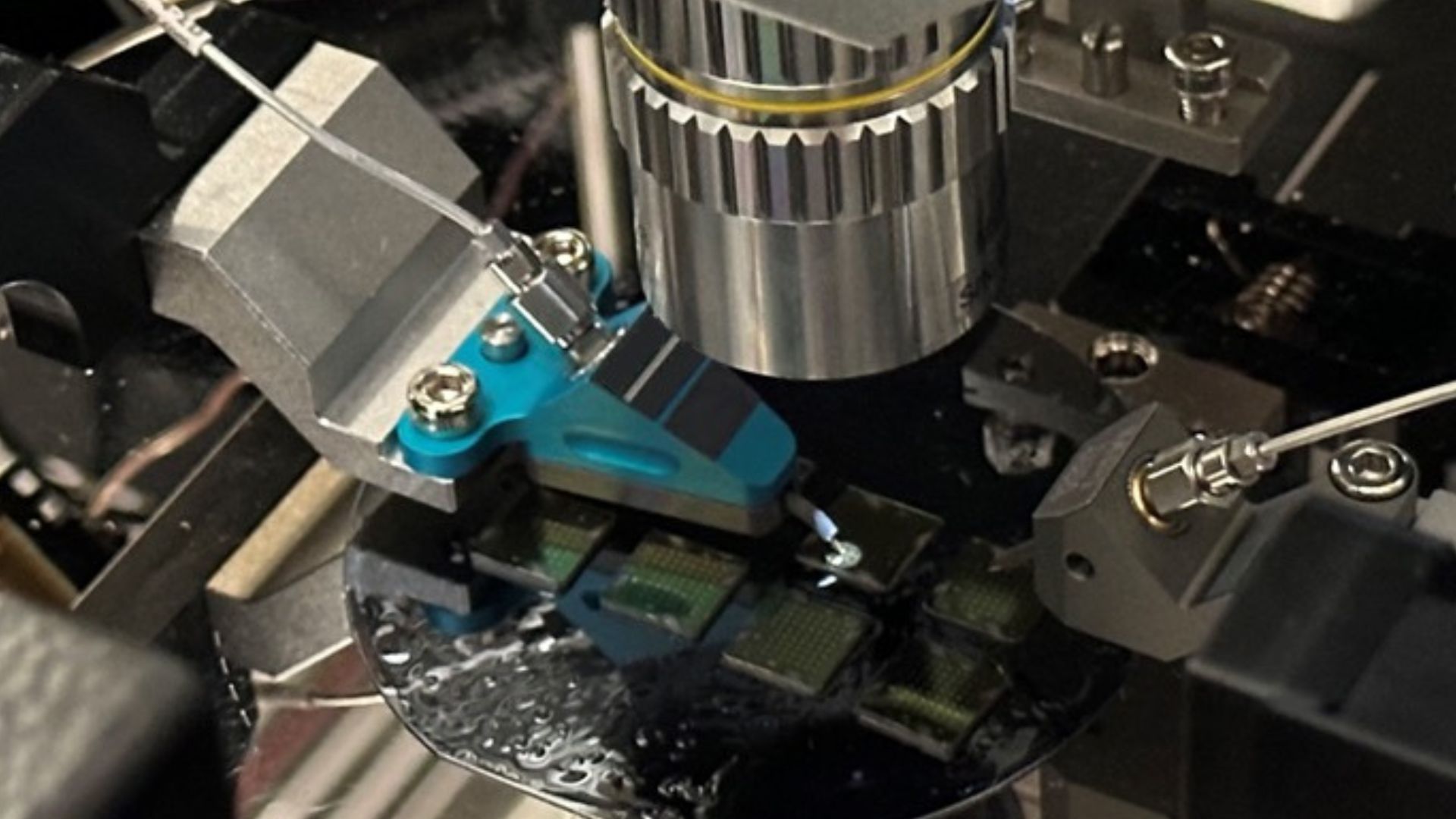
Testing at such high frequencies is extremely difficult. Measurement equipment often introduces errors because metal electrodes and wiring affect the signals. Distinguishing the material’s true performance from these unwanted effects required an entirely new measurement approach.
Advanced Measurements Confirm Material’s Performance
The next phase of the project focused on solving a measurement problem rather than a materials problem. Researchers needed a reliable way to test the new dielectric at microwave frequencies without interference from the testing equipment. Existing methods could not provide clear answers.
Scientists at the National Institute of Standards and Technology (NIST) took on this challenge. Physicists Florian Bergmann, Nate Orloff, Meagan Papac, and their colleagues worked for several years to improve the measurement process. Their goal was to isolate the material’s true electrical behavior.
The difficulty came from the tiny size of the devices being tested. At microwave frequencies, even the metal contacts and wiring around the material affect the results. These unwanted effects made the data difficult to understand.
The first measurements raised more questions than they answered. The signals appeared noisy and inconsistent. The researchers could not confidently separate the material’s performance from the influence of the test structure.
Instead of giving up, the team designed a completely new testing method. They built a control sample consisting only of the metal structure used in the experiments. The control had the same layout as the real device but lacked the dielectric material.
READ ALSO: MBDA’s FastTrack AI Plans Cruise Missile Strikes in Minutes, Transforming Battlefield Planning
This simple idea proved to be the missing piece. By measuring the control first, the scientists identified the errors introduced by the test setup itself. They then removed those effects from the final measurements.
The improved calibration revealed the material’s true properties. Data that had once appeared confusing suddenly matched theoretical predictions. The researchers finally had clear evidence that the dielectric performed exactly as expected.
The measurements confirmed two important qualities simultaneously. The material remained highly tunable under applied voltage. It also maintained exceptionally low microwave energy loss.
This combination has remained one of the most significant goals in microwave electronics for more than 20 years. Scientists often described it as the ‘holy grail’ because no practical material had successfully delivered both characteristics together. The new results finally changed that situation.
The study brought together experts from Cornell University, Rice University, the University of Maryland, the University of Connecticut, Boise State University, NIST, and several other research groups. Each institution contributed expertise in a different area. The project showed how teamwork across multiple scientific fields can solve difficult engineering problems.
Why Tunable Dielectric Matters
The new dielectric could improve many high-frequency electronic systems. These include wireless communication equipment, radar systems, satellite electronics, and advanced sensing technologies. Better materials help these systems transmit signals more efficiently.
Modern wireless networks continue to demand faster data transfer and lower energy consumption. Every small improvement in microwave components helps improve overall system performance. Materials that waste less energy also reduce heat generation inside electronic devices.
The dielectric also offers advantages for compact electronics. Since it works with an out-of-plane electric field, engineers can build smaller components without sacrificing performance. Smaller parts make it easier to design lighter and more efficient communication hardware.
Researchers also see opportunities in microwave resonators. These devices store microwave energy and are widely used in communication systems, scientific instruments, and sensors. Lower energy loss allows resonators to perform more accurately and with greater stability.
Another promising application involves electro-optic modulators. These devices convert electrical signals into optical signals that travel through fiber-optic communication networks. They form a key part of the infrastructure that carries internet traffic around the world.
Improving these modulators could increase communication efficiency while reducing energy use. Better dielectric materials can help devices operate faster and more reliably. This becomes increasingly important as global data traffic continues to grow.
The material also attracts interest for quantum information technologies. Quantum devices often require materials with extremely low energy loss because even small losses reduce performance. The new dielectric offers properties that fit these demanding requirements.
Researchers believe the work extends beyond one specific material. The methods used to redesign the crystal structure may inspire scientists to investigate other layered materials. Similar strategies could produce additional electronic materials with unique combinations of properties.
Another important advantage is manufacturing consistency. Many ferroelectric materials exhibit significant variations between samples. The newly engineered material displayed highly uniform properties across the films tested by the researchers.
Consistency matters for commercial production. Electronics companies need materials that perform consistently every time they manufacture a device. Reliable performance reduces production costs and improves product quality.
WATCH ALSO: Britain delivers laser-guided Air defense missiles to Ukraine six months ahead of schedule
The study also highlights the importance of advanced measurement science. Creating a new material is only part of the process. Researchers also need accurate tools to verify that the material performs as expected.
Without the improved measurement technique developed at NIST, the team would not have been able to confirm the dielectric’s true behavior. The new testing method itself represents an important scientific contribution. It may also help evaluate future high-frequency materials.
The project’s success also reflects years of patient research. Scientists continued investigating an idea that many experts had considered impractical. Their willingness to explore an unconventional approach eventually produced results that challenged long-held assumptions.
The discovery also demonstrates how theory and experiments complement each other. Computer calculations guided the redesign of the crystal structure. Laboratory experiments later confirmed that the predictions were correct.
As wireless communication, satellite systems, artificial intelligence hardware, and quantum technologies advance, demand for high-performance electronic materials will grow.
This newly engineered low-loss tunable dielectric provides researchers and industry with a practical path toward more efficient microwave devices. The achievement also opens new opportunities to design future electronic materials that combine properties once considered mutually exclusive.