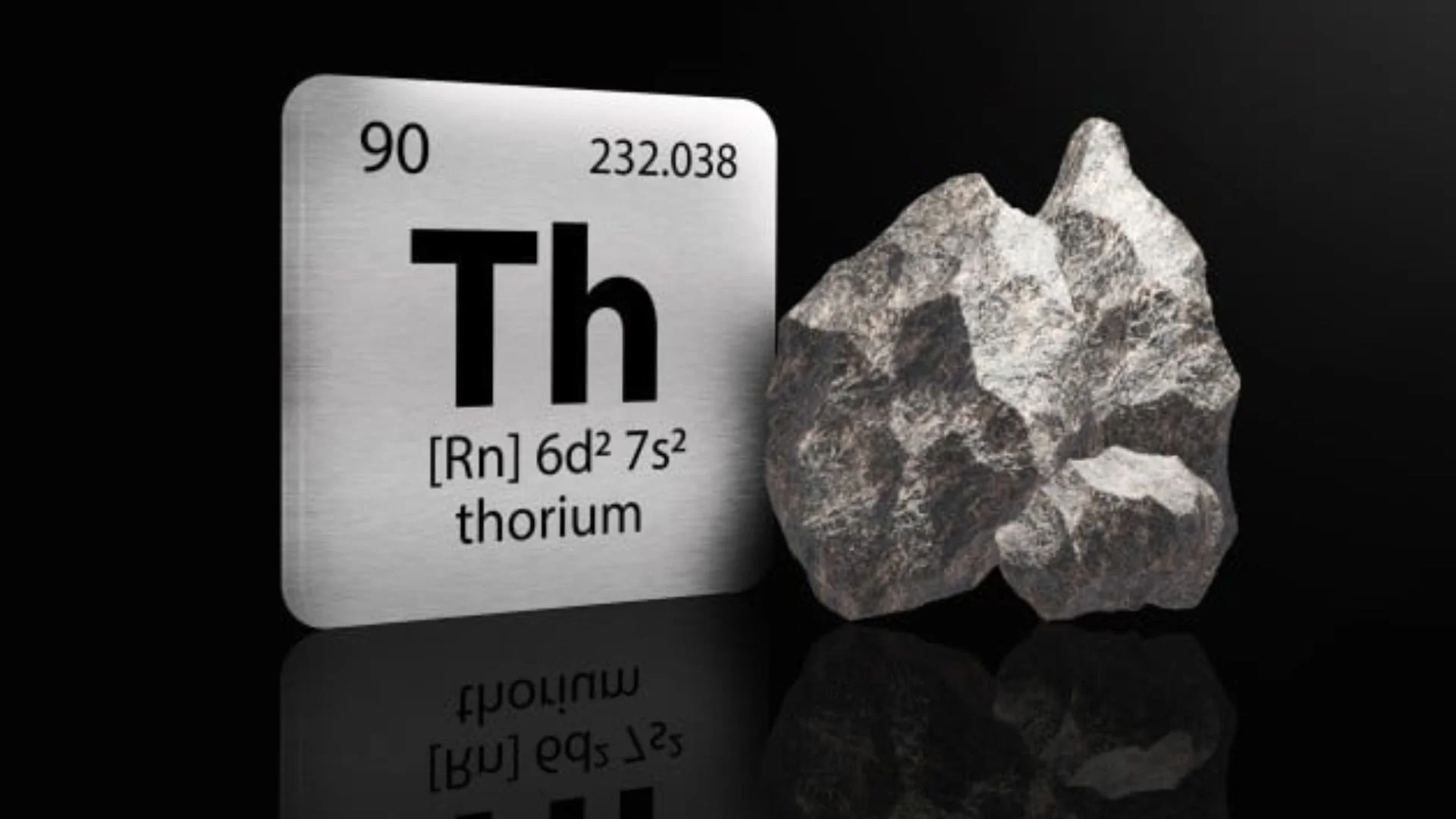
Scientists have directly observed a rare form of thorium–thorium bonding for the first time. The achievement provides researchers with clear experimental evidence of how electrons are shared among some of the heaviest atoms in the periodic table.
The findings also demonstrate a powerful new way to study chemical bonding in complex materials using standard experimental data.
A team of researchers has successfully visualized an unusual type of chemical bond involving three thorium atoms. Their work appears in the journal Chem. The study provides the first direct experimental evidence of multi-centre thorium–thorium bonding.
Unlike ordinary chemical bonds, this bonding does not exist between just two atoms. Instead, electrons are shared across three thorium atoms at the same time. This special arrangement has been predicted by scientists for years but has not been directly observed.
The research focused on two specially designed trithorium clusters. These clusters contain three closely spaced thorium atoms. They served as ideal model systems for studying how electrons behave in heavy elements.
The scientists used a technique called Hirshfeld atom refinement(HAR). It combines experimental X-ray measurements with advanced quantum calculations. This approach creates a detailed picture of where electrons are located inside a material.
READ ALSO: STMicroelectronics Launches World’s First Post-Quantum Secure Mobile Chip for Smartphones
Electron density shows how electrons are distributed around atoms. This distribution determines how atoms bond together. By accurately mapping electron density, scientists can better understand the strength and nature of chemical bonds.
Thorium Bonding Defies Convention
Measuring chemical bonding directly has always been difficult. Scientists often describe bonding using the concept of covalency, in which atoms share electrons. However, proving that sharing occurs through experiments has remained a major challenge.
One of the most accurate methods uses X-ray charge density measurements. This technique maps electron positions inside crystals. However, it normally requires extremely high-quality crystals and carefully controlled experimental conditions.
HAR offers a more practical alternative. It combines real experimental observations with theoretical calculations to improve the accuracy of electron maps. This makes the method easier to apply than traditional charge density techniques.
Heavy elements such as thorium create additional challenges. Their electrons move in ways influenced by relativistic effects because of the large atomic mass. These effects make it much harder to measure and interpret electron behavior.
The researchers tested HAR on two different trithorium clusters. One cluster shared a single electron among the three thorium atoms. The second cluster shared two electrons across the same three-atom arrangement.
These systems represented demanding test cases. The thorium atoms sit very close together. Their overlapping electron clouds make bonding difficult to distinguish using conventional methods.
The team carefully examined the electron density inside both clusters. They identified key bonding points, which are specific regions that confirm bonding interactions between atoms. These features closely matched predictions from theoretical calculations.
The results also showed clear differences between the two clusters. Those differences reflected the number of electrons shared among the thorium atoms. This confirmed that changing the electron count changes the nature of the chemical bond.
According to Professor Stephen Liddle of The University of Manchester, the work enables scientists to obtain experimental information previously beyond reach.
He said the study opens the door to examining bonding in many more complex chemical systems. He also noted that directly measuring electron sharing helps connect experiments with theoretical predictions more reliably.
WATCH ALSO: United States is considering to conduct air strikes against drug cartels in Venezuela
Understanding electron distribution is important because bonding affects how materials behave. Even small changes in bonding can influence chemical reactions, stability, conductivity, and other physical properties. Better knowledge of these interactions helps scientists design improved materials for future technologies.
Thorium belongs to the actinide family of heavy elements. These elements are important in nuclear science, advanced materials research, and fundamental chemistry. Understanding their bonding behavior improves knowledge across all of these fields.
An important advantage of this study is that HAR achieved these results using standard experimental data. Researchers did not need the highly specialized conditions required by traditional charge density methods. This makes the technique more accessible to laboratories studying complex materials.
The success of this work extends beyond thorium chemistry. Scientists can now apply the same approach to investigate other heavy-element compounds and difficult chemical systems.