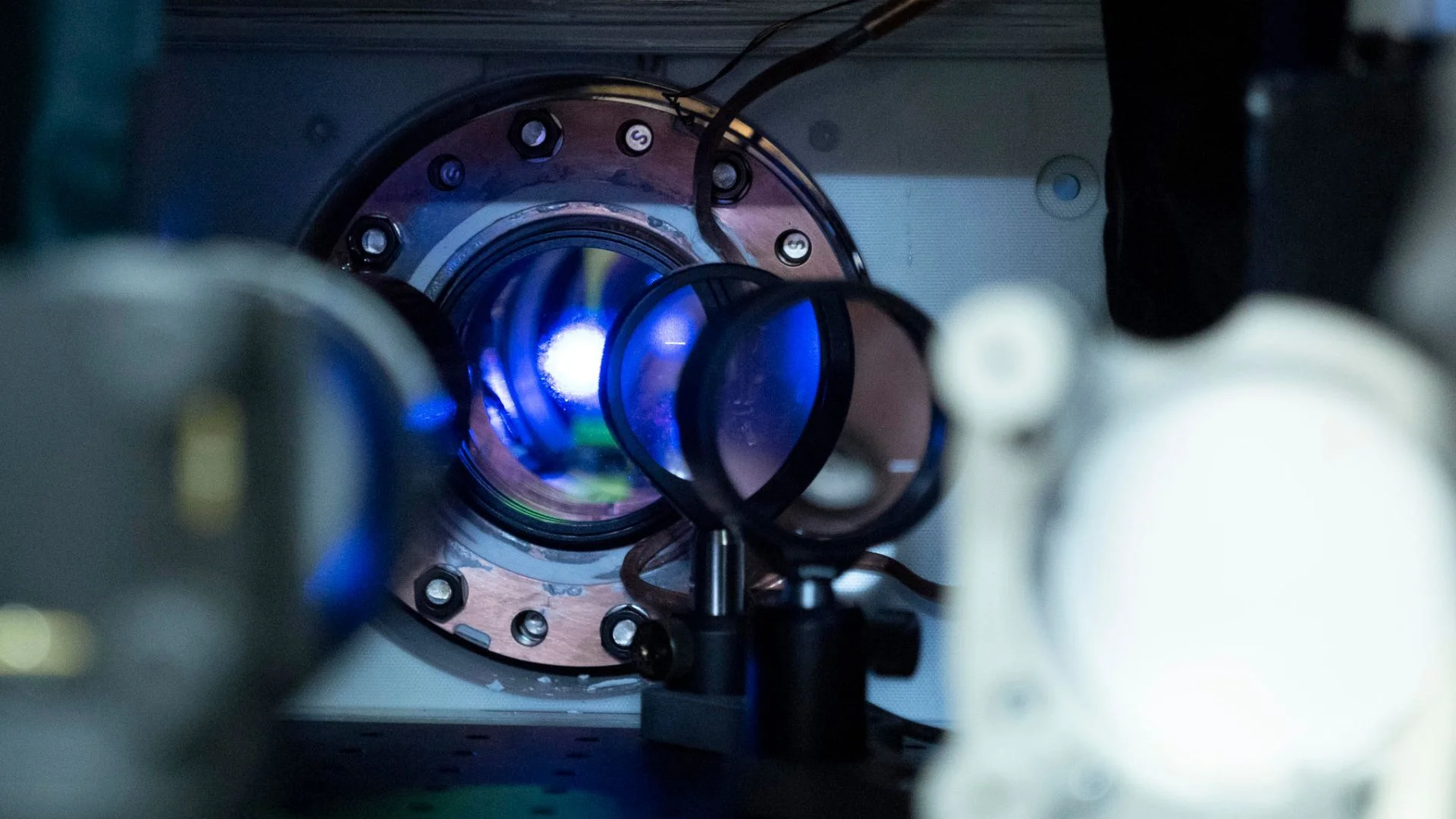
Scientists from China and Europe have independently developed the world’s first working nuclear clocks.
The achievement represents a major step forward in the science of measuring time. Researchers believe these new devices can eventually outperform today’s most advanced atomic clocks.
The two research teams were led by Beichen Huang at Tsinghua University in China and Luca Toscani De Col at the Vienna Center for Quantum Science and Technology in Austria. Both groups recently published their findings on the arXiv preprint platform. Their results demonstrate that nuclear clocks can now operate in real-world experimental conditions.
How Nuclear Clocks Work
Modern atomic clocks are currently the most accurate timekeeping devices available. They work by measuring the frequency of light emitted when electrons move between different energy levels inside atoms. Because these frequencies remain extremely stable, scientists can use them to measure time with exceptional accuracy.
Nuclear clocks follow a similar principle but focus on the atomic nucleus instead of the electrons surrounding it. The nucleus contains protons and neutrons that also have specific energy levels. By measuring transitions between these nuclear energy levels, researchers can create an even more stable reference for keeping time.
Scientists have pursued nuclear clocks for decades because atomic nuclei are naturally protected from many external disturbances. Electric and magnetic fields can affect electrons and slightly influence atomic clock measurements. The nucleus remains far more isolated, making it a stronger candidate for ultra-precise timekeeping.
Among all known elements, thorium-229 is unique for this application. Its nucleus contains an unusually small energy transition that can be accessed using laser light. No other known atomic nucleus offers a similar combination of properties.
Despite this advantage, creating a nuclear clock has been extremely difficult. The required laser light exists in the vacuum ultraviolet region of the electromagnetic spectrum. Producing and controlling light in this range presents significant technical challenges.
Both research teams solved this problem using a similar strategy. They embedded thorium-229 nuclei inside calcium fluoride crystals. The nuclei were then probed with a highly precise continuous-wave laser operating at about 148 nanometers.
READ ALSO: Royal Navy duo play pivotal role in trials to arm F-35 jets with UK’s Meteor missile
The two groups used slightly different experimental designs. The Chinese researchers relied on a more powerful laser system. The European team used crystals containing a higher concentration of thorium nuclei.
Each team also used a different method to test its clock’s performance. Huang’s team showed that the nuclear transition could stabilize the frequency of the ultraviolet laser. The system achieved fractional frequency instability approaching 1 part in 10 trillion after 1 day of operation.
The Austrian team focused on a different scientific goal. Researchers used their nuclear clock to search for signs of ultralight dark matter, a theoretical form of matter believed to make up much of the universe’s unseen mass. They looked for tiny changes in the thorium nuclear transition that might indicate the presence of these particles.
The experiment did not detect any dark matter signals. However, the clock reached a sensitivity level equal to or better than many of the world’s best atomic clocks. This result demonstrated the practical power of nuclear-based timekeeping systems.
The development is important because precise clocks support many technologies used every day. Satellite navigation systems, telecommunications networks, scientific laboratories, and financial systems all depend on highly accurate timing. Improvements in clock accuracy often translate into gains across these fields.
Nuclear clocks also offer new opportunities for fundamental physics research. Scientists can use them to test whether the basic constants of nature remain unchanged over time. Such measurements help researchers study some of the deepest questions about the structure of the universe.
WATCH ALSO: NASA rover discovered ancient microbial life signature on Mars
Another promising area is gravitational sensing. Extremely precise clocks can detect tiny differences in gravity by measuring how time passes at different locations. This capability could support future Earth observation systems and advanced scientific instruments.
Researchers now aim to improve the performance and practicality of the technology. Future versions are expected to become smaller, more reliable, and easier to operate. Continued development could eventually bring nuclear clocks out of specialized laboratories and into real-world applications.
The successful operation of the first nuclear clocks marks the beginning of a new stage in precision measurement. As the technology matures, it is expected to support scientific discoveries and advanced technologies that require timing accuracy beyond the limits of today’s atomic clocks.