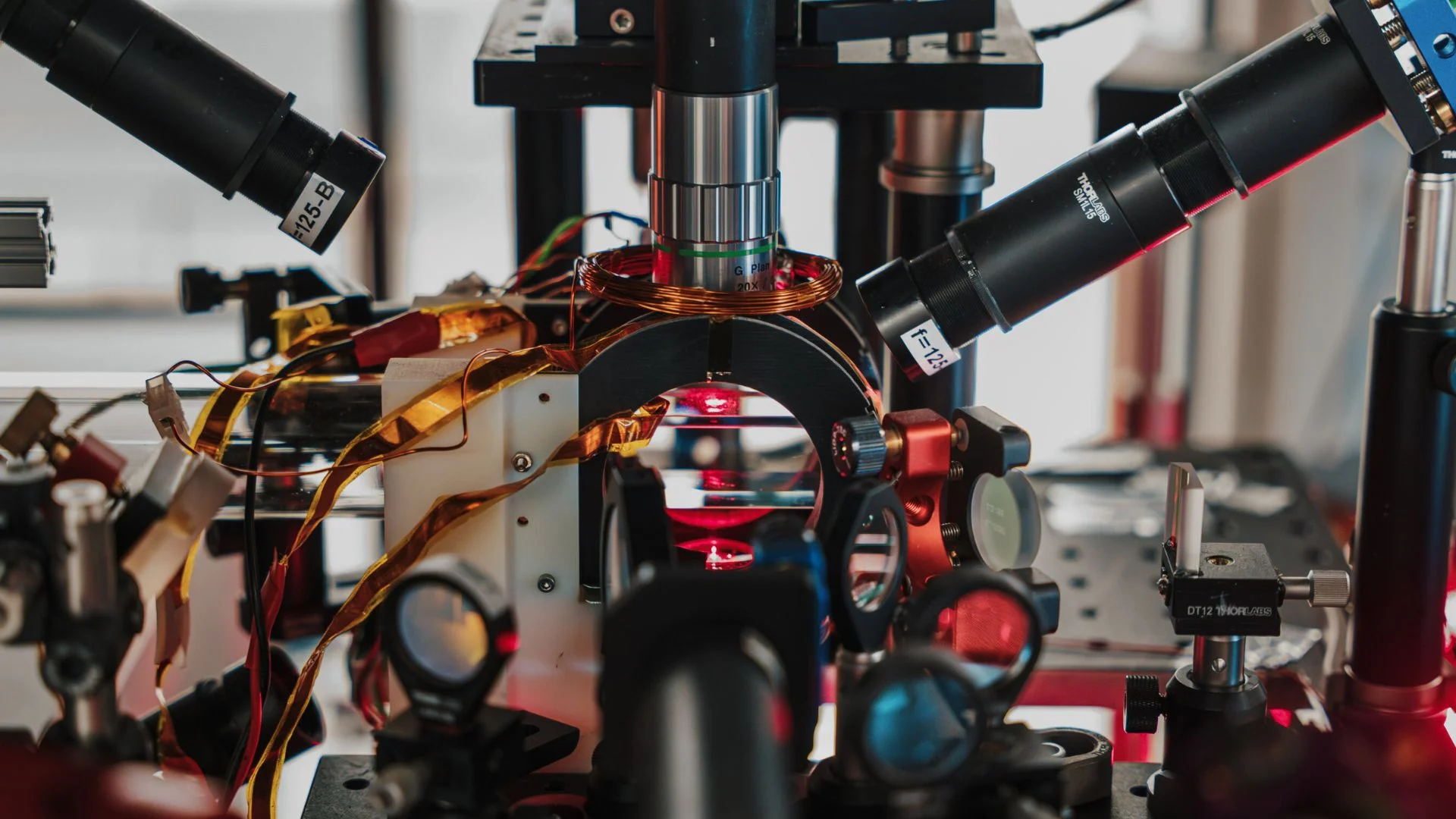
Scientists have created a laboratory-made ‘mini-universe’ that measures the flow of time without relying on a clock.
A physicist at the University of Birmingham has built a small quantum system that challenges traditional ideas about time. The experiment shows that time can be measured from changes happening inside a system itself. The findings were published in the journal Physical Review Research.
The study was led by Professor Giovanni Barontini. His goal was to investigate a question that has puzzled scientists for decades. He wanted to understand how time appears in a universe without an external clock.
Many modern theories suggest that time may not be a fundamental feature of reality. One example is the Wheeler–DeWitt equation, a theory often discussed in quantum gravity research. According to this idea, the universe exists as a single quantum state without a built-in concept of time.
In such theories, the universe does not evolve over time as people normally imagine. Instead, everything exists together in one complete quantum description. The sense of past, present, and future must emerge from relationships between different parts of the system.
READ ALSO: Boston Metal Celebrates Historic Commissioning Run of MOE Green Steel Cell
Building the Mini-Universe
To explore this idea, Barontini and his team created a miniature universe inside a laboratory. They used around 24,000 ultracold atoms cooled to temperatures only a few billionths of a degree above absolute zero. At such temperatures, quantum effects become easier to observe and control.
The atoms were trapped inside a carefully isolated environment. Researchers then used two laser beams with different frequencies to create a thin barrier within the system. This barrier divided the atoms into two regions, the bright sector and the dark sector.
The bright region could be observed directly by scientists. The dark region remained hidden from direct observation. Together, these two sections formed a closed quantum system that acted as a simplified model of a universe.
Inside this mini-universe, the bright sector repeatedly expanded and contracted. The process resembled a cycle, like a Big Bang followed by a Big Crunch. A Big Crunch is a theoretical scenario in which the expansion of the universe reverses, and everything collapses back together.
The researchers found they could reconstruct the sequence of events within the system without using an external clock. Instead, they tracked how atoms moved between the bright and dark regions. The changing arrangement of atoms provided enough information to determine the order of events.
The experiment revealed that time emerged from internal changes within the system. In other words, time was not imposed from outside. It appeared naturally through the behavior of the atoms themselves.
A key part of the study involved entropy. Entropy is often described as a measure of disorder or the spread of energy and particles within a system. Scientists frequently associate increasing entropy with the direction of time’s flow.
As atoms moved between the two regions, the particle distribution changed. When that distribution evolved, the system effectively moved forward in time. When the distribution remained unchanged, time appeared to stop within the model.
READ ALSO: Neutrons reveal lithium flow could boost performance in solid-state battery
Barontini referred to this concept as entropic time. This form of time followed a clear direction and provided a reliable way to arrange events in sequence. It also changed speed as entropy shifted throughout the system.
One important result was that entropic time produced the familiar arrow of time. This is the idea that time moves from past to future rather than in reverse. The experiment demonstrated that such an arrow can emerge naturally from internal physical processes.
The researchers also showed that the system remained consistent with established quantum physics. A version of the Schrödinger equation, the central equation of quantum mechanics, could still be written using entropic time. This allowed scientists to predict how the system’s quantum state would evolve.
The findings are significant because they bring highly theoretical questions into the laboratory. Ideas about time and quantum gravity are usually discussed using mathematical models rather than experiments. This study provides a controlled environment where such concepts can be tested directly.
The work also creates new opportunities for future research. Scientists may use similar systems to investigate conditions that existed in the early universe. More advanced versions of the experiment could help researchers explore theories related to the Big Bang, cosmic evolution, and black holes.
WATCH ALSO: Humanoid robot plays table tennis like human beings
Understanding how time emerges remains one of the deepest challenges in modern physics. This mini-universe offers a practical tool for studying that mystery.
As researchers expand the technique, laboratory experiments may yield new insights into the nature of time and the fundamental structure of the universe. This research opens a new path for testing ideas in quantum gravity and cosmology under real-world laboratory conditions.
Future experiments based on this mini-universe approach may help scientists better understand the origins of time, the evolution of the cosmos, and some of the most fundamental laws of nature.