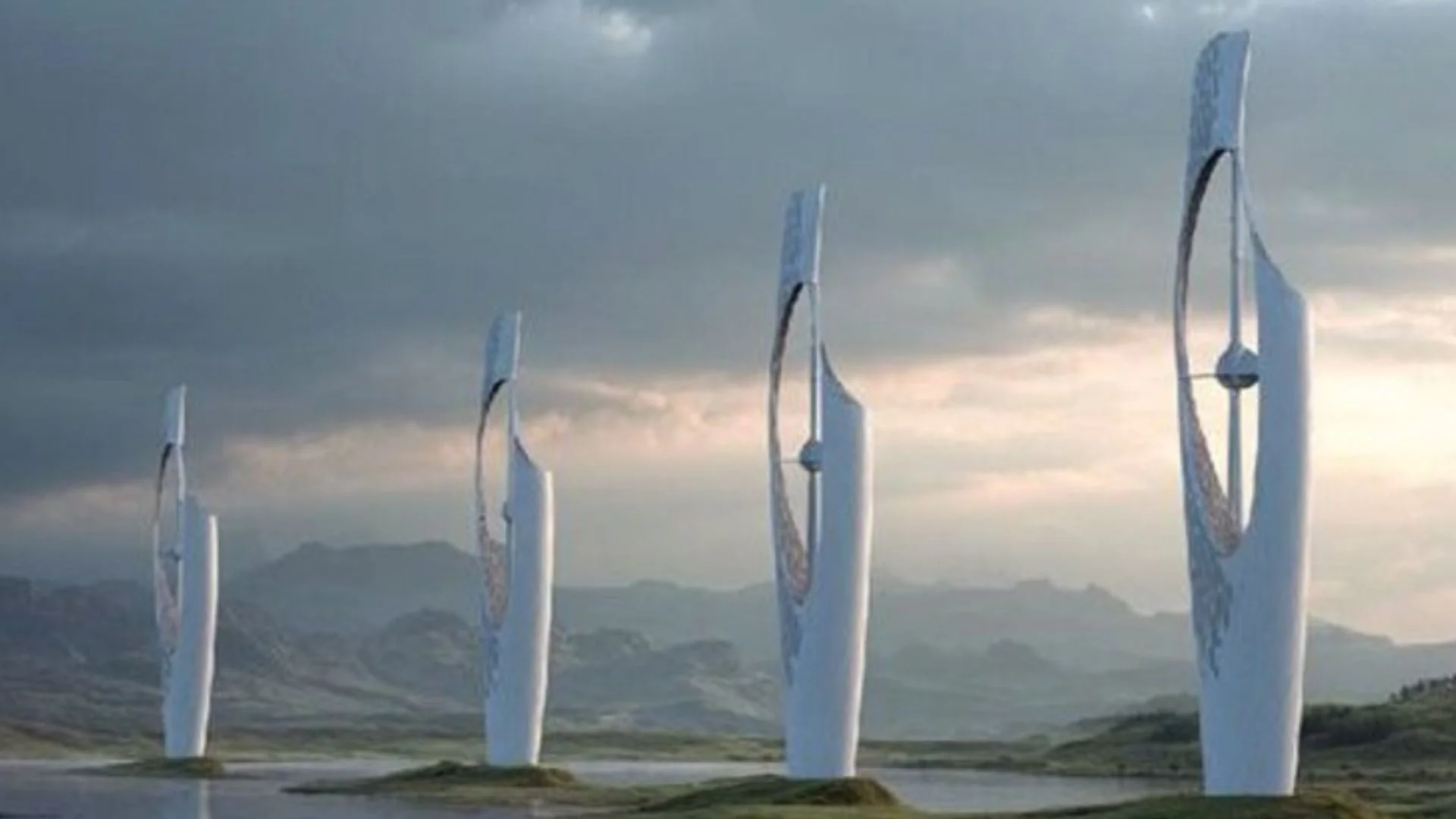
Iranian researchers have developed a new bladeless wind turbine that aims to improve wind energy production while reducing noise, maintenance, and space requirements.
The design replaces conventional rotating blades with a magnetic-levitation rotor and a smart wind-guidance system. The project has now entered the prototype development stage at the Tabriz Science and Technology Park.
The new system has been designed to capture wind from every direction without using the complex mechanisms found in traditional wind turbines. This allows the turbine to continue generating electricity even when wind direction changes frequently. Developers say the design offers a compact alternative for locations where installing large wind turbines is difficult.
Smarter Wind Design
According to the project’s lead developer, Mohammadreza Leghaei, the turbine uses self-adjusting conical scoops instead of long rotating blades. These scoops guide wind toward a magnetically levitated rotor that produces electricity with very little mechanical contact. The reduced friction helps lower maintenance needs while extending the system’s operating life.
Traditional wind turbines usually need yaw systems that rotate the entire turbine to face the wind. The new design removes that requirement by directing wind from all directions toward the rotor. This simplifies the overall structure while helping the turbine work more efficiently under changing wind conditions.
READ ALSO: Robot Fighting Arrives: 32 Teams Battle Humanoid Robots in World’s First URKL Tournament
Another key feature is its ability to begin operating at wind speeds of around 2.5 to 3 meters per second. Conventional turbines often require stronger winds before they start generating useful amounts of electricity. This makes the new system suitable for regions with lower or inconsistent wind speeds.
Bladeless Wind Turbine Innovation
Unlike conventional wind farms, where each tower normally supports a single turbine, the new design allows several units to be installed vertically on one tower. Leghaei said up to ten turbines can be stacked on a single structure. This creates what he describes as a vertical wind power plant that increases electricity production without requiring additional land.
The research team estimates that this stacked configuration can increase energy generation per unit of land by as much as seven times compared with traditional installations. The higher output comes from making better use of vertical space rather than expanding across larger areas. This approach may benefit locations where land availability is limited.
Developers also expect the compact design to make transportation and installation easier than conventional wind turbines. Smaller units may reduce infrastructure requirements while simplifying maintenance activities. The quieter operation also makes the technology more suitable for areas close to people.
Hybrid Energy Potential
The turbine has also been designed to operate alongside solar panels in hybrid renewable energy systems. Combining wind and solar power allows electricity generation from two renewable sources using the same site. This approach can improve energy availability throughout different weather conditions.
Leghaei said the technology is suitable for urban areas, industrial facilities, remote regions, ports, coastal locations, offshore sites, and even marine vessels. The flexible design allows it to serve different environments where conventional wind turbines may face installation challenges. Its modular structure also supports expansion as energy demand grows.
READ ALSO: Sikorsky Brings MATRIX Autonomy to BETA MV250 as Uncrewed Military Logistics Expands
Developers estimate that the turbine may initially deliver 10 to 15 percent higher efficiency than conventional wind turbines. They believe further testing and design improvements may raise efficiency to between 30 and 40 percent. However, Leghaei emphasized that these figures will only be confirmed through real-world operational testing.
Prototype Testing Begins
The invention has already received patent protection in Iran and has also secured a positive international search report under the Patent Cooperation Treaty. According to the research team, all 14 patent claims were recognized as novel, inventive, and suitable for industrial application. These recognitions strengthen the project’s intellectual property position as development continues.
The prototype will now undergo testing at the Tabriz Science and Technology Park before moving toward operational validation and commercial development. Engineers will evaluate its performance, durability, and energy production under real operating conditions. These trials will determine whether the system performs as expected outside laboratory environments.
As countries continue expanding renewable energy capacity, technologies that improve efficiency while reducing land use and maintenance costs are attracting greater attention.
However, Iran’s bladeless wind turbine may offer an additional option for clean energy projects in regions with low-speed and changing winds, supporting more flexible renewable power generation in the years ahead.