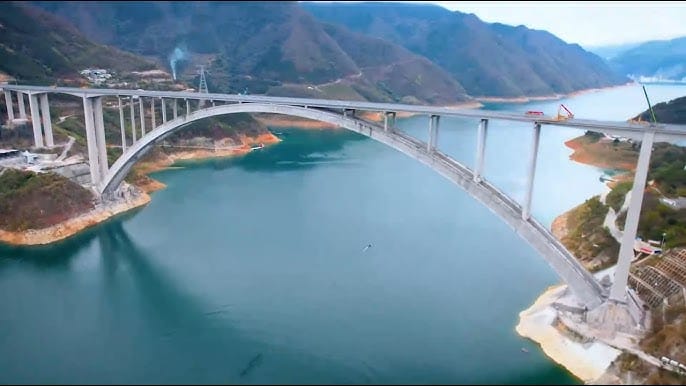
China has set a new world record in concrete arch bridge construction with the Tian’e Longtan Bridge in Guangxi, southern China.
Its 600-meter main arch span is the longest of its kind and moves well beyond the limits that had constrained large concrete arch projects for decades.
The project also demonstrates how changes in structural design and concrete construction can make very long spans more practical. The bridge opened to traffic in 2024 and forms part of a two-way, four-lane transport route.
The bridge has a total length of 2,488.55 meters, while its 600-meter arch is the central feature of the structure.
The project received the top prize at a Guangxi provincial science and technology awards ceremony held on August 24. The award recognized a project focused on the key technologies used to construct concrete arch bridges in the 600-meter class.
The record is significant because engineers have long faced major difficulties when attempting to extend concrete arches to very large spans. Conventional concrete arch bridges were generally considered difficult to extend beyond about 400 meters. Concrete-filled steel tube arch bridges also faced challenges when their arch spans approached or exceeded 500 meters.
READ ALSO: https://modernmechanics24.com/post/china-largest-underwater-river-tunnel/
For decades, Japan, Croatia and other countries with advanced bridge-building industries studied the possibility of constructing concrete arches with spans around 600 meters.
However, projects in those countries reportedly did not progress beyond about 390 meters. The Tian’e Longtan Bridge has, therefore, placed China at the forefront of this particular area of long-span concrete bridge construction.
Reducing The Structural Weight
One of the central challenges in building a very long concrete arch is its own weight.
Engineers involved in the Tian’e Longtan Bridge said the bridge’s dead load, meaning the weight of the structure itself, accounts for more than 90 percent of the total stress in a long-span concrete arch. Concrete surrounding the steel framework represents more than half of that structural weight.
The design team addressed this problem by changing the shape and internal arrangement of the main arch. Instead of treating the arch as one wide structure, engineers divided it into two separate ribs and removed sections that carried relatively low levels of stress. This reduced the overall width of the arch from 23 meters to 13 meters.
The change significantly reduced the amount of concrete required for the main structure. Concrete consumption fell from about 40,000 cubic meters to 28,000 cubic meters, while the stress level remained essentially unchanged. The amount of concrete used per meter was also about 22 percent lower than that of bridges in the 400-meter class.
This approach helped reduce the load that the bridge itself places on its supporting structure. Lower structural weight is particularly important as bridge spans become longer because every additional amount of material adds weight that the bridge must carry. By controlling that weight, engineers can improve the feasibility of constructing larger arches without simply adding more material.
Tackling Concrete Cracking
Weight reduction was only one part of the engineering challenge faced by the project. Concrete can develop cracks during construction because of factors such as temperature changes, internal heat and stress as large quantities of material harden. Such cracking becomes an important concern when engineers pour large volumes of concrete into a major arch structure.
The Tian’e Longtan Bridge project introduced new methods for concrete pouring aimed at reducing and preventing cracking. These construction techniques were developed alongside the changes to the arch design. They helped engineers manage both the structural weight and the construction risks associated with the unusually large span.
WATCH ALSO: https://modernmechanics24.com/post/china-c919-first-international-flight/
The project was formally described as having broken through the recognized technical barrier for 600-meter-class concrete arch bridges. Its construction combined structural optimization with construction methods designed specifically for a very large concrete arch. The result was a bridge that extended the practical scale of concrete arch construction while keeping the structure within controlled stress levels.
Lower Costs And Long-Term Value
The engineering choices also produced economic benefits compared with another possible bridge design.
According to the project information, selecting the Tian’e Longtan Bridge’s arch design instead of a cable-stayed bridge saved about 110 million yuan, equivalent to roughly $16.37 million. The comparison also includes expected long-term maintenance costs.
Over the bridge’s 100-year design life, maintenance costs are expected to be about 470 million yuan lower than those associated with the cable-stayed alternative.
These figures show that the design was assessed not only on its ability to achieve a long span but also on construction and lifetime costs. The economic calculation adds another dimension to the significance of the engineering work.
The bridge also reflects the growing importance of advanced construction techniques in major infrastructure projects. As transport networks expand across difficult terrain, engineers increasingly need structures that can cross wide rivers and deep valleys while limiting the amount of supporting infrastructure required. Long-span bridges can help address those geographical challenges when their construction and maintenance costs remain manageable.
The technology behind the Tian’e Longtan Bridge also attracted international attention during its construction.
READ ALSO: https://modernmechanics24.com/post/fukushima-water-release-172700-tons/
In 2023, the International Association for Bridge and Structural Engineering and the Chinese Academy of Engineering held a global conference in Nanning, the capital of Guangxi. Experts attending the event described the bridge’s technology as world-class, according to the report.
The Tian’e Longtan Bridge now provides a working example of how concrete arch construction can move beyond previously established span limits. Its 600-meter arch combines a lighter structural design, reduced concrete use and construction methods aimed at controlling cracking.
The experience gained from the project could provide useful technical references for future long-span bridges as engineers continue to explore larger and more efficient structures.