

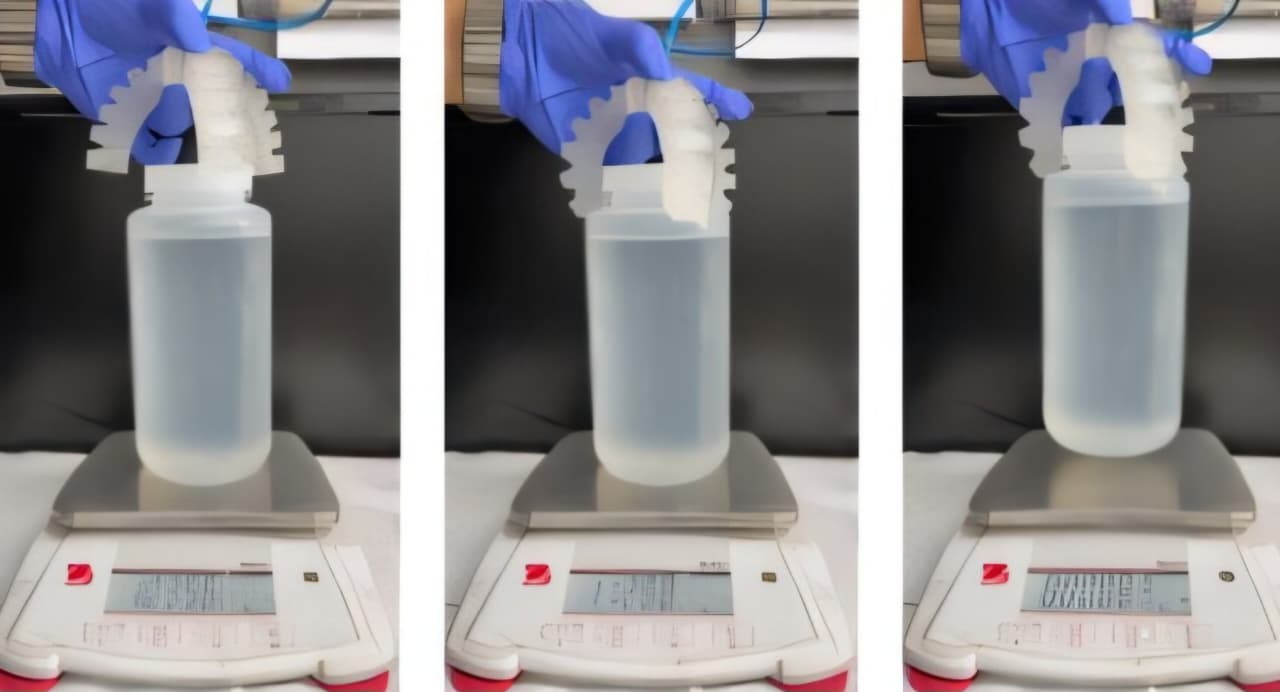
Korean researchers have used artificial intelligence to develop a highly stretchable material for 3D printing that has been tested in a soft robotic hand capable of handling objects ranging from fragile eggs to a 1-kilogram water bottle.
The material can stretch to more than six times its original length while retaining the properties needed for Digital Light Processing (DLP), 3D printing. The work offers a new approach to designing flexible materials for robots, wearable technology and customised medical devices.
AI Searches Material Space
The research was led by Professor Seungchul Lee of the Department of Mechanical Engineering at the Korea Advanced Institute of Science and Technology (KAIST).
The team worked with Dr. Jongbeom Na’s group at the Korea Institute of Science and Technology’s Extreme Materials Research Center and Professor Bumsoo Park of the Department of Manufacturing Systems and Design Engineering at Seoul National University of Science and Technology.
READ ALSO: https://modernmechanics24.com/post/best-luvata-fusion-superconductor-supply/
Their findings were published in Nature Communications. The research addresses a longstanding problem in soft 3D printing: materials need to flow easily enough to form detailed structures but also remain flexible and strong after they have been cured.
DLP printing works by exposing liquid material to light, causing selected areas to harden into a programmed shape. The process is well suited to producing complex structures, but increasing a material’s flexibility and durability often makes the liquid thicker and harder to process through a printer.
Making the formulation thinner improves its flow but can reduce its strength and ability to stretch. The researchers therefore focused on finding a composition that balanced printability, elasticity and mechanical performance.
Machine Learning Guides Formulation
The team created a database by preparing different liquid material formulations and testing their physical properties. Researchers measured how far each material could stretch, how strong it was, how quickly it hardened under light and how easily it flowed.
Importantly, the dataset included formulations that were difficult to print because of their high viscosity. Including these challenging materials gave the machine-learning system a wider range of information about how changes in composition affected performance.
The researchers then trained an AI model to identify relationships between the formulations and their measured properties. The system used the experimental data to search for a combination that offered both sufficient flow for DLP printing and high elasticity after curing.
The resulting formulation was tested on a DLP printer and produced reliable printed structures. When pulled, the material stretched to more than six times its original length without easily tearing, demonstrating a level of flexibility suited to soft robotic components.
WATCH ALSO: https://modernmechanics24.com/post/us-army-46m-autonomous-cargo-drone/
Soft Actuator Mimics Fingers
The researchers next tested the material in a functional soft actuator. Unlike conventional rigid motors and mechanical joints, a soft actuator uses mechanisms such as air pressure to produce flexible movement similar to muscles.
The team printed an actuator from the new material and inflated it with air. As pressure increased, the structure expanded and bent in a motion resembling a human finger.
Several of these actuators were then combined to create a soft robotic hand. The hand successfully lifted a 1-kilogram water bottle and maintained stable grips on objects with different shapes and levels of rigidity.
The tests included fragile eggs, glass bottles, an egg carton and a computer mouse. The ability to handle such different objects is important for soft robotics because conventional rigid grippers can require precise control to avoid either dropping an object or applying excessive force.
Soft structures can instead deform around the surface of an object. This makes them particularly relevant to applications where robots need to interact directly with people, delicate products or irregularly shaped objects.
Faster Route To Materials
The researchers said the significance of the work extends beyond the specific material developed for the robotic hand. Their approach uses AI to reduce the number of experimental combinations that researchers need to test manually when searching for materials with particular characteristics.
Traditional material development can require researchers to formulate and test many combinations before finding one that meets several requirements at the same time. The AI-based method uses existing experimental measurements to identify promising formulations before researchers carry out physical validation.
This creates a two-stage process in which machine learning narrows the search and laboratory experiments confirm the predicted performance. The approach can reduce trial and error and potentially shorten the time required to develop specialised 3D-printing materials.
Professor Lee said combining experimental data with artificial intelligence can help identify material combinations that are difficult to find through conventional testing alone.
He said the team expects the method to support faster development of 3D-printing materials for soft robots, wearable devices and customised medical equipment.
The potential applications extend across several areas where flexibility and precise shaping are important. Soft robotic systems can use such materials for grippers and body-safe mechanisms, while wearable devices can benefit from structures that conform more closely to the human body.
Custom medical devices are another potential application because additive manufacturing can produce shapes tailored to individual users. The ability to combine complex geometry with rubber-like flexibility could therefore expand the types of components that can be manufactured through 3D printing.
READ ALSO: https://modernmechanics24.com/post/lynx-xm30-army-testing-bradley-replace/
The study also points to a broader shift in materials research, where AI is being used not simply to analyse finished products but to guide the search for new formulations. As researchers build larger experimental databases, such methods may provide a more systematic route to developing materials with specific combinations of strength, flexibility, flow and curing behaviour.
The Korean team’s work demonstrates how that approach can move from laboratory measurements to a functioning robotic system. Further development and testing will determine how the material performs across more demanding manufacturing conditions and longer periods of use, but the research establishes a practical link between AI-guided material design, flexible 3D printing and next-generation soft robotics.














One Response