

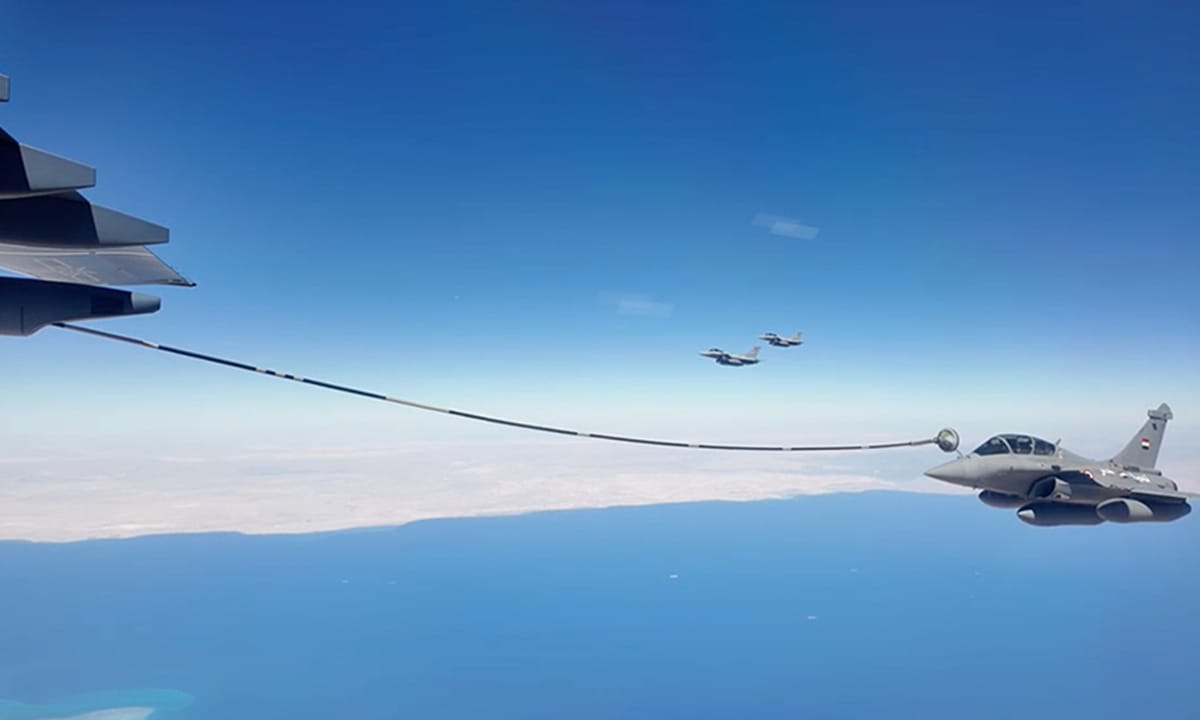
A Chinese YU-20 aerial tanker has refueled an Egyptian Rafale fighter during a joint military exercise in Egypt, offering a rare public view of the two air forces operating together.
The operation took place during Eagles of Civilization 2026, a China-Egypt air force exercise involving several types of combat aircraft. The refueling mission highlights a level of coordination that extends beyond air combat training to aircraft support and operational procedures.
YU-20 Meets Rafale
The refueling operation was shown in a photograph posted on Monday by an official military spokesperson for the Egyptian Armed Forces on X.
READ ALSO: https://modernmechanics24.com/post/japan-hypersonic-arms-race-china/
The image showed a YU-20 tanker operated by the Chinese People’s Liberation Army Air Force connected to an Egyptian Rafale during flight. Wang Yanan, editor-in-chief of Beijing-based Aerospace Knowledge magazine, described such a refueling operation between the two aircraft as rare.
The Eagles of Civilization 2026 exercise is being conducted at several Egyptian air bases. It involves multi-role fighters from both countries and covers air combat, strikes against simulated hostile targets and the protection of important targets. The exercise also includes aerial refueling, allowing the participating air forces to train in both combat and supporting operations.
The Egyptian Armed Forces said the exercise is designed to improve the ability of personnel from both countries to plan and execute modern air operations. It also aims to promote the exchange of operational experience and improve coordination between pilots. The broader objective is to strengthen the readiness of the participating air forces to perform assigned missions together.
How Refueling Works
The YU-20 and Rafale are compatible for aerial refueling because both use a probe-and-drogue system.
In this arrangement, the tanker extends a hose with a cone-shaped drogue, while the receiving aircraft uses a probe to connect to the drogue and receive fuel. The system is widely used for refueling fighter aircraft and differs from the rigid boom system used by some tankers.
Wang said the shared refueling method reduces the technical difficulty of connecting the two aircraft. The fuel-transfer pressure and basic operating principles are similar, although minor adjustments may be required when aircraft from different manufacturers are involved. The larger challenge is ensuring that pilots and tanker crews follow compatible procedures.
Aircraft do not all approach tankers in the same way. Differences in speed, altitude, flight characteristics and configuration mean crews must establish procedures for rendezvous, approach, docking and separation before attempting refueling. According to Wang, the coordination required for such an operation demonstrates the preparation involved in the China-Egypt exercise.
WATCH ALSO: https://modernmechanics24.com/post/china-c919-first-international-flight/
China Expands Tanker Role
The YU-20 is based on China’s Y-20 heavy transport aircraft and has been developed to provide airborne fuel support to combat aircraft. By transferring fuel during flight, a tanker can allow fighters and other aircraft to remain airborne for longer periods without returning to a base. This makes aerial refueling an important support capability for long-range and extended-duration air operations.
China Military Bugle highlighted the YU-20’s refueling capabilities in a promotional video released on June 28. The footage showed the tanker refueling several Chinese aircraft, including the J-35, J-20, J-16 and J-15 fighters. It also showed the tanker refueling an H-6N bomber, providing a rare view of the YU-20 supporting a much larger aircraft.
The Egyptian exercise now provides evidence of the tanker operating with a foreign fighter type. The Rafale is a French-designed multirole fighter operated by several countries, including Egypt. Its participation gives the Chinese tanker crews an opportunity to practise refueling procedures with an aircraft outside China’s own military fleet.
J-16 Joins Rafale
The YU-20-Rafale refueling mission is part of a wider programme of air combat training between China and Egypt. CCTV News released footage on August 24 showing Chinese J-16 fighters taking part in air combat drills against Egyptian MiG-29 and Rafale fighters. The exercise brought together aircraft developed under different national systems and operating doctrines.
Chinese military analysts said the training was the first joint exercise involving the J-16 and Rafale. China had also deployed the J-16 to the exercise for the first time, while the Egyptian Rafale was participating in the bilateral training. The combination gives both sides an opportunity to practise against aircraft with different capabilities and operating characteristics.
The inclusion of the J-16 and Rafale is significant because the two aircraft are built around different design approaches. The Chinese J-16 is a twin-engine multirole fighter derived from the Su-30 family, while the Rafale is a French twin-engine multirole aircraft designed for a wide range of air and ground missions. Training between them allows pilots to gain experience operating against unfamiliar aircraft.
READ ALSO: https://modernmechanics24.com/post/argonne-ai-nuclear-physics-problem/
Interoperability Takes Focus
The aerial refueling operation adds an important support element to the exercise. Air combat training tests how aircraft perform against one another, while refueling tests how aircraft crews coordinate during a complex procedure involving close formation flying. Successfully combining the two requires common procedures, communication and careful timing.
Wang said the operation demonstrates the depth of interoperability between the Chinese and Egyptian air forces.
In practical terms, interoperability means that different aircraft, crews and support systems can work together despite being developed and operated by separate militaries. The ability to conduct aerial refueling provides an additional layer of cooperation beyond conventional fighter training.
Such exercises can also prepare personnel for situations requiring coordinated operations involving different types of equipment. The experience gained from working with unfamiliar aircraft can help crews understand different operating procedures and improve communication between participating units.
However, the exercise itself does not indicate that China and Egypt have established a permanent joint operational arrangement.
Wider Military Significance
China and Egypt have increased military exchanges in recent years, with joint exercises providing an avenue for both countries to develop operational experience. Eagles of Civilization 2026 brings together fighter aircraft, tanker support and different mission profiles within a single training framework. This makes the exercise broader than a simple air combat drill.
For China, operating the YU-20 alongside a foreign fighter provides an opportunity to demonstrate the tanker’s ability to support aircraft using the probe-and-drogue system.
For Egypt, training with Chinese aircraft provides exposure to a different set of platforms and operational procedures. Both sides can use the exercise to identify differences in tactics, communication and coordination.
WATCH ALSO: https://modernmechanics24.com/post/apple-opens-advanced-center-houston/
The photograph of the YU-20 refueling the Rafale is therefore significant primarily because it documents an uncommon form of military cooperation. It shows that the China-Egypt exercise has progressed from individual combat missions to more complex activities involving airborne support.














3 Responses