

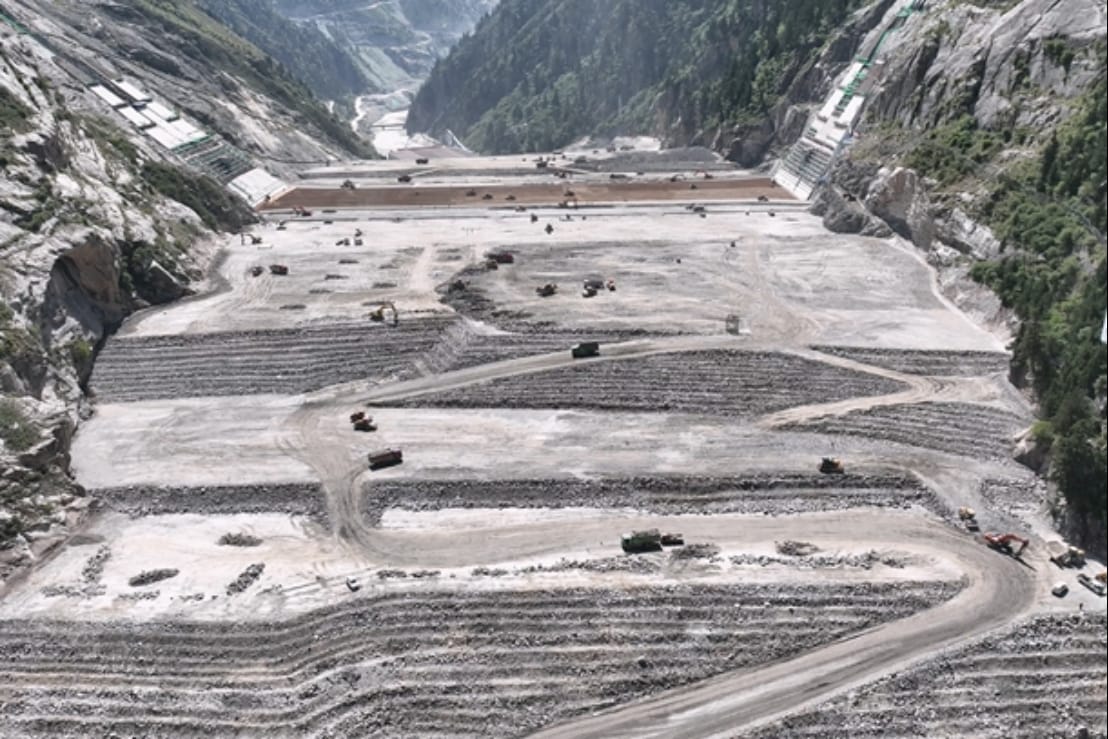
Three generating units at China’s Shuangjiangkou Hydropower Station in Sichuan province have entered operation, bringing the project built around the world’s tallest dam closer to full capacity.
The station, located on the upper Dadu River in southwest China, is designed to generate electricity while also supporting flood control and water management. Its commissioning comes as Sichuan faces strong summer electricity demand and China continues to expand its hydropower capacity.
China Energy Investment Corp said on Monday that the three units from the first phase are now operating, according to China Media Group. The first unit began generating electricity in June, followed by two more as the project team brought additional capacity online. The three units have so far generated about 500 million kilowatt-hours of electricity.
READ ALSO: https://modernmechanics24.com/post/china-tanker-refuels-egypt-rafale-drill/
The Shuangjiangkou project has a total planned installed capacity of 2 million kilowatts. It consists of four generating units, each with a capacity of 500,000 kilowatts, using Francis turbines to convert the energy of flowing water into electricity. The reservoir is designed to hold about 2.9 billion cubic metres of water.
The project’s 315-metre-high dam is the tallest in the world. It is also a key control facility on the upper Dadu River, where its reservoir will help regulate water flows through the basin. Alongside electricity generation, the station is intended to support flood management and the allocation of water resources.
The three operating units are helping meet peak summer demand in the Chengdu-Chongqing economic circle. The region includes major industrial and population centres in southwest China and has seen continued growth in electricity consumption. Once all four units are operational, the station is expected to generate about 7.7 billion kilowatt-hours of electricity annually.
Reservoir Adds Flexibility
The project is expected to have an impact beyond the electricity produced directly at the station. Its operation is forecast to increase annual generation at downstream cascade hydropower stations by about 6.6 billion kilowatt-hours. The additional output is linked to the project’s ability to regulate water flows through the river system.
Lin Boqiang, director of the China Center for Energy Economics Research at Xiamen University, said the reservoir’s storage capacity would allow operators to retain water when inflows are high and increase generation when electricity demand rises or conditions become drier. That ability gives reservoir-based hydropower a role in managing fluctuations in electricity supply. It can also contribute to grid stability during periods of high demand.
The flexibility is more relevant as China rapidly expands wind and solar power. Electricity production from those sources varies with weather conditions and, in the case of solar, daylight hours. Reservoir hydropower can adjust output to help balance such fluctuations and support the integration of more variable renewable generation into the grid.
WATCH ALSO: https://modernmechanics24.com/post/nvidia-cosmos-real-world-driving/
Complex Construction Conditions
The Shuangjiangkou project has been built in a high-altitude area with difficult geological and geographical conditions. Low temperatures and a relatively short construction season added to the challenges faced by engineers and construction teams. The scale of the dam has also required advanced techniques for building and managing an ultra-high rock-fill structure.
Lin said the project demonstrated China’s ability to develop large hydropower facilities under demanding conditions.
Experts cited the construction as evidence of domestic capabilities in ultra-high rock-fill dams and associated high-head flood-discharge systems. The project forms part of China’s broader effort to expand large-scale renewable power infrastructure.
The commissioning of the three units also illustrates the way major hydropower projects are being brought online in stages. Rather than waiting for the entire station to be completed, individual generating units can begin supplying electricity once they are ready. This allows new capacity to contribute to the grid while construction and commissioning work continues elsewhere at the site.
China Expands Hydropower
China remains the world’s largest hydropower producer by installed capacity and continues to add conventional and pumped-storage facilities.
The National Energy Administration said China added 6.03 million kilowatts of hydropower capacity in the first half of the year. Conventional hydropower accounted for 3.03 million kilowatts, while pumped-storage projects added 3 million kilowatts.
China’s total installed hydropower capacity reached 454 million kilowatts by the end of June, according to the administration. Major power producers generated 588.6 billion kilowatt-hours of hydropower during the first six months of the year. The average utilisation of hydropower facilities nationwide stood at 1,452 hours during that period.
The expansion comes as China seeks to increase renewable energy while maintaining a stable electricity supply. Hydropower provides both electricity and, through reservoirs and pumped-storage facilities, a means of balancing other renewable sources. Shuangjiangkou’s eventual full operation will add another large reservoir and generating facility to that system.
READ ALSO: https://modernmechanics24.com/wp-admin/post.php?post=28584&action=edit
Focus Shifts To Full Capacity
With three of its four generating units now operating, attention will turn to the remaining unit and the station’s transition to full operation.
At full capacity, the project is expected to supply billions of kilowatt-hours of electricity each year while increasing output from downstream hydropower stations. Its reservoir will also provide greater control over water flows in the upper Dadu River.
The project illustrates the continuing role of large hydropower schemes in China’s energy strategy despite the rapid expansion of wind and solar power. Its combination of generation, water storage and grid-balancing functions gives it a role that extends beyond simply adding electricity capacity.
The next stage will be the completion of the remaining generating unit and the integration of the full station into the regional power system.






One Response