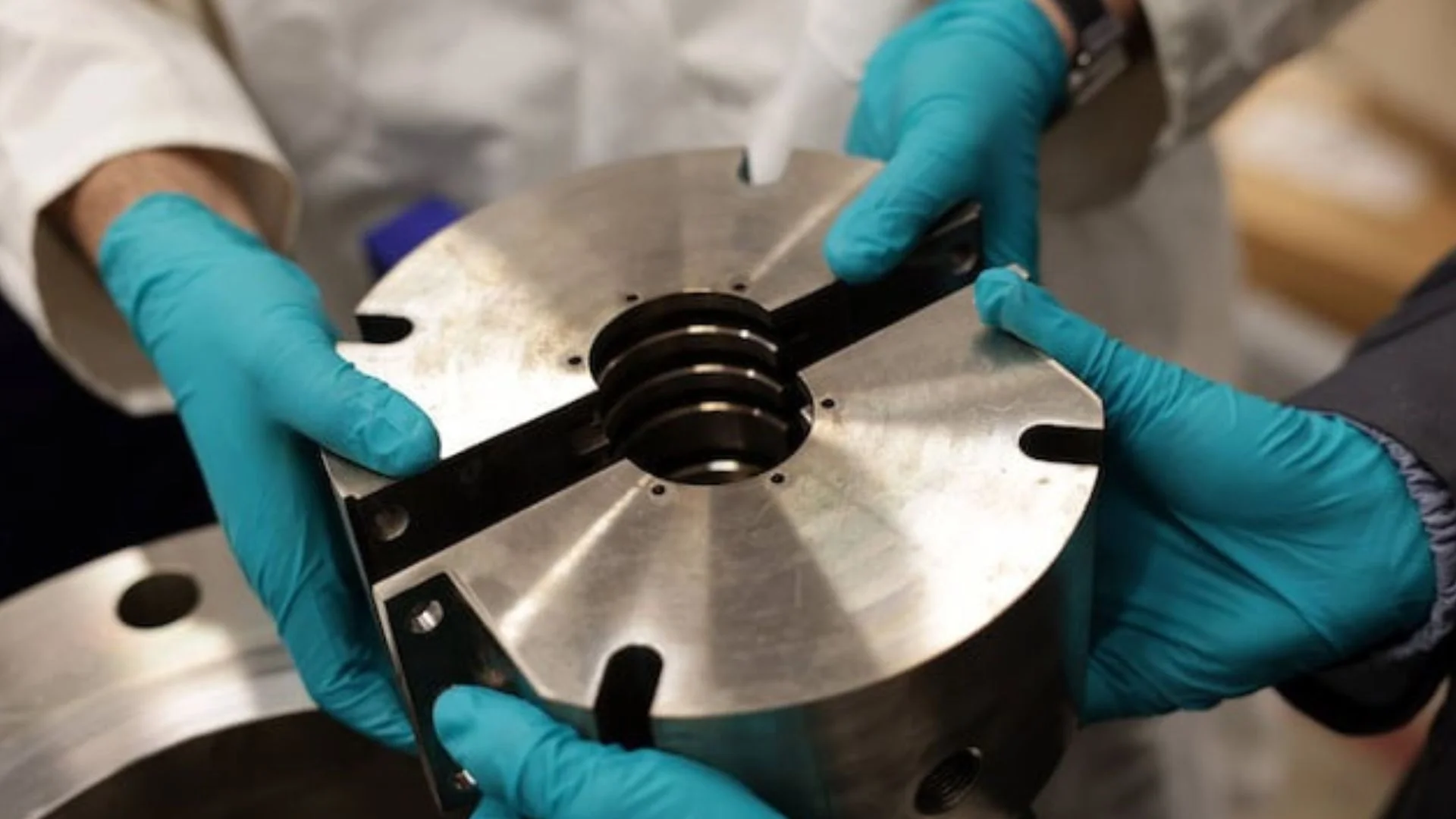
Researchers at the University of Michigan have completed a rare, long-duration experiment examining how a commercially available pump shaft seal performs under conditions similar to those in molten salt nuclear reactors.
The testing lasted about 2,300 hours and showed that the seal remained stable, with very little corrosion or damage, after an initial wear-in period. The study provides new engineering data that can help improve the design of future molten salt reactors and other advanced energy systems.
The research focused on a small but essential component known as the shaft seal. This part surrounds the rotating pump shaft and prevents hazardous salt vapors and gases from escaping while allowing the shaft to spin normally. Reliable seals are important because any failure could reduce efficiency and create safety concerns inside a reactor.
The findings were published in Progress in Nuclear Energy and supported by the US Department of Energy’s Office of Nuclear Energy through its Nuclear Energy University Program.
According to the research team, long-duration experiments of this type remain uncommon, especially in university laboratories. The successful test helps address an important engineering challenge that has received limited experimental attention.
Why Molten Salt Matters
Molten salt reactors belong to a new generation of advanced nuclear technologies designed to operate differently from conventional nuclear power plants. Instead of using water as the primary coolant, these reactors rely on special molten salts that remain liquid at very high temperatures. This allows reactors to produce heat more efficiently while operating at much lower pressures.
READ ALSO: China Builds Early Warning System to Detect Hidden Asteroids to Strengthen Space Safety
The salts used in these systems include compounds similar to ordinary table salt and fluoride salts found in products such as toothpaste. Once heated above their melting point, they become liquids capable of transferring large amounts of heat. Because these salts boil only at extremely high temperatures, reactors can operate safely without the high pressures required in traditional water-cooled systems.
Lower operating pressure reduces the risk of pressure-related accidents while improving the efficiency of converting heat into electricity. This makes molten salt reactors attractive for future clean energy generation. Many experts also expect these systems to produce less long-lived nuclear waste than conventional reactor designs.
However, molten salts also introduce their own engineering challenges. The hot liquid salts are highly corrosive and may generate radioactive or toxic gases during reactor operation. One of these gases is hydrogen fluoride, which requires careful handling because of its hazardous nature.
To manage these risks, molten salt reactors continuously inject an inert gas into the empty space above the molten salt. This protective gas, known as a cover gas or blanket gas, removes oxygen and moisture while carrying harmful gases toward treatment systems. Maintaining a reliable seal is therefore essential to keep these gases safely contained inside the reactor.
To study seal performance under realistic operating conditions, researchers designed and built a dedicated Shaft Seal Test Facility. The custom system consisted of two stainless steel tanks connected through piping that allowed molten salt to move between them. The design closely recreated the environment expected inside advanced molten salt reactors.
Testing the Salt Reactor Seal
The lower tank served as a storage vessel containing 32 kilograms of FLiNaK salt. FLiNaK is a mixture of lithium fluoride, sodium fluoride, and potassium fluoride that behaves similarly to radioactive molten salts used in reactor systems. Pressure differences transferred the molten salt into the upper test chamber where experiments took place.
A long rotating shaft extended through the upper tank and connected to an electric motor mounted above it. Around the shaft, engineers installed a commercially available circumferential graphite bushing seal. This seal had the important task of preventing vapors from escaping while allowing continuous shaft rotation.
Researchers operated the facility at temperatures reaching 550 degrees Celsius and shaft speeds of up to 1,500 revolutions per minute. They also evaluated different protective gases, including argon, nitrogen, and helium. These operating conditions closely represented those expected in future molten salt reactor systems.
The facility continued operating for approximately 2,300 hours without significant technical problems. After completing the experiment, researchers carefully inspected the equipment. They found no major corrosion, structural damage, or noticeable degradation in the shaft seal.
Key Performance Findings
One of the most important observations involved the seal’s behavior during the first ten days of operation. During this initial period, friction between the spinning shaft and the graphite seal gradually created a very small clearance. This process changed the internal pressure before the system eventually reached stable operating conditions.
READ ALSO: Joyson Electronics Debuts Robotic Hand, AI Brain, and Smart Battery Tech at WAIC 2026
After the wear-in period ended, the seal performed consistently throughout the remaining test period. Researchers found that the distance between the shaft and the seal, known as radial clearance, had the greatest influence on overall performance. This measurement proved more important than either operating temperature or shaft speed.
The team also compared the effectiveness of different cover gases. Argon produced the strongest performance by maintaining higher internal pressure while using the same gas flow rate as the other gases tested. Nitrogen and helium did not perform as effectively under identical operating conditions.
Lead author Shuai Che said the findings transform an under-studied pump component into a measurable engineering problem. He explained that the data will support future seal design, optimization, and scaling efforts for molten salt reactors as well as other high-temperature energy technologies.
Corresponding author Xiaodong Sun said dependable pump and seal performance remains essential for making molten salt reactors practical and safe.
He added that the research fills an important knowledge gap by providing experimental data gathered under realistic operating conditions. These results can help engineers design more reliable reactor systems in the future.
Future Reactor Impact
Large-scale molten salt testing campaigns remain relatively rare because they require specialized equipment, high operating temperatures, and long testing periods. Many previous studies have relied on smaller amounts of molten salt or much shorter experiments. This makes the University of Michigan project particularly valuable for engineers developing advanced nuclear systems.
Associate research scientist Adam Burak said the successful operation of the Shaft Seal Test Facility demonstrates that university research teams can solve practical engineering problems facing advanced reactor development.
He noted that focused academic research can generate important data for technologies that require long-term reliability. Such efforts complement the work being carried out by government laboratories and industry partners.
The results may also support ongoing reactor development projects in the US. One example is the molten salt-cooled reactor under construction in Oak Ridge, Tennessee, which began construction in April 2026. Engineering information from this study may help improve component selection and operating strategies for similar future facilities.
READ ALSO: Defense Ship Deal: TOTE Services, Hanwha Philly Win US Missile Tracking Contract
The research team also included Muyue Li from the University of Michigan and Minghui Chen from the University of New Mexico. Funding was provided by the US Department of Energy, Office of Nuclear Energy, through grant DE-NE0008977. Their work adds practical knowledge that engineers can apply when designing safer, more reliable advanced nuclear reactors.
As countries continue investing in advanced nuclear technologies to strengthen clean energy supplies, dependable components such as pump shaft seals will remain essential.
Long-term experiments like this provide the detailed engineering evidence needed to improve reactor performance and safety. The findings are expected to support the next generation of molten salt reactors as development moves from research laboratories toward commercial deployment.