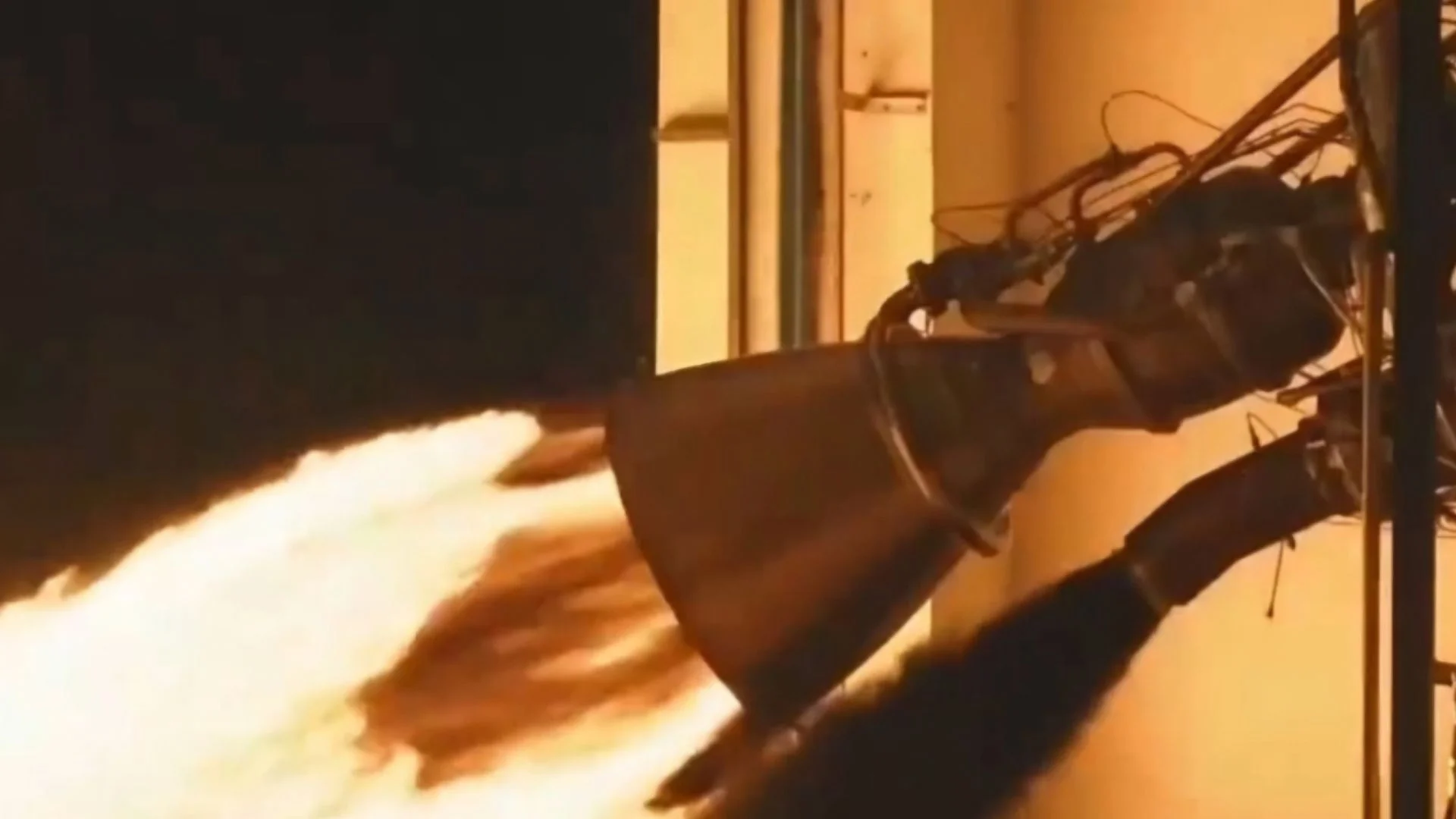
China’s private aerospace company CAS Space has successfully completed a long-duration qualification test of its Kinecore-2 rocket engine.
The engine is designed to power the company’s reusable Kinetica-2 and Kinetica-2H launch vehicles. The test marked an important step toward routine commercial launches.
The Kinecore-2 is a 110-ton-class liquid oxygen and kerosene engine. Liquid oxygen acts as the oxidizer, while kerosene serves as the fuel. This combination is widely used because it provides strong performance and proven reliability.
The latest qualification test pushed the engine far beyond normal operating conditions. Engineers extended the total running time to 620 seconds. That duration equals about 3.5 times the expected flight time of the rocket.
The engine also completed a continuous burn lasting 400 seconds. According to Chinese state broadcaster CCTV, this set a new record for the engine’s longest stable single firing. The result showed that the engine maintained stable performance throughout the test.
Long-duration firing tests are designed to measure durability instead of basic performance. Engineers intentionally run engines much longer than required during a mission. This helps identify possible weaknesses before the engine enters regular service.
According to Ming Aizhen, vice president of the power design department at CAS Space, the qualification test placed the engine under extreme conditions. It operated with high temperatures, high rotational speeds, intense heat, and continuous vibration. These conditions allowed engineers to verify the engine’s reliability under heavy stress.
Ming said the test confirmed stable overall performance across all expected flight conditions. The results also showed that the engine has enough service-life margin for repeated use. This is especially important for reusable rockets that are expected to fly multiple missions.
Engineers also examined many technical parameters during the test. They evaluated the engine’s performance during continuous operation and monitored its reliability. The successful results support future engineering applications and large-scale manufacturing.
READ ALSO: Skyryse Turns Robinson’s R66 Helicopter Into a Pilotless Military Drone
CAS Space has already planned the next stages of development. The company will continue qualification firing tests and begin testing three engines working together. Teams will also complete rocket integration, expand production, and prepare for the first launch.
The Kinecore-2 engine is expected to become the main propulsion system for both the reusable Kinetica-2 Launcher and the larger Kinetica-2H Launcher. Once fully qualified, it will support regular and high-frequency launch missions. That capability is important for meeting the growing demand for commercial space transportation.
The successful engine test came shortly after another major milestone in China’s private space industry. On Monday, LandSpace completed a static fire test of its reusable Zhuque-3 Y-2 rocket. The test took place at the Dongfeng Commercial Space Innovation Pilot Zone in northwest China.
A static fire test allows engineers to ignite the rocket engines while the vehicle remains secured to the ground. This process confirms that the engines, fuel systems, and launch equipment operate correctly before an actual launch. It also helps reduce technical risks during flight.
LandSpace said all major ground verification work for the rocket has now been completed. Engineers will continue with launch preparations ahead of upcoming flight tests. The company stated that both the launch systems and rocket systems performed normally during the static fire.
Unlike the Kinecore-2 engine, Zhuque-3 uses liquid oxygen and methane as propellants. Methane has attracted growing interest because it burns cleaner than kerosene and simplifies engine reuse after landing. Several space companies worldwide are also developing methane-powered reusable rockets.
Why Reusable Rocket Engine Matters
China’s commercial space sector has steadily focused on lowering launch costs while increasing launch frequency. According to Wang Yanan, editor-in-chief of Beijing-based Aerospace Knowledge magazine, both private companies and state-owned organizations have made consistent progress in reusable launch technology. Their work supports the country’s long-term space ambitions.
Reusable rockets reduce the need to build entirely new launch vehicles for every mission. After landing safely, major rocket components can be inspected, refurbished, and used again. This approach lowers costs and allows more launches within shorter periods.
China expects growing demand for launches as it expands orbital infrastructure. Future projects include large low-Earth orbit satellite internet networks, space-based computing facilities, and long-term plans for space solar power systems. These projects require frequent and affordable access to space.
READ ALSO: NASA’s New Space Refueling Test Brings Moon and Mars Missions One Step Closer to Reality
Private companies have already improved engine performance, thrust, and orbital launch capabilities in recent years. Their next goal is turning reusable rocket technology into a practical commercial system. Success in that effort would strengthen China’s growing commercial space industry and support larger space operations.
The latest engine qualification and rocket testing show that China’s private aerospace companies are moving from technology development toward regular commercial operations.
As more reusable launch systems complete testing, the country is expected to expand its launch capacity while reducing mission costs. These advances will play an important role in supporting future satellite deployments and broader space infrastructure in the years ahead.