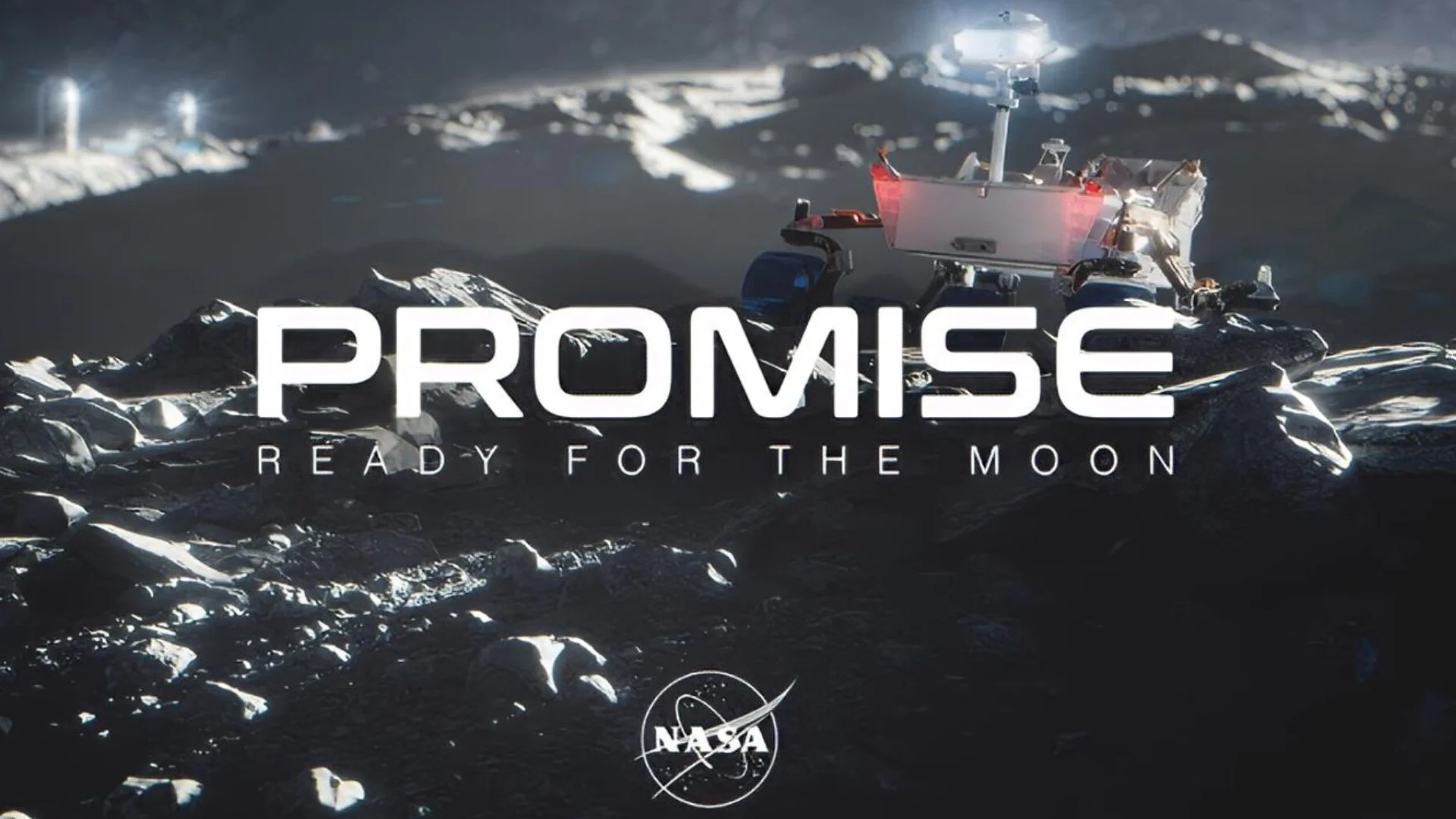
NASA has announced plans to send its PROMISE rover to the Moon as part of its growing Artemis exploration program.
The rover was originally built as a ground-based engineering model for the Perseverance and Curiosity Mars rovers. Now, the agency wants to give it a real mission on the lunar surface.
The announcement came during NASA’s monthly Moon Base program update on June 30. At the same event, the agency awarded four new robotic lunar landing missions to commercial partners. These missions will help study the Moon before astronauts begin building a long-term presence there.
NASA Administrator Jared Isaacman said the agency is following a step-by-step approach similar to the one used during the Apollo era. Instead of rushing toward a permanent lunar base, NASA plans to test technologies and gather important scientific data first. This approach is designed to reduce risks and improve future missions.
Isaacman revealed that the agency has been studying a new role for PROMISE. The rover was once known as Optimism before receiving its current name, which stands for Polar Rover for Observation, Mapping, and In-Situ Exploration. It has spent years at NASA’s Jet Propulsion Laboratory in California helping engineers safely test software and hardware before sending commands to Mars.
PROMISE has served as an Earth-based copy of the Perseverance and Curiosity rovers. Engineers use it to test repairs, software updates, and driving commands without risking the actual Mars rovers. That process has supported two of NASA’s most successful planetary exploration missions.
NASA now believes the rover can do much more than remain inside a testing facility. After some refurbishment, PROMISE can be prepared for work on the Moon. The rover already includes many proven systems that have performed well during years of Mars operations.
READ ALSO: Hitachi Energy Starts Building Largest US Transformer Factory as AI Power Demand Climbs
Nuclear-powered Rover Offers Advantages
One of PROMISE’s biggest strengths is its power system. Like Perseverance and Curiosity, it runs on a radioisotope thermoelectric generator(RTG). This system produces electricity by converting heat from naturally decaying radioactive material into usable power.
Unlike solar-powered vehicles, an RTG does not depend on sunlight. That makes it especially useful for lunar exploration, as many parts of the Moon experience long periods without sunlight. The Moon’s south pole also has permanently shadowed areas.
NASA plans to establish its Artemis base near the lunar south pole. Scientists believe this region contains large amounts of frozen water inside shadowed craters. Water ice is considered an important resource because it can support astronauts by providing drinking water, breathable oxygen, and even rocket fuel after processing.
The lighting conditions near the south pole are also challenging. Some locations receive sunlight for long periods, while nearby craters remain dark almost all the time. A nuclear-powered rover can continue working without relying on changing sunlight conditions.
PROMISE Rover’s New Mission
Sending PROMISE to the Moon would come with one trade-off. NASA would lose the engineering model currently used to support the Mars rovers from Earth. However, Isaacman said the years of experience gained from operating Perseverance and Curiosity make the idea worth considering.
He noted that taxpayers have already invested heavily in the rover. Rather than leaving it as a test vehicle, NASA believes it can deliver valuable science and engineering data on the Moon. That better uses existing technology while supporting future Artemis goals.
Alongside the rover announcement, NASA selected Astrobotic, Firefly Aerospace, and Intuitive Machines to provide four new robotic lunar landers. These missions are part of the agency’s Commercial Lunar Payload Services, or CLPS, program. The initiative allows private companies to deliver NASA science equipment to the Moon.
NASA plans to launch up to 20 CLPS missions through 2029. These robotic flights will study the lunar environment and test technologies before astronauts establish a permanent outpost. The information gathered will reduce uncertainty for future human missions.
One expected mission later this year involves Blue Origin’s Blue Moon Mark 1 cargo lander. The spacecraft is planned to launch aboard the company’s New Glenn rocket. That schedule has become more challenging after New Glenn experienced an explosion during a recent engine test, though Blue Origin expects another launch attempt before the end of the year.
Astrobotic’s Griffin 1 lander has received two lunar delivery missions. One of those flights will transport Astrolab’s FLIP rover to the Moon during the second half of 2026. Firefly Aerospace and Intuitive Machines will also use their Blue Ghost and Nova-C landers on future CLPS missions.
Every new lander will carry several NASA scientific instruments. One instrument, called the Stereo Camera for Lunar Plume Surface Studies, will examine how rocket engine exhaust affects lunar dust during landing. The results will help engineers design safer landing operations and reduce dangerous dust movement.
WATCH ALSO: Chinese firm’s humanoid robot can perfectly pick up tennis ball
Another payload is the Laser Retroreflector Array. It will help improve navigation by allowing spacecraft to measure their position using reflected laser signals. Better navigation will become increasingly important as more spacecraft travel to the lunar surface.
The missions will also carry the Linear Energy Transfer Spectrometer. This instrument will measure radiation around the Moon and across different landing sites. Understanding radiation levels is essential before astronauts begin living and working on the lunar surface for extended periods.
Moon Base program manager Carlos Garcia-Golan said NASA still has much to learn about the lunar south pole. Robotic explorers will gather information about terrain, resources, and environmental conditions before people arrive. He added that those discoveries are essential for building a safe and sustainable Moon base.
Garcia-Golan also supported the idea of sending PROMISE to the Moon. He said exploring difficult ideas has always been part of NASA’s mission and reflects the spirit of innovation at the Jet Propulsion Laboratory.
However, the mission would give a proven Mars rover design a second life while helping prepare the next generation of human exploration beyond Earth.