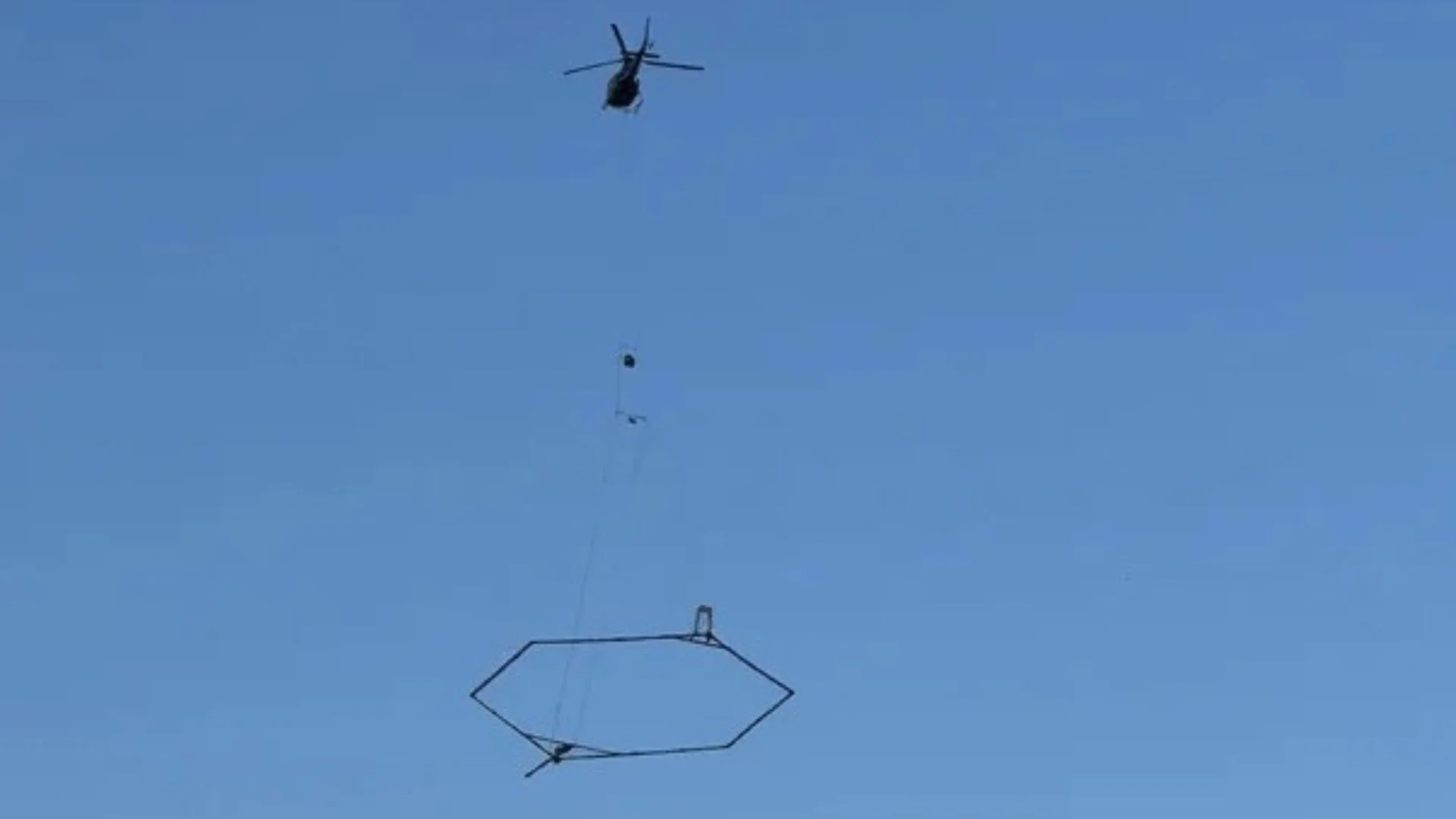
China has completed a flight test of a large airborne electromagnetic detection system that uses a suspended giant coil array beneath a helicopter.
Researchers say the technology is designed to improve geological exploration by helping scientists map underground structures. The project was detailed in a study published in the Chinese journal Acta Aeronautica et Astronautica Sinica on April 25.
The research was led by associate professor Fu Jingcheng from Beihang University and the Institute of Geology and Geophysics under the Chinese Academy of Sciences.
The team focused on solving a major engineering challenge involving the stability of large airborne detection equipment. Their work aimed to ensure accurate measurements while the system operates in flight.
The test involved a helicopter carrying a large kite-like structure beneath it. The structure consisted of three giant coils arranged vertically and connected by a network of cables. Each coil measured about 25 meters in diameter and formed part of a sophisticated detection system.
The technology is known as Airborne Transient Electromagnetic detection(ATEM). It works by sending a strong electrical pulse through a transmitter coil. That pulse creates a temporary electromagnetic field that penetrates the ground or water below.
When the pulse stops, conductive materials in the surrounding area generate small eddy currents. These currents create a secondary magnetic field. A receiver coil then captures that signal for analysis.
READ ALSO: Charging electric vehicles five times faster in below‑freezing temperatures.
Scientists can use the returning signal to identify hidden objects and underground structures. The signal’s strength and decay rate provide information about an object’s size, depth, and conductivity. This allows researchers to build detailed images of what lies beneath the surface.
How the Technology Detects Submarines
Although the latest project focuses on civilian surveys, scientists have previously examined the technology for submarine detection. One reason is the contrast between seawater and a submarine’s metal hull. Their different electrical properties create conditions that electromagnetic systems can identify.
A 2012 study by researchers from Changan University and Shandong University explored this possibility. The team proposed combining Atem technology with synthetic aperture imaging techniques. Their goal was to improve the real-time detection of submerged targets.
The researchers conducted simulation tests using a scaled submarine model placed in salt water. According to their findings, the system successfully identified the boundary between the model and the surrounding water. The results suggested that electromagnetic imaging could help locate submarines under certain conditions.
Traditional submarine-hunting methods primarily rely on sonar and magnetic anomaly detection. Sonar works by sending sound waves through water and listening for echoes. Magnetic anomaly detection measures disturbances in Earth’s magnetic field caused by large metal objects.
Both methods have limitations. Sonar performance can be affected by ocean noise, water temperature layers, and decoys. Magnetic anomaly detection often works only at relatively short distances and becomes less effective against submarines designed to reduce magnetic signatures.
Electromagnetic detection approaches offer an alternative way to search underwater. Instead of relying solely on sound or magnetic disturbances, they focus on electrical conductivity differences. Researchers believe this could provide another tool for detecting difficult-to-find underwater targets.
Challenge Behind Giant Coil Array
One of the biggest obstacles facing airborne electromagnetic systems is stability during flight. The large suspended structure behaves like a giant pendulum beneath the helicopter. Wind, rotor wash, and aircraft movements can cause the coils to swing and tilt.
Even small changes in coil position can affect measurement accuracy. If the coils move significantly, the quality of the collected data drops. This creates problems for both scientific surveys and any potential future operational uses.
To solve the issue, Fu’s team developed a detailed computer model. The model calculated the forces acting on every cable in the structure. Researchers then determined the exact cable lengths required to keep the system balanced during flight.
The team discovered that rapid acceleration caused the coils to swing dramatically. In some cases, the structure is pitched more than 20 degrees. Such movement created safety concerns and reduced measurement precision.
Researchers introduced an aerodynamic film to the rear section of the main transmitter coil. The flexible material acted as a passive stabilizer. It generated forces that reduced oscillations and helped keep the system level.
Flight testing showed promising results. During 7 minutes of steady flight, onboard sensors recorded the coil array’s motion. The data confirmed that the system could maintain the stable orientation needed for precise electromagnetic measurements.
The study also highlighted the importance of careful flying techniques. Researchers advised pilots to avoid sudden acceleration and aggressive turns. Smooth flight paths produced better stability and improved data quality.
WATCH ALSO: SpaceX rocket sends 11,000 pounds of scientific investigations, cargo to space station
The preferred approach involves slowing down before a turn, completing the maneuver gradually, and accelerating afterward. This reduces stress on the cables and limits unwanted movement of the suspended structure. The strategy helps maintain accuracy throughout a survey mission.
The successful flight test represents an important step for large-scale airborne electromagnetic systems. For now, the technology is aimed at mineral exploration, groundwater mapping, and the study of underground geological formations. However, continued advances in detection capabilities are expected to attract attention from both scientific and defense communities.
As researchers refine the technology and improve its performance, airborne electromagnetic systems could become an extremely valuable tool for exploring hidden environments beneath land and sea.