NASA and Sandia National Laboratories have completed the final round of heat shield testing for the Dragonfly mission, an important step before the rotorcraft begins its journey to Titan.
The tests were conducted at Sandia’s National Solar Thermal Test Facility in New Mexico. Engineers recreated the extreme heating conditions Dragonfly will experience when it enters Titan’s atmosphere.
Dragonfly is scheduled to explore Titan, the largest moon of Saturn. Before reaching the surface, the spacecraft must survive a descent lasting about two hours through Titan’s thick atmosphere. During this phase, intense friction and air compression generate extreme heat around the vehicle.
The recently completed campaign marked the sixth and final testing phase in a program that began in 2023. NASA and Sandia used the facility’s unique solar tower system to expose large heat shield sections to flight-like heating conditions. The goal was to confirm that the thermal protection system can safely protect Dragonfly during atmospheric entry.
Dragonfly Heat Shield Tested
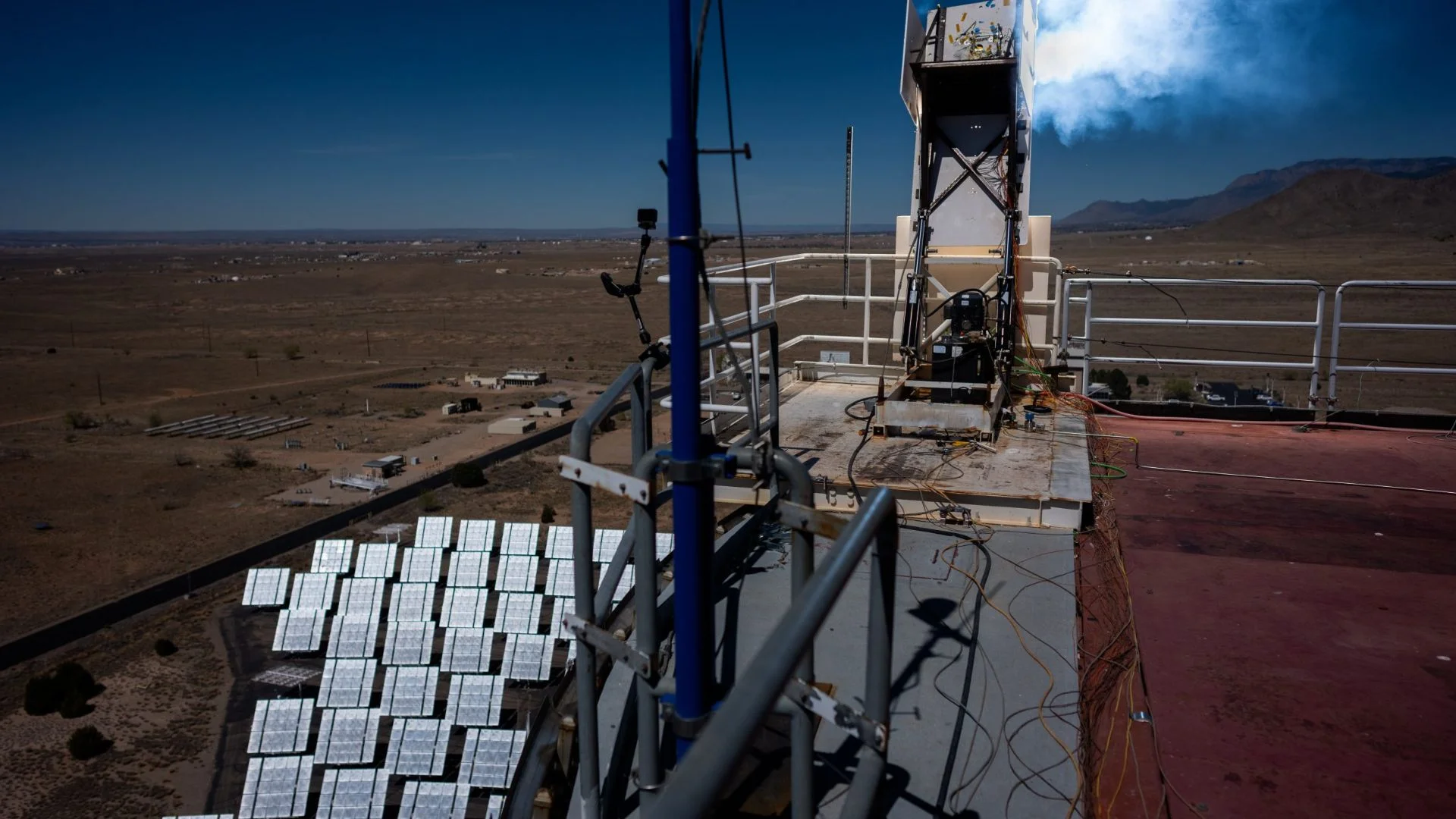
Each test took place on top of Sandia’s 200-foot solar tower. Engineers mounted sections of the heat shield on a special fixture that allowed them to change the angle of exposure. This helped recreate different conditions the spacecraft will encounter during entry.
The facility uses hundreds of heliostats, which are large mirrors that track the Sun. These mirrors concentrated sunlight onto a target area about 24 inches wide. The focused energy generated temperatures above 4,500 degrees Fahrenheit, significantly higher than the temperatures expected during Dragonfly’s arrival at Titan.
READ ALSO: One of UK’s largest Iron Age hoards unearthed in North Yorkshire
Engineers also flowed inert gas across the test samples. This step helped mimic Titan’s atmosphere, which is mostly made of nitrogen. By combining heat and gas flow, researchers created a more realistic testing environment.
The heat shield material charred and produced smoke under the intense heat. Advanced sensors and infrared cameras monitored how heat moved through the material. Researchers closely studied curved edges, shoulder sections, and gaps to understand how different parts of the shield reacted under stress.
PICA-D Material Faces Realistic Entry Conditions
Dragonfly’s heat shield is built from a material known as Phenolic Impregnated Carbon Ablator-Domestic ( PICA-D). NASA’s Ames Research Center developed this material to withstand extreme temperatures during atmospheric entry. As the material heats up, it slowly burns away in a controlled manner, carrying heat away from the spacecraft.
NASA tested several heat shield configurations during the campaign. These included flat panels, rounded sections, and gap fillers placed between larger pieces. Engineers also tested damaged and intentionally flawed samples to ensure the system remains effective even with minor imperfections.
According to the mission team, Sandia’s facility was selected because it is the only ground-based qualification site capable of generating the required heat levels on large test articles. Testing full-scale components is important because it simulates the stresses encountered during actual flight.
READ ALSO: NASA Trials Innovative Supersonic Parachute Delivery Technology
Ken Armijo, Sandia’s lead engineer and test director for the project, said the facility allows engineers to reproduce realistic heating conditions on meaningful physical scales. He explained that the repeatable testing process helps teams validate designs and improve confidence before launch.
Benefits Extend Beyond NASA’s Titan Mission
The Dragonfly program also delivered long-term benefits beyond planetary exploration. During the project, Sandia refined testing methods that combine concentrated solar energy, detailed diagnostics, and controlled gas flow. These techniques create realistic entry-like environments for evaluating advanced materials.
The expanded capability supports Sandia’s broader national security responsibilities. The laboratory can apply similar testing methods to evaluate materials and components used in the US’s nuclear deterrence programs. The approach also offers valuable tools for commercial aerospace companies developing future spacecraft and high-speed flight systems.
WATCH ALSO: EHang’s next-gen autonomous eVTOL completes first public flight
Dragonfly is one of NASA’s most ambitious planetary science missions. Unlike traditional rovers, it is a rotorcraft designed to fly between locations on Titan and study the moon’s geology, atmosphere, and chemistry. Scientists hope the mission will provide new insights into environments that may resemble conditions on early Earth.
With the qualification campaign now complete, NASA can use the collected data to finalize certification of Dragonfly’s thermal protection system. The successful tests bring the mission one step closer to exploring one of the most intriguing worlds in the solar system, while also advancing technologies that support future space exploration and major national programs.