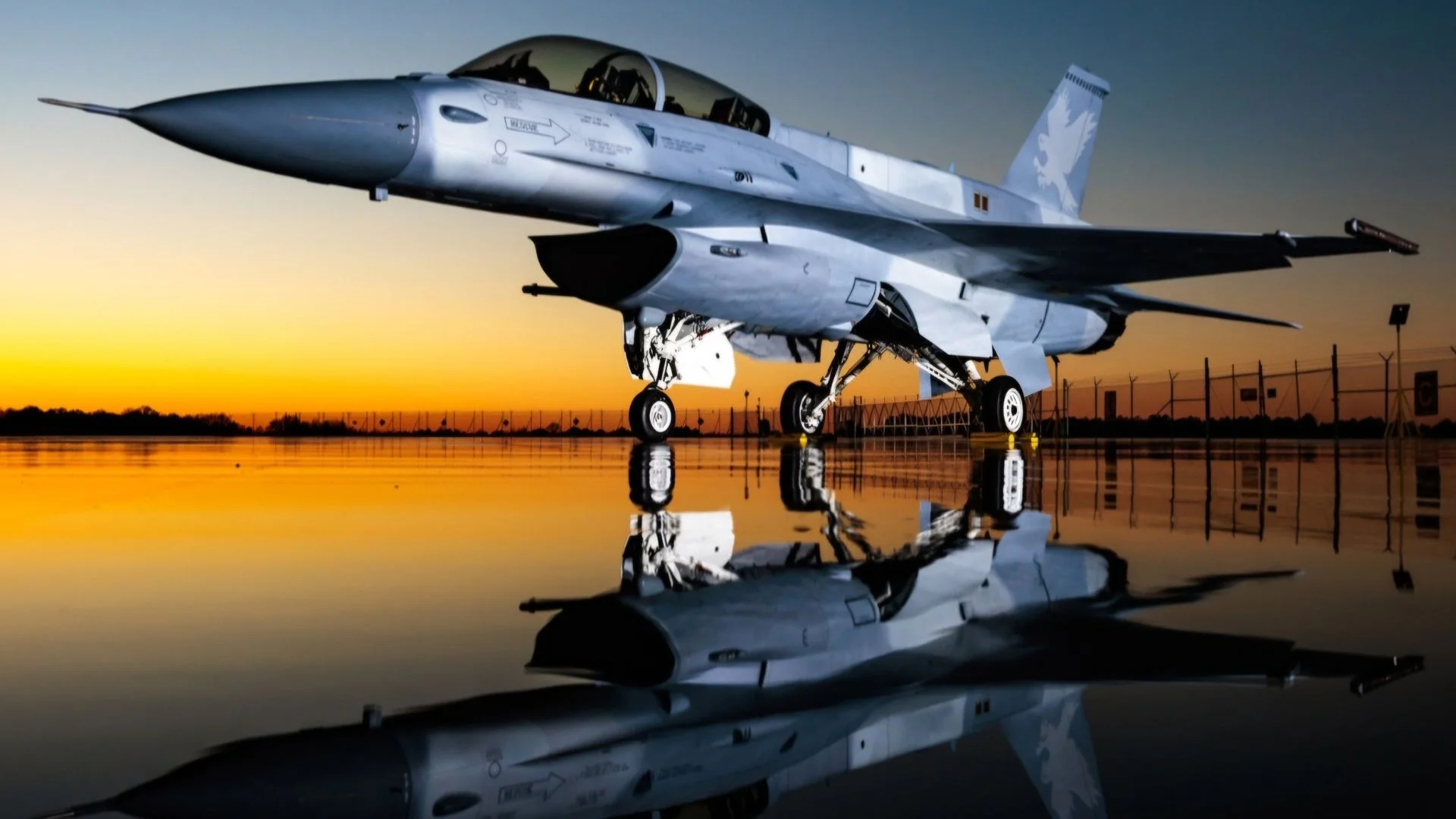
The global F-16 fighter fleet has reached a major modernization milestone with the delivery of the 1,000th AN/APG-83 AESA radar by Northrop Grumman.
The upgrade gives older F-16 jets improved detection, tracking, and targeting capabilities for modern combat operations.
The APG-83 Scalable Agile Beam Radar(SABR) replaces older mechanically scanned systems with advanced Active Electronically Scanned Array (AESA) technology that improves speed, accuracy, and resistance to electronic threats.
The upgrade also helps pilots engage targets from longer distances while improving performance in both air-to-air and air-to-ground missions. The milestone reflects a growing global effort to extend the operational life of existing fighter fleets while strengthening combat readiness and interoperability.
An AESA radar works through hundreds of small transmit-and-receive modules. These modules rapidly direct radar beams without moving physical parts. This design improves reliability and reduces maintenance requirements.
The radar allows pilots to detect and engage threats from longer distances. It also improves target tracking accuracy during high-speed maneuvers. These advantages are important in contested airspace, where reaction time can decide the outcome of an engagement.
Northrop Grumman developed the APG-83 at its facility in Linthicum, Maryland. The system draws technology from the AN/APG-77 radar used on the Lockheed Martin F-22 Raptor and the AN/APG-81 radar installed on the Lockheed Martin F-35 Lightning II. The company adapted those technologies for the F-16 platform.
READ ALSO: Space Debris Threatens Climate Satellites as Collision Risks and Avoidance Maneuvers Rise
The upgrade gives older F-16 aircraft capabilities closer to those of newer-generation fighters. Pilots gain faster target updates and better resistance against electronic interference. The radar also supports simultaneous air-to-air and air-to-ground operations more efficiently than older systems.
APG-83 AESA Radar Improves Missile and Strike Performance
The APG-83 directly improves the effectiveness of beyond-visual-range air combat. Modern missiles such as the AIM-120 AMRAAM depend heavily on radar quality during engagements. Better radar tracking improves missile guidance and target accuracy.
The radar also supports short-range combat systems such as the AIM-9X Sidewinder. Pilots can track multiple targets while maintaining awareness of nearby threats. This increases the survivability during fast-moving dogfights.
In ground-attack missions, the APG-83 provides high-resolution synthetic-aperture radar mapping. This feature creates detailed ground images even in poor weather or low visibility conditions. Pilots can identify targets more accurately without depending entirely on optical sensors.
The improved radar supports guided weapons, such as Joint Direct Attack Munition (JDAM) bombs and Small Diameter Bombs (SDBs). It also works alongside targeting pods and mission computers to improve strike coordination. These upgrades strengthen the F-16’s ability to perform precision attacks.
The radar itself is not a weapon system. Instead, it acts as an advanced sensor that helps pilots use existing weapons more effectively. Better target detection and tracking increase the chances of successful engagements.
The US Department of Defense’s Director, Operational Test and Evaluation Office, reviewed the system during the F-16 Radar Modernization Program. The office stated that the APG-83 significantly outperformed the older APG-68 radar. Testing showed improvements in tracking range, target identification, electronic protection, and datalink support.
WATCH ALSO: Lightweight advanced materials are transforming aerospace innovations
However, the review also noted limitations linked to older F-16 hardware and software. Some aircraft still operate with legacy mission computers and avionics. These systems limit how much of the radar’s full capability can be used.
Military planners consider this an important lesson for modernization programs. Installing a new radar alone does not fully transform an aircraft. Air forces also need updated software, displays, electronic warfare systems, and data processing equipment.
Global F-16 Operators Expand Modernization Programs
The APG-83 program has gained strong international demand through Foreign Military Sales agreements. Many countries continue operating large F-16 fleets because replacing them entirely with newer aircraft is expensive. Modernization offers a faster and more affordable option.
Taiwan remains one of the largest APG-83 customers. In 2019, the US approved a deal for 66 new F-16 Block 70 aircraft and 75 APG-83 radars, including spare systems. Taiwan has also upgraded older F-16A/B aircraft to the F-16V standard.
The modernization effort supports Taiwan’s need to maintain air defense readiness against growing regional military pressure. The radar improves detection and engagement performance against modern aircraft and missile threats. Faster tracking and stronger electronic protection are especially important in heavily contested environments.
Slovakia also selected the APG-83 as part of its F-16 Block 70 purchase. Its 2018 agreement covered 14 aircraft and 16 radars. Other countries, including Morocco and Bulgaria, followed similar modernization paths.
The Philippines joined the growing customer list through a proposed 2025 package. The deal included 22 APG-83 radars for 20 F-16 aircraft, along with spare units. The package also covered training, sustainment, weapons, and mission systems.
The APG-83 upgrade fits into a broader strategy across NATO and allied air forces. Many countries need capable fighter aircraft immediately rather than waiting years for next-generation deliveries. Upgrading existing fleets helps maintain operational readiness while reducing costs.
READ ALSO: Appalachian Mountains Hold 2.5M Tons of Lithium, Enough for 130M EVs
The radar is also part of the larger Lockheed Martin F-16 Block 70 modernization package. The upgraded aircraft includes new cockpit displays, mission computers, electronic systems, and an Automatic Ground Collision Avoidance System. The Block 70 airframe also features a 12,000-hour service-life extension.
Lockheed Martin states that the APG-83 shares around 95 percent software commonality and 70 percent hardware commonality with the F-35 radar. This helps reduce development risks and improves long-term support efficiency. However, the F-16 still lacks stealth shaping and deep sensor fusion features found in fifth-generation fighters.
Military analysts consider the APG-83 as a practical modernization path, rather than a replacement for stealth aircraft. The upgrade allows the air forces to preserve pilot training systems, maintenance infrastructure, logistics networks, and existing weapons inventories. This reduces transition costs while improving combat performance.
The delivery of the 1,000th APG-83 radar shows that the program has moved to sustained large-scale production. It also indicates an increasing demand for high-tech sensors in modern air warfare.