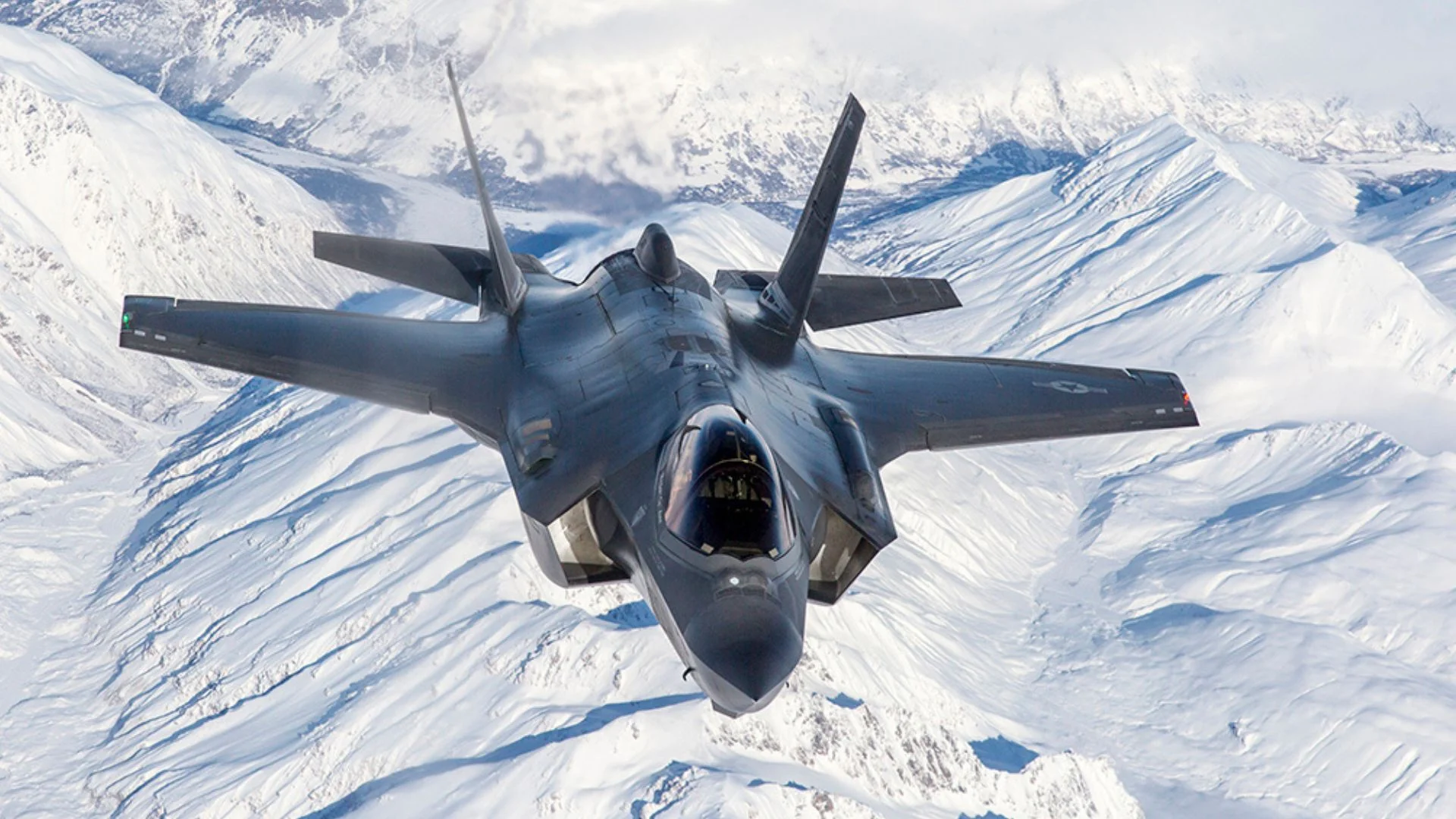
The US Department of Defense is putting fresh momentum behind the F-35 program with a new investment aimed at accelerating future upgrades.
The Pentagon has awarded Lockheed Martin a $177.49 million contract modification to build three specialized F-35 flight sciences test aircraft.
These aircraft will act as flying laboratories. Their purpose is to expand flight-testing capacity and help validate upcoming improvements, including the much-anticipated Block 4 upgrades.
This latest award builds on an earlier $180 million contract issued in April 2025. That earlier deal focused on converting three existing F-35 jets into test aircraft.
READ ALSO: PLA Tests YJ-20 Anti-Ship Hypersonic Missiles as Balikatan Drills Expand In South China Sea
Now, the scope has widened. The new modification includes the engineering and labor needed to design, build, and deliver three additional test jets across all variants of the F-35 Lightning II.
Each aircraft version will be covered. The F-35A will support the US Air Force, the F-35B will serve the Marine Corps with its short take-off and vertical landing ability, and the F-35C will operate from Navy aircraft carriers.
These new test aircraft are not just additions; they are replacements. Officials aim to avoid a gap in testing capability as older test assets phase out. At the same time, they will allow more detailed and frequent testing needed for future upgrades under the Joint Strike Fighter program.
Funding for the project has already begun. Of the total contract, $37.67 million has been allocated for the current fiscal year. This includes $18.83 million from each of the Air Force and the Navy, plus $8.39 million from international partners.
WATCH ALSO: Engineers from Australia have introduced a spray that enhances the fire-resistance of clothing
Work on the program will be spread across multiple locations. Most of the effort will take place in Fort Worth, Texas, and El Segundo, California. Additional work will be carried out in Warton, UK, which will handle about 20 percent, and in Grenaa, Denmark, which will contribute around 5 percent. The full program is expected to run through April 2031.
Flight sciences test aircraft play a critical role in modern aviation programs. Engineers equip them with specialized tools such as sensors, cameras, and telemetry systems. These instruments help measure how the aircraft behaves in real flight conditions, tracking aerodynamics, structural loads, and performance limits.
To make room for this equipment, non-essential components are often removed. In some cases, features like spin chutes are added to support specific test scenarios.
A shortage of such aircraft has already slowed parts of the program. Officials have linked delays in the Technology Refresh 3 effort to limited testing capacity. This upgrade is a key foundation for the broader Block 4 improvements.
READ ALSO: 80 Times Cheaper Than Lithium, China’s Iron Battery Runs 16 Years Straight
Recognizing the need, the F-35 Joint Program Office increased its plan for flight sciences aircraft. It originally aimed to convert six jets but later raised that number to nine, all sourced from Lot 18 production.
With this expanded fleet, the Pentagon hopes to accelerate testing timelines and keep the F-35’s next-generation capabilities on track.