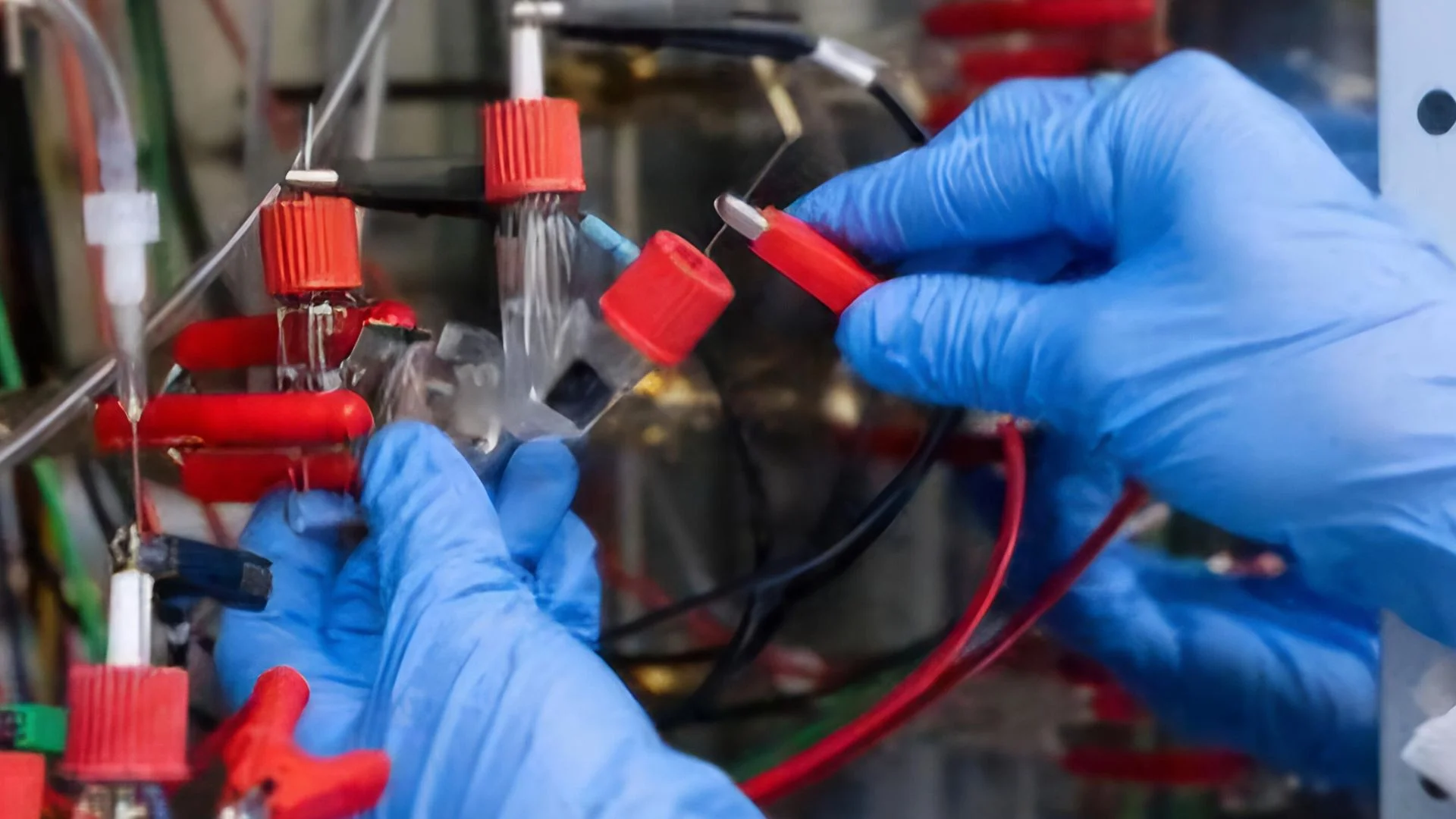
Researchers at Rice University have developed a new biological sensor that converts chemical signals into electricity.
The system, called e-COSENS, offers a practical and flexible way to detect substances linked to human health and environmental safety.
The study, carried out with partners from Tufts University and Baylor College of Medicine, has been published in Nature Biotechnology.
Traditional bacterial sensors often use light to signal their detection. However, light-based systems are not always useful outside controlled lab conditions.
READ ALSO: No Motors, No Air: This Origami Robot Moves in a Completely New Way
Electricity, on the other hand, is easier to measure and transmit. Scientists have long been interested in using bacteria that produce electricity, but turning them into reliable sensors has been difficult.
The team led by Professor Caroline Ajo-Franklin approached this challenge in a new way. Instead of relying on a single bacterium to do everything, they divided the work between two types of bacteria. This design serves as the basis for the Electroactive Co-culture Sensing System(e-COSENS).
“Bioelectrical sensing is not new,” Ajo-Franklin said. “But e-COSENS lets us build these sensors in a simple and modular way, like assembling parts. It opens the door to monitoring many things, from human health to environmental contaminants.”
The system combines the strengths of two different bacteria. One bacterium is easy to engineer but does not naturally produce electricity. The other produces electricity but is difficult to modify. By pairing them, the researchers created a system that is both adaptable and functional.
WATCH ALSO: India’s DRDO successfully completes user evaluation trials of Akash-NG Missile System
For example, E. coli is widely used in laboratories because it can be easily programmed to respond to specific substances. However, it cannot generate electricity. On the other hand, Lactiplantibacillus plantarum can produce electricity using a molecule called quinone, but it is hard to engineer.
The researchers solved this problem by splitting the roles. The engineered E. coli acts as a sensor. It is designed to produce quinone only when it detects a target substance, known as an analyte. The second bacterium, L. plantarum, then uses this quinone to generate an electrical signal.
“This division of labor makes the system flexible and powerful,” said Siliang Li, the study’s first author.
Quinone plays a key role in this process. L. plantarum cannot produce quinone on its own and depends on its environment to obtain it. This makes quinone an ideal signal molecule. When E. coli releases quinone in response to a specific analyte, it effectively switches the electrical signal on.
READ ALSO: Oil Route at Risk: Iran Warns on Strait of Hormuz as US Blockade Refuses to Ease
The signal can then be measured using a simple electrode connected to a current meter. This allows researchers to quickly determine whether a target substance is present.
To test the system, the team designed four different sensor setups. Each one targeted a specific analyte in a different environment.
One setup used E. coli to detect heavy metal ions in bayou water. Another was designed to sense inflammation markers in artificial saliva. A third system used Lactococcus lactis to detect antimicrobial peptides in human fecal samples provided by Baylor researchers. The fourth setup identified an antibiotic in store-bought milk.
Each sample was placed in a separate reactor connected to a current meter. Within a few hours, all systems produced measurable electrical signals. In some cases, the response arrived within 20 minutes.
These results showed that e-COSENS can work across different conditions and sample types. However, the initial setup used large lab-based reactors, which are not practical for field use.
To address this, the team collaborated with Tufts engineers. They developed a compact electronic disk about the size of a coin. This device can connect to standard digital multimeters, making the system easier to use outside the lab.
“This simplified hardware lowers the barrier to using bioelectronic sensors in real-world settings,” Li said. “It also creates opportunities for low-cost, field-ready diagnostics.”
WATCH ALSO: Chinese humanoid robot plays basketball with almost human-like accuracy
The researchers also explored other bacteria that could either produce or respond to quinone. This expands the range of environments where e-COSENS can be applied. From water testing to medical diagnostics, the system shows strong potential for practical use.
Ajo-Franklin emphasized that collaboration played a major role in the project’s success. “The strength of e-COSENS comes from sharing tasks between different cells,” she said. “In the same way, this research succeeded because of teamwork across different groups and institutions.”
The study highlights a growing trend in synthetic biology, where scientists design systems by combining the natural abilities of different organisms. Instead of forcing one organism to do everything, researchers are creating networks that work together more efficiently.
With its modular design and ability to deliver clear electrical outputs, e-COSENS represents a step toward more accessible, scalable biosensing technologies. As the system evolves, it may help detect pollutants, monitor health conditions, and enable faster decision-making in both clinical and environmental settings.