Rocket Lab has introduced a new electric propulsion system designed to meet the fast-growing demand for satellite constellations.
The system, called Gauss, marks a major step in the company’s effort to solve one of the space industry’s most persistent challenges, scaling propulsion technology for large numbers of spacecraft.
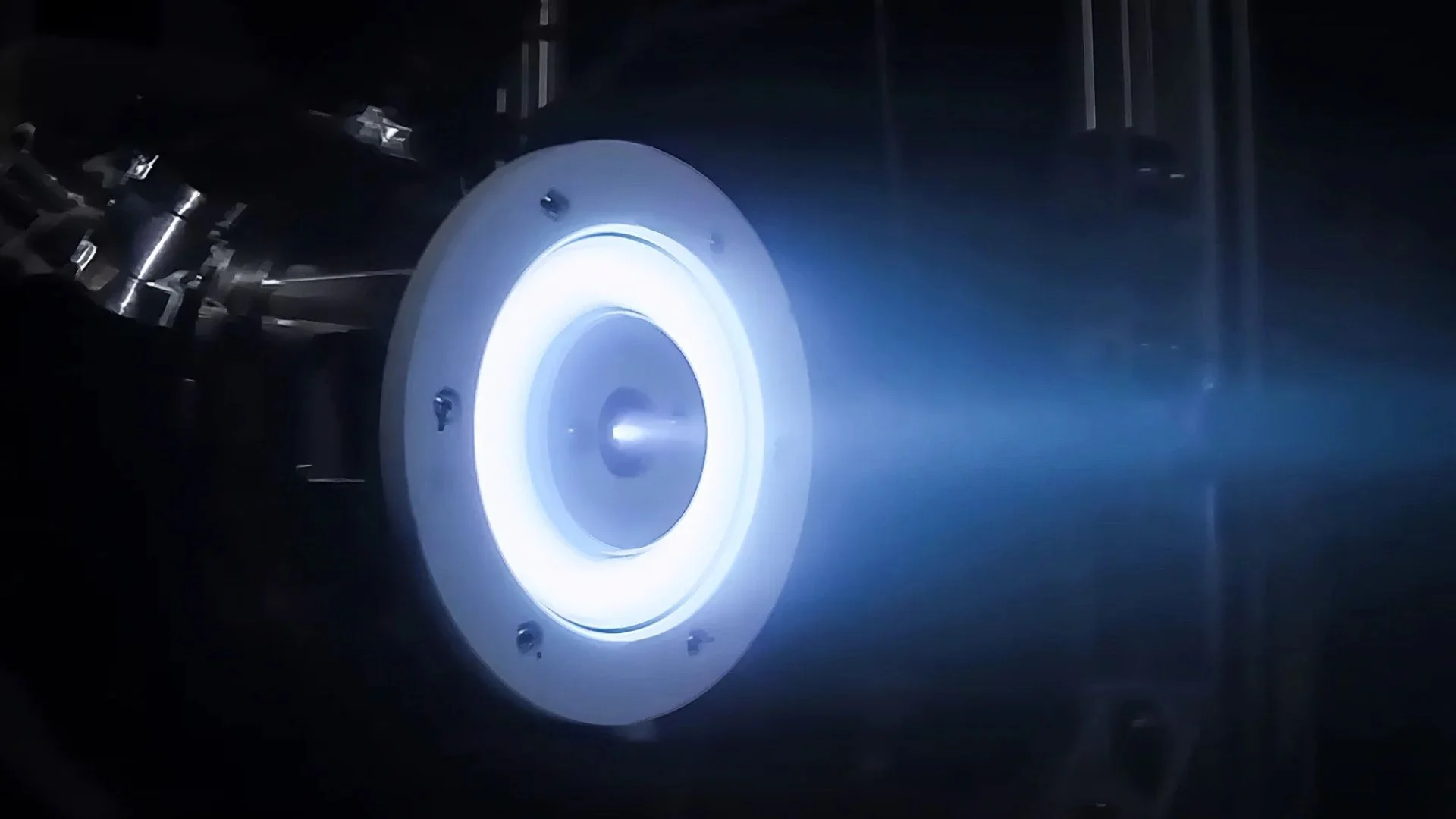
Developed and built entirely in-house by Rocket Lab, the Gauss system combines three core components: a Hall Thruster, a Power Processing Unit, and a Propellant Management Assembly. These elements enable satellites to maneuver efficiently in orbit while using less fuel.
The announcement comes as satellite constellations expand rapidly. Commercial operators and national security agencies are launching hundreds and sometimes thousands of satellites into low Earth orbit.
READ ALSO: Lenovo’s 1000Wh Battery Reveal Signals More Than Just Better Battery Life
However, propulsion systems have struggled to keep up with this pace, often becoming a bottleneck in satellite production and deployment.
Rocket Lab says it has addressed this issue head-on by building a high-volume production line for Gauss. The company plans to manufacture more than 200 thrusters per year. This is a significant shift in an industry where electric propulsion systems have traditionally been difficult to produce at scale.
According to the company, this approach will reduce supply chain risks and ensure customers can access propulsion systems when needed. This is especially important for constellation operators, who rely on consistent and timely satellite deployment.
Speaking on the development, Peter Beck emphasized the growing importance of scalable propulsion. He said, “Proliferated constellations are now the norm for commercial and national security space users, but the propulsion systems needed to maneuver these spacecraft in orbit have simply not been reliably available at any kind of scale. Rocket Lab is solving this bottleneck with Gauss.”
WATCH ALSO: EHang’s next-gen autonomous eVTOL completes first public flight
He added that the company has already demonstrated its ability to scale other satellite components. “We’ve successfully scaled other satellite components to thousands of units per year to meet the market’s needs for volume and speed. Now we’re giving electric satellite propulsion the same treatment,” he said.
One of the key advantages of the Gauss thruster lies in its efficiency. Unlike traditional chemical propulsion systems, it offers a higher specific impulse.
In simple terms, this means it can produce more thrust using less propellant. This allows satellites to carry less fuel while still achieving strong performance.
This efficiency makes Gauss especially suitable for long-duration missions. It can support deep-space exploration as well as routine satellite operations, such as station-keeping within constellations.
The system also introduces several technical features to improve performance and reliability. It uses heaterless cathode technology, allowing instant start without preheating. Magnetic shielding reduces wear and tear, helping extend the thruster’s lifespan during long missions.
READ ALSO: XM8 Is Back: US Army’s New 6.8mm Carbine Aims to Redefine Modern Combat
The electronics are based on GaNFet technology, which improves efficiency and performance. In addition, the software interface has been simplified, removing the need for complex parameter management in the power processing unit. This makes the system easier to operate.
Gauss is designed to work with xenon as its primary propellant, although krypton can also be used. The system is ITAR- and EAR-free, making it more accessible to a wide range of international customers and applications, particularly for low Earth orbit constellations.
The naming of the thruster follows Rocket Lab’s tradition of honoring notable scientists. Gauss is named after Carl Friedrich Gauss, a pioneering mathematician and physicist.
The company has previously named its engines after other prominent figures, including the Rutherford engine used on its Electron rocket, the Archimedes engine for the upcoming Neutron rocket, and the Curie engine used in the Electron Kick Stage.
Shaun O’Donnell, Rocket Lab’s Chief Engineer of Special Projects, highlighted the company’s strategy of addressing supply chain challenges. He said the team initially considered acquiring existing technologies but chose to develop Gauss internally to ensure both performance and scalability.
WATCH ALSO: 6-ton tiltrotor aircraft completes first flight in China
He pointed to Rocket Lab’s track record in propulsion as a key advantage. The company’s Rutherford engine was the first 3D-printed orbital rocket engine, and more than 850 units have already been launched into space. Its Curie engines have supported the deployment of over 200 spacecraft, including missions to the Moon and advanced Earth re-entry operations.
O’Donnell described Gauss as the next step in this journey. He said it will play a crucial role in enabling future satellite constellations, both for Rocket Lab’s customers and its own missions.
With Gauss, Rocket Lab is positioning itself not just as a launch provider, but as a full-scale space systems company. By tackling the challenge of propulsion at scale, the company aims to support the next phase of growth in the global space industry.