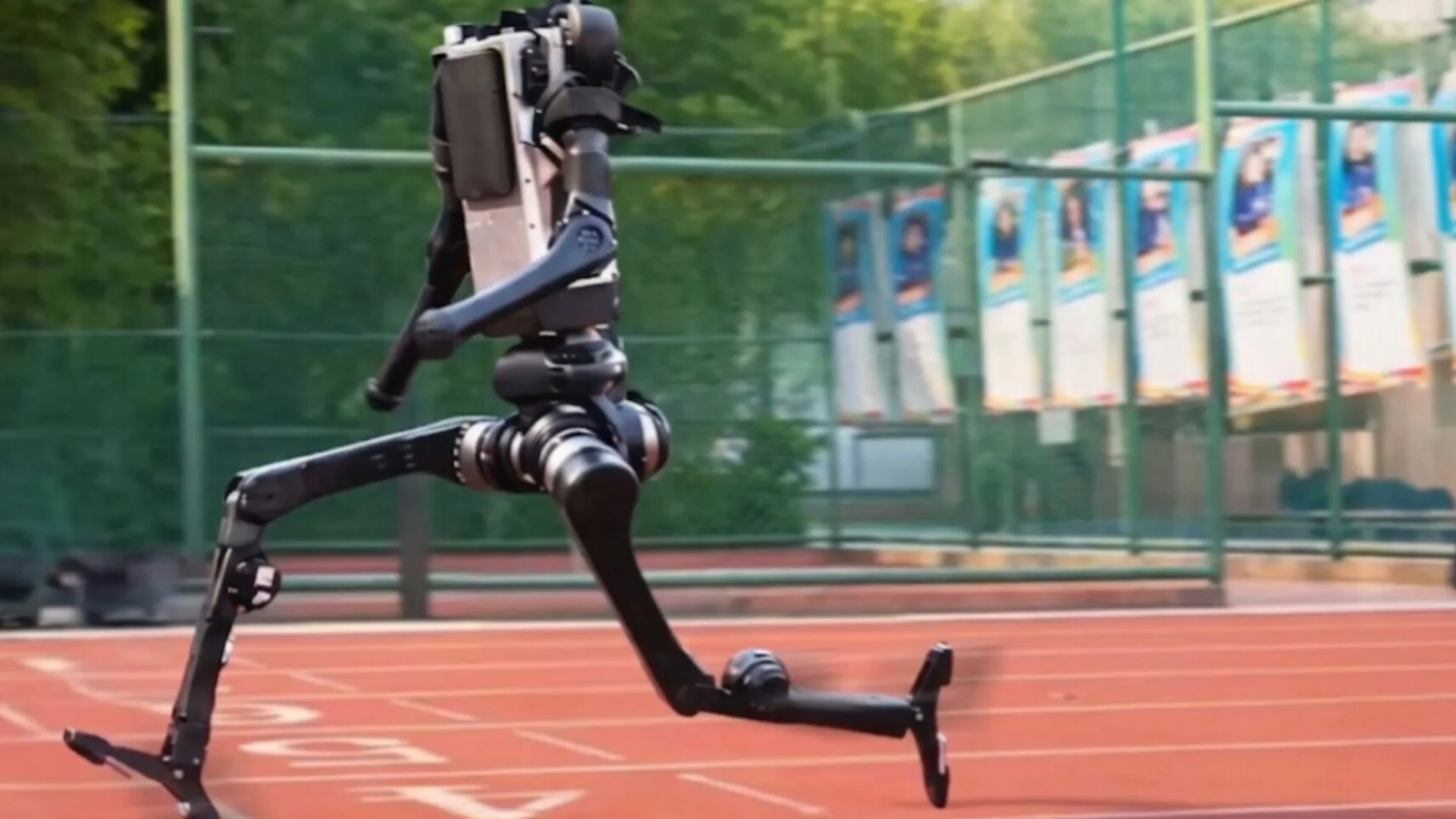
A humanoid robot is now running fast enough to challenge the limits once thought to belong only to humans. Chinese robotics company Unitree Robotics has revealed that its H1 humanoid robot can sprint at speeds close to the fastest human ever recorded.
In a recent video released by the company, the H1 robot was seen running on an athletics track. As it passed a speed-measuring device, the display showed a speed of 10.1 meters per second.
The company noted that the measuring equipment might have some margin of error, but the result still places the robot among the fastest-moving humanoid machines ever built.
The robot’s physical design adds to the surprise. It has a combined thigh and calf length of about 80 centimeters and weighs roughly 62 kilograms. These measurements are similar to those of an average human adult. The video caption described it simply: “With the physique of an ordinary person, running at a world champion’s speed.”
READ ALSO: Anti-Drone Laser System Gets Pentagon, FAA Nod Amid Rising Drone Threat
This comparison becomes even more striking when set against the record set by Usain Bolt. Bolt’s legendary 100-meter run in 2009 was completed in 9.58 seconds, with an average speed of around 10.44 meters per second. The H1 robot is now approaching that level, narrowing a gap that once seemed impossible to close.
Speaking at the 2026 Yabuli Entrepreneurs Forum, Unitree Robotics CEO Wang Xingxing shared an even bolder vision. He said humanoid robots may break the 10-second barrier in the 100-meter race by mid-2026. If that happens, machines would officially outrun the fastest human in history.
The video quickly gained attention online. On Sina Weibo, users reacted with amazement. One user said the robot looked like it was about to take off. Another remarked that the amateur has become a pro, pointing to how quickly robotic performance is improving.
The clip also spread widely on X, where it gathered over 270,000 views within a short time. Many users were impressed not just by the speed, but by how natural the robot’s movement appeared.
WATCH ALSO: China Sets World Record with 700 km/h Maglev
One commenter wrote that the world has moved beyond asking whether robots can walk, and is now asking whether they can outrun Olympic athletes. Another noted that even the cameraman struggled to keep up with the robot during the test.
Some observers focused on the technology behind the motion. A user pointed out that such smooth running requires advanced coordination between sensors, motors, and software systems. This suggests that real progress is not just about speed, but about the overall intelligence and control of humanoid machines.
Running has become a key benchmark for robotics companies, especially in China. It is seen as a test of balance, coordination, and real-world performance.
At the 2025 World Humanoid Robot Games, the Tien Kung Ultra robot won the 100-meter race with a time of 21.50 seconds. It outperformed other robots, including Unitree’s H1 models entered by different teams.
Tien Kung Ultra also made headlines by completing the world’s first half-marathon for humanoid robots in about 2 hours and 40 minutes. These events show how quickly robotic endurance and speed are improving.
READ ALSO: Seawater Hydrogen Puzzle Solved? China Maps Entire Chain From Lab to Ocean
Competition in this field is growing. Another Chinese company, MirrorMe, introduced a full-size humanoid robot named Bolt in February 2026. The robot stands 175 centimeters tall, weighs 75 kilograms, and can reach a peak speed of 10 meters per second, according to the company.
On April 19 this year, the second Humanoid Robot Half Marathon is scheduled to take place in Beijing. More than 70 teams have already conducted test runs in the city’s Economic-Technological Development Area. Experts expect multiple robots to compete side by side, making the event more competitive and exciting than before.
What once seemed like science fiction is now unfolding on real tracks. Humanoid robots are no longer just learning to walk; they are learning to run, and run fast.