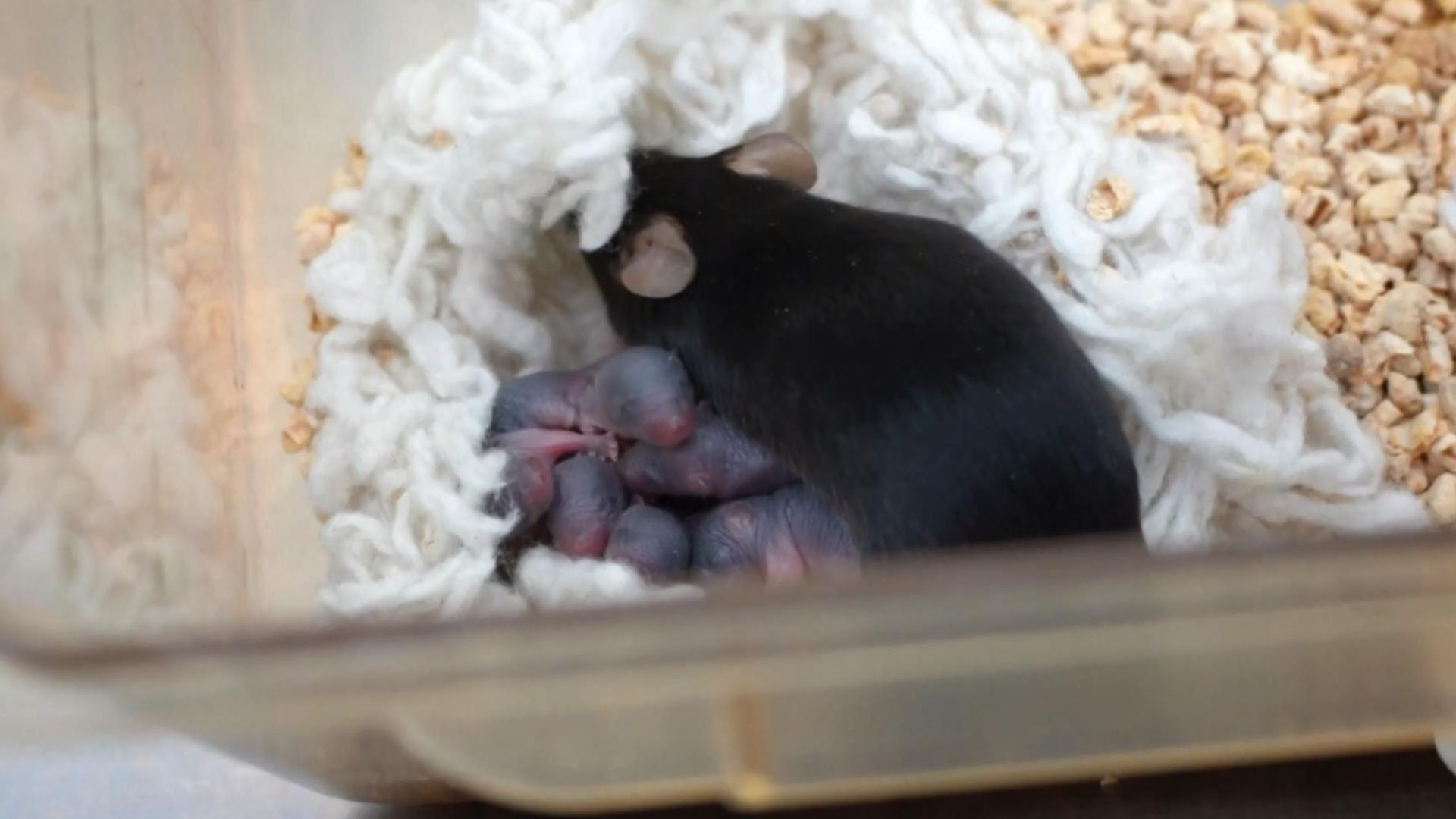
A female mouse that once lived aboard China’s space station has now delivered her third healthy litter back on Earth.
This gives scientists fresh insight into how mammals reproduce after spaceflight.
The mouse was part of a historic experiment carried out during the Shenzhou-21 mission. On October 31, 2025, four mice were sent to the China Space Station. It was China’s first small-mammal experiment conducted in orbit.
The rodents spent about two weeks in a special habitat under microgravity conditions. They returned safely to Earth on November 14.
Soon after returning, one of the female mice conceived. On December 10, she delivered her first litter of nine pups.
READ ALSO: https://modernmechanics24.com/post/apollo-moon-rocks-lunar-mystery-solved/
Since then, she has given birth to two more litters. The second litter had 10 pups. The third had nine. All three litters were born healthy.
Each litter was larger than normal. On Earth, mice usually give birth to five to seven pups at a time. The larger litter sizes surprised researchers.
Scientists say this will provide valuable data about how spaceflight affects reproduction.
Researchers at the Chinese Academy of Sciences, specifically its Institute of Zoology, are closely monitoring the pups. They have noticed subtle behavioral differences among the three litters.
WATCH: https://modernmechanics24.com/post/china-6-ton-tiltrotor-first-flight/
The first litter appeared more cautious. The pups often hid in sheltered areas and showed socially anxious behavior.
The second litter showed more confidence. These pups explored their surroundings more freely and adapted more quickly.
By the third litter, scientists observed even better adjustment to life on Earth. The new pups seemed more comfortable and active in their environment.
Researchers say, “Each successive litter shows improved adaptation to ground living conditions.” They believe these small changes are important for understanding how space exposure may influence future generations.
Why Mice Matter in Space Research
Mice are widely used in scientific studies because they share about 85 percent of their genes with humans. They also reproduce quickly, making them ideal for studying possible generational effects.
READ ALSO: https://modernmechanics24.com/post/fraunhofer-rmit-advanced-3d-metal-print/
Scientists are interested in finding out whether long-term space missions could affect human reproduction. As countries plan extended missions to the Moon and Mars, this question becomes more relevant.
By observing the space pups, researchers hope to understand whether space travel causes lasting biological changes.
They are now tracking the mice’s growth patterns. They will also test whether the pups can reproduce normally when they reach adulthood. This will help scientists detect any potential multi-generational impact.
According to the research plan, the team will conduct longer-duration studies in orbit. Future missions will keep mice in space for more than six months. This would mirror the length of many human missions aboard space stations.
Researchers want to study how extended exposure to microgravity affects physical health, reproduction, and adaptation.
These findings move scientists closer to answering whether mammals can successfully reproduce beyond Earth. Now, the healthy birth of three litters is a promising sign for humanity’s future in deep space exploration.