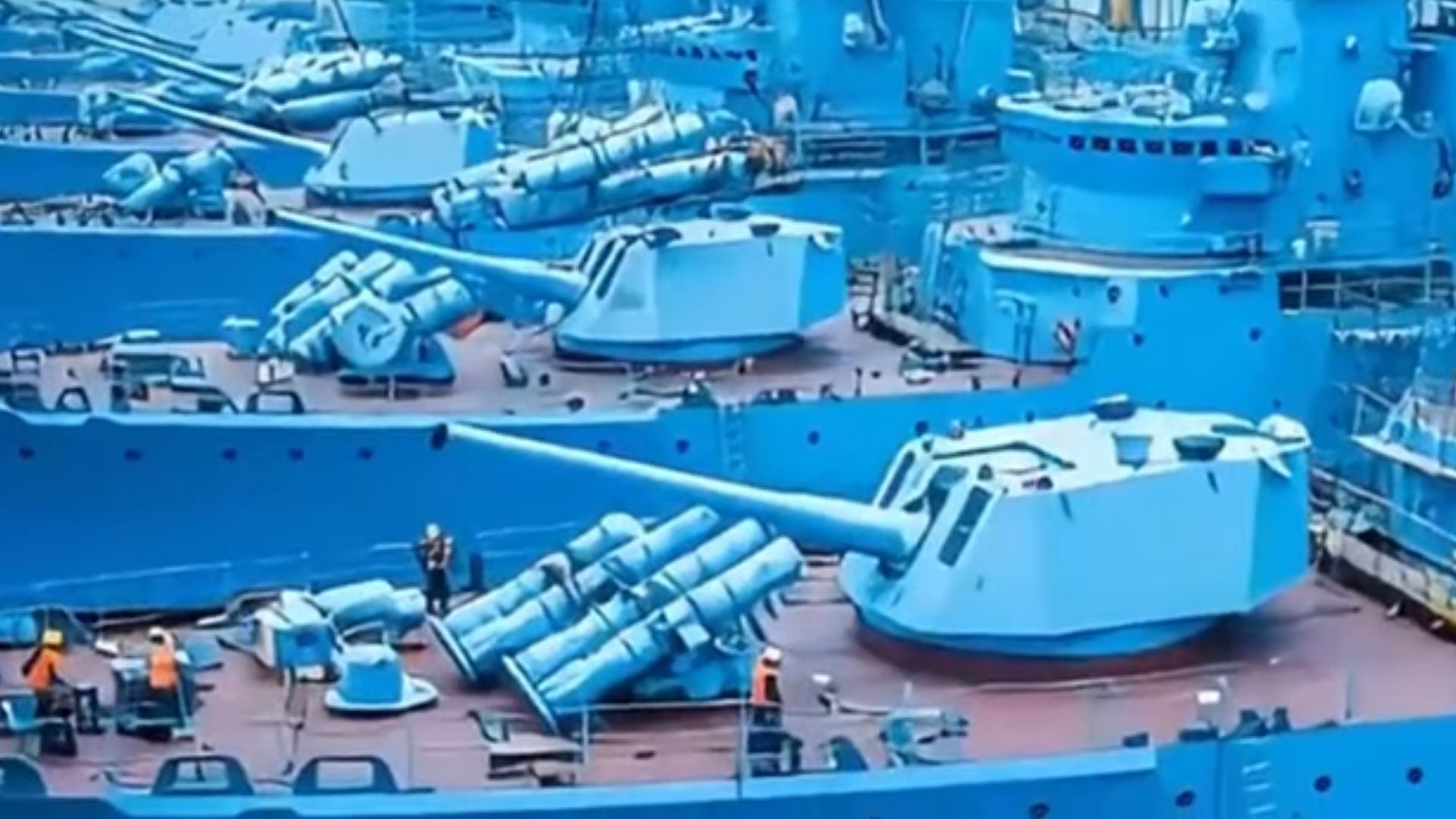
Images surfaced online showing a massive 155mm naval gun mounted on a test vessel in Dalian, China.
The development signals a potential boost to the People’s Liberation Army Navy’s (PLAN) amphibious warfare capabilities, particularly in coastal assault operations.
Photographs circulating on Chinese social media platforms show a large-calibre gun installed on the bow of a ship reportedly docked at the Liaonan shipyard in Dalian, Liaoning province.
According to claims, the weapon’s barrel length and turret design closely resemble previously seen prototypes developed by China North Industries Group Corporation (Norinco).
The system had earlier been photographed while being transported by road, indicating it was nearing advanced testing stages.
READ ALSO: https://modernmechanics24.com/post/agilitys-digit-humanoids-in-toyota/
The appearance of the 155mm gun aboard a test ship suggests the project may be entering sea trials. Defence observers say such trials would be a critical step before operational deployment.
If commissioned, the 155mm system would become the largest-calibre main naval gun currently fielded by a modern navy.
It weighs an estimated 21.8 tonnes and reportedly can fire precision-guided munitions. It represents a notable jump in firepower for the PLAN.
At present, China’s advanced Type 055 and Type 052D destroyers are equipped with the 130mm H/PJ-45 main gun. Earlier destroyers used the 100mm H/PJ-87, while frigates and amphibious vessels such as the Type 071 carry the 76mm H/PJ-26. These systems primarily provide air defence and limited surface strike capabilities. However, they lack the heavy bombardment power typically associated with larger naval artillery.
Analysts suggest the new 155mm gun could be intended for amphibious assault ships rather than destroyers.
The PLAN’s Type 071 amphibious transport docks and larger Type 075 amphibious assault ships are designed to deploy troops, helicopters, and unmanned systems during landing operations. But their existing armament focuses largely on defensive roles, relying heavily on close-in weapon systems and smaller guns.
WATCH ALSO: https://modernmechanics24.com/post/humanoid-robots-engage-chat-unscripted/
In a potential cross-strait conflict involving Taiwan, naval gunfire support would play a crucial role. Ship-mounted artillery provides sustained, cost-effective coastal bombardment compared to missile strikes. These are significantly more expensive per round. A 155mm naval gun capable of firing guided munitions could deliver precision strikes while maintaining a high rate of fire.
The development also reflects broader global debates about naval artillery. The US Navy previously installed 155mm Advanced Gun Systems on its Zumwalt-class destroyers. It had intended to use Long-Range Land Attack Projectiles (LRLAP).
However, the programme faced setbacks when each round reportedly cost around US$800,000. It led to the eventual replacement of the guns with additional missile launch systems.
Unlike missile systems, conventional naval guns provide volume fire support, particularly valuable during amphibious assaults where sustained suppression of coastal defences is required.
Strategically, the large-calibre naval artillery bridges the gap between short-range defensive guns and long-range precision missile systems.
China is also pursuing next-generation naval weapons, including electromagnetic rail guns and laser systems. A prototype rail gun was spotted on a test ship in 2018, signalling Beijing’s interest in advanced kinetic energy weapons.
READ ALSO: https://modernmechanics24.com/post/nasa-moon-mission-delayed-rocket-issue/
Additionally, high-powered laser systems have reportedly been integrated into certain amphibious vessels, enhancing air defence capabilities.
Beijing views Taiwan as part of its territory and has not ruled out the use of force to achieve reunification.
The testing of the 155mm naval gun, therefore, carries strategic implications beyond technical advancement. It reflects China’s continued efforts to enhance its amphibious warfare capabilities and strengthen its naval firepower in contested maritime environments.
With sea trials, this will showcase how the new artillery system performs and whether it becomes a standard feature of China’s expanding amphibious fleet.