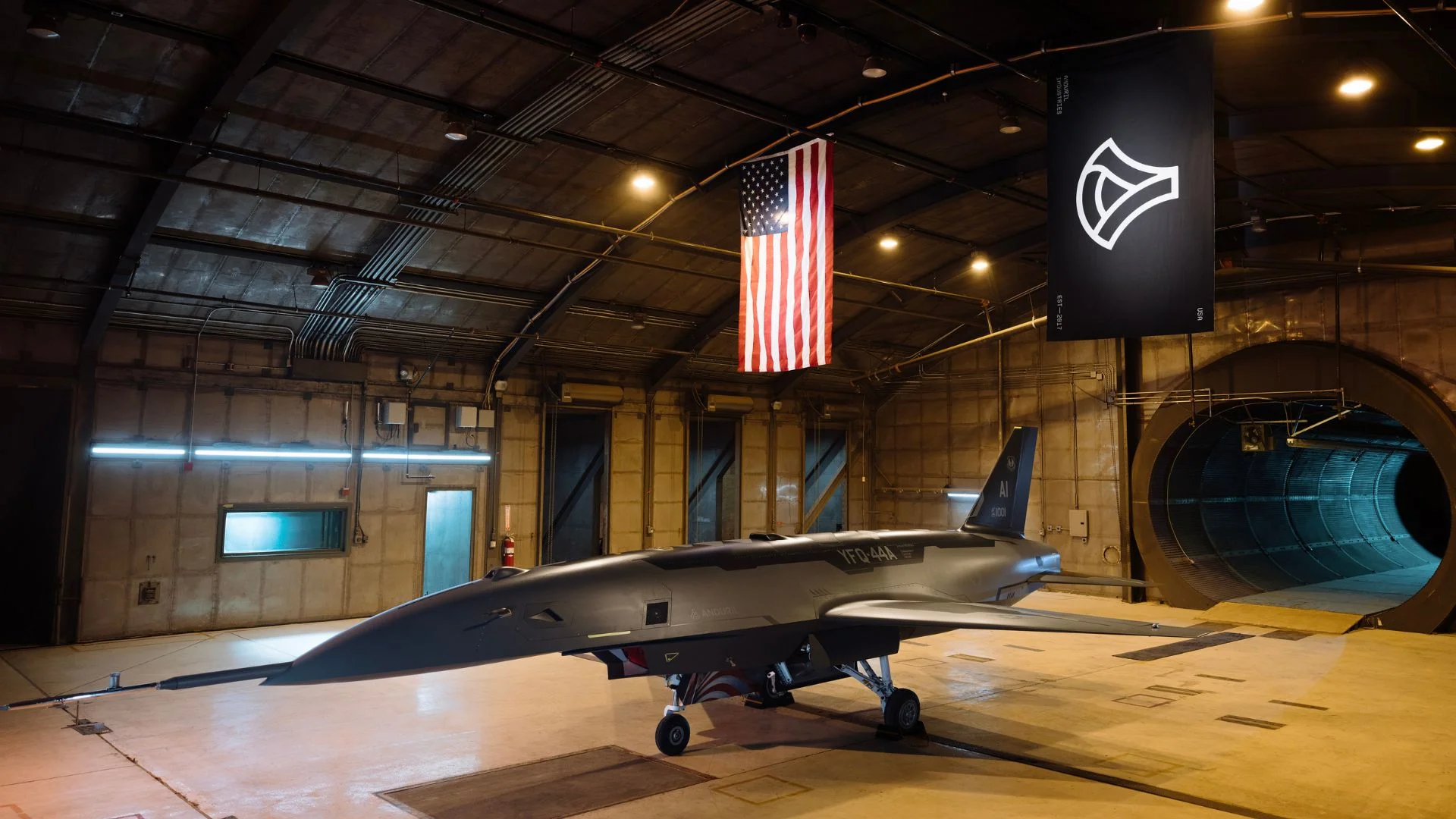
The US Air Force has officially selected both the FQ-42A Dark Merlin and FQ-44A Fury for production.
The move follows months of flight testing and evaluation of the two drone designs. It also confirms that the Air Force will operate a mixed fleet rather than choosing a single winner.
The two aircraft emerged from the Air Force’s CCA Increment 1 competition. General Atomics and Anduril were chosen in 2024 to continue development after an earlier selection process, respectively. Their aircraft later received the designations YFQ-42A and YFQ-44A during testing.
The Dark Merlin completed its first flight in August 2025. The Fury followed with its first flight in October 2025. Both aircraft have continued testing over the past year, although Dark Merlin’s program experienced a temporary pause after a crash earlier this year.
Air Force officials say testing has since resumed successfully. The service believes both aircraft now meet the requirements for moving into full-scale manufacturing. Officials also noted that the production decision was made four months ahead of schedule.
FQ-42A, FQ-44A Move Forward
Secretary of the Air Force Troy Meink described the decision as an important milestone. He said the contracts help accelerate the delivery of combat-ready autonomous systems. He also reaffirmed the Air Force’s goal of acquiring more than 150 operational CCAs before the decade ends.
The Air Force has requested nearly $1 billion in its Fiscal Year 2027 budget to begin procurement activities. That funding will support the first production batches of these aircraft. Initial deliveries are expected to support continued testing before operational deployment.
READ ALSO: Robotic Rabbit Recognizes Elderly Users by Voice to Deliver Personalized Emotional Support
Why Air Force Chose Two Different Drone Designs
Selecting both aircraft reduces the Air Force’s risk. If one platform encounters technical problems, the other can continue development and production. This approach also prevents reliance on a single supplier.
The two drones are designed with different strengths and capabilities. Operating both platforms allows military planners to use them in different missions. It also creates flexibility as future operational requirements evolve.
Collaborative Combat Aircraft are designed to fly alongside crewed fighter jets. They can perform tasks such as reconnaissance, electronic warfare, missile carrying, and strike missions. Their purpose is to expand combat capacity without putting additional pilots at risk.
Military leaders view these aircraft as force multipliers. A single fighter pilot could potentially control several autonomous aircraft during a mission. This concept increases combat mass while reducing operational costs compared to traditional fighter fleets.
Air Force Chief of Staff General Ken Wilsbach said CCAs will change how the military projects power in contested environments. He noted that faster delivery of the capability helps maintain a tactical advantage. The service views autonomous systems as a key element of future air superiority.
The production contracts also establish a pathway for future purchases. Anduril stated that the agreement creates a framework for acquiring additional production lots over several years. This structure allows the Air Force to expand the fleet as requirements grow.
General Atomics confirmed that manufacturing preparations have already been underway. Company officials said production activities are moving forward immediately. That preparation helped support the accelerated contract timeline.
WATCH ALSO: Microsoft delivers first large scale production cluster with more than 4,600 NVIDIA GB300 NVL72
Software Competition Becomes a Key Battleground
While aircraft production moves forward, the Air Force is also separating hardware and software development. Officials believe this approach will accelerate innovation and improve long-term flexibility. The strategy treats autonomy software as a separate product from the aircraft itself.
This model allows software upgrades without redesigning the aircraft. New capabilities can be added through software updates rather than costly hardware changes. The approach resembles how modern smartphones receive regular software improvements.
The Air Force currently maintains a pool of software providers. Companies involved include Anduril, Collins Aerospace, Shield AI, Lockheed Martin, Northrop Grumman, and RTX. These firms compete to provide mission autonomy systems for future aircraft.
At the same time as the production announcement, the Air Force awarded additional software contracts to Anduril, Collins Aerospace, and Shield AI. These contracts launch a six-month competitive phase focused on developing software for operational autonomy. Performance during this period will determine future awards.
A second competitive phase will follow after the initial evaluation. The Air Force plans to select a primary mission autonomy provider for CCA Increment 1 by the summer of 2027. Officials believe competition will drive faster innovation and lower costs.
The service has also introduced a new payment model. Under this structure, software providers receive full compensation only if their systems meet operational needs and perform effectively during testing. Feedback from military operators will directly influence contract payments.
Government ownership of key software architecture plays a major role in the program. The Air Force uses an Autonomy Government Reference Architecture (A-GRA). This framework allows software from different companies to operate across multiple autonomous aircraft types.
Anduril says its Lattice for Mission Autonomy software fully complies with A-GRA standards. The company believes this compatibility will help create a broader ecosystem of autonomous aircraft. Shield AI’s Hivemind software already runs on several drone platforms and recently drew attention for enabling swarming capabilities in military systems.
WATCH ALSO: Chinese firm’s humanoid robot can perfectly pick up tennis ball
The Air Force believes open architecture reduces dependence on a single vendor. It also creates more opportunities for competition throughout the program’s life. This strategy supports lower costs, stronger supply chains, and faster technological advancement.
Beyond Increment 1, the Air Force is already looking ahead to Increment 2 of the CCA program. Specific requirements have not yet been released publicly. However, additional aircraft designs are already emerging.
Northrop Grumman’s Talon Blue has received the YFQ-48A designation and entered public view in late 2025. Boeing’s MQ-28 Ghost Bat, originally developed in Australia, is also gaining a stronger presence in the US. Both platforms could play roles in future CCA competitions.
The US Navy and US Marine Corps are closely monitoring the Air Force’s progress. The Marine Corps plans to receive its first MQ-58 Valkyrie collaborative combat aircraft in 2029. The Navy remains in the early stages of developing its own autonomous combat aircraft program.
The production approval for the FQ-42A Dark Merlin and FQ-44A Fury represents one of the most significant milestones in the Air Force’s autonomous aviation strategy.