

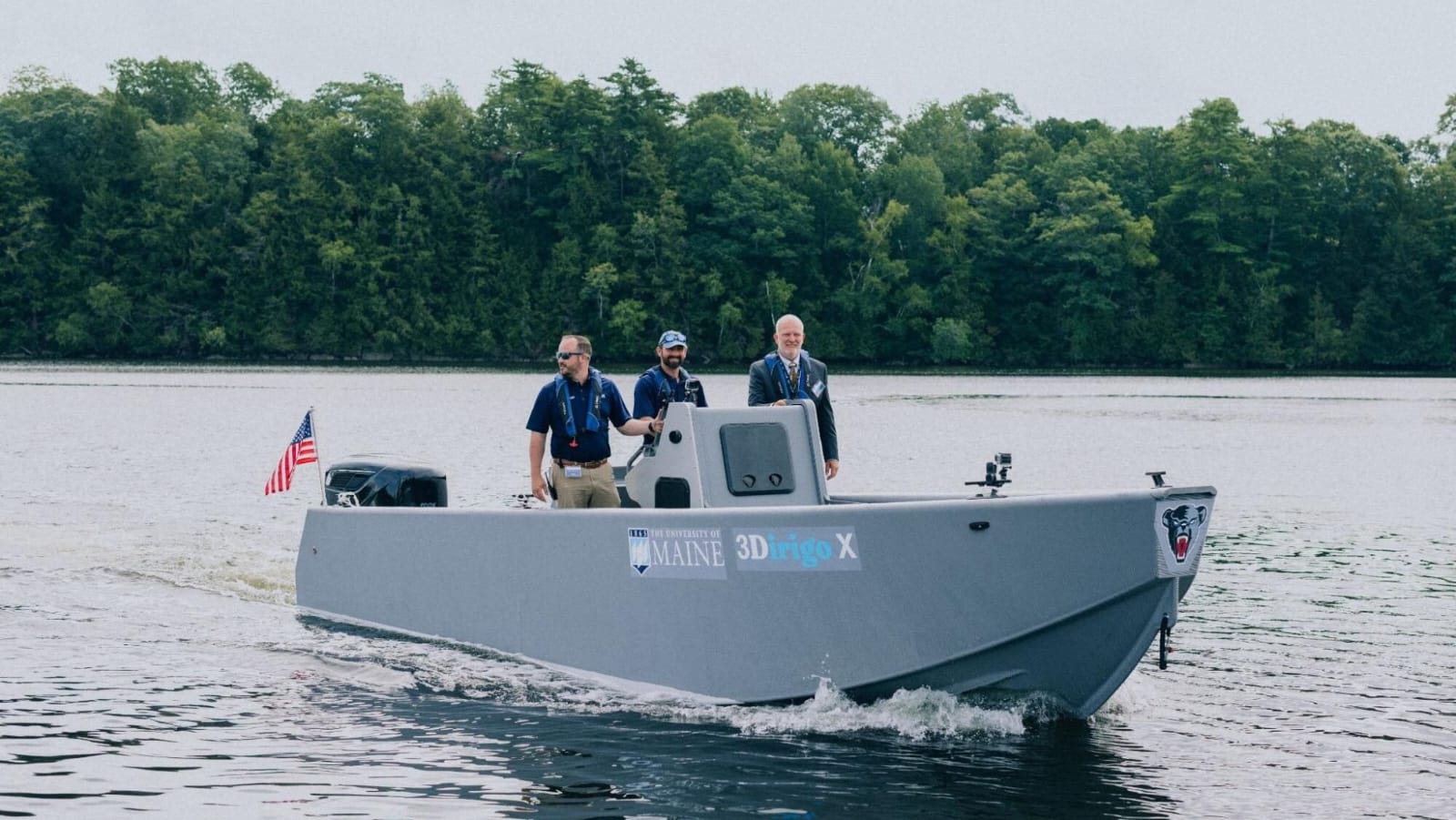
The University of Maine has launched a 30-foot (9-metre) 3D-printed boat as researchers test whether large-scale additive manufacturing can make vessel production faster and more flexible.
The 3Dirigo X was designed and built at the university’s Advanced Structures and Composites Center and is intended to operate offshore at speeds approaching 40 knots (46 mph). Researchers will now test the vessel in Atlantic waters as they assess the technology’s performance and manufacturing potential.
From Demonstration To Testing
The vessel builds on UMaine’s original 3Dirigo, unveiled in 2019 to demonstrate the use of large-scale 3D printing in boat construction.
That project produced a vessel of similar scale and earned three Guinness World Records related to its construction. The 3Dirigo X has been designed for higher speeds and the structural demands associated with offshore operation.
READ ALSO: https://modernmechanics24.com/post/amprius-debuts-500whkg-battery-drones/
Large-scale 3D printing uses a computer-controlled system to deposit material layer by layer, rather than relying on conventional molds to form a vessel’s structure.
Researchers say this allows digital designs to be changed without producing a new mold for every variation. The approach is being examined for applications where manufacturers need to produce specialized vessels or modify designs relatively quickly.
Printing Speed Has Increased
UMaine said its printing rate has risen from about 20 pounds of material per hour when the research began to roughly 500 pounds per hour today. The increase has been supported by advances in composite materials, digital design, sensors and process controls. Researchers are continuing to work on the manufacturing process and the properties of the materials used.
The university is also preparing to open a Factory of the Future inside its new 55,000-square-foot (5,100-square-metre) GEM facility. The facility is expected to expand UMaine’s large-scale additive and related manufacturing capabilities. The university is targeting a deposition rate of 1,000 pounds per hour as the technology develops.
Atlantic Testing Comes Next
The launch begins a new phase of testing for the 3Dirigo X rather than completing its development. Researchers will evaluate the boat in Atlantic waters, examining its performance, durability and ability to withstand repeated stress and offshore conditions. The results will be fed back into computer models to refine future designs and manufacturing processes.
Habib Dagher, executive director of UMaine’s Advanced Structures and Composites Center, said the research team had developed methods to model vessels for extreme ocean environments but still needed to optimize manufacturing and material properties.
Researcher DeVries said digital manufacturing also enables engineers to create a digital twin of the vessel, allowing physical test results to be incorporated into subsequent designs. The process is intended to shorten the design and testing cycle by using data from each build to improve the next.
WATCH ALSO: https://modernmechanics24.com/post/xpeng-second-gen-iron-humanoid-robot/
Defense Applications In Focus
The project is also being developed with potential applications for the US defense sector. Researchers have identified unmanned vessels, patrol craft, logistics vessels, sensor platforms and replacement components among possible uses. Digital production could allow designs to be adjusted for different missions without requiring new molds and specialized tooling.
The 3Dirigo X was developed through UMaine’s Accelerated Rapid Prototyping initiative, which brings together the university, defense research organizations, national laboratories and industry partners.
The initiative focuses on large-scale manufacturing technologies that can be adapted for different industrial and defense requirements. The involvement of multiple research and industry partners reflects broader efforts in the US to develop more flexible domestic manufacturing capabilities.
A Test For Wider Adoption
Researchers said the technology is not intended to replace conventional shipyards or the workers who build vessels using established methods.
Instead, they see large-scale 3D printing as another production option that may reduce dependence on specialized molds and make design changes easier to implement. Wider adoption will depend on whether manufacturers can demonstrate consistent production, reliable inspection and costs that compete with established construction methods.
READ ALSO: https://modernmechanics24.com/post/xos-mobile-charging-hub-1gwh-milestone/
The project is also being used as a training platform for students working in advanced manufacturing and engineering. The coming Atlantic trials will provide further data on whether the 3Dirigo X’s manufacturing approach can move toward broader use in commercial and defense vessel production.






2 Responses