Scientists in Austria and Germany have captured the earliest stages of how light begins turning into electrical energy, offering a detailed view of a process that underpins solar cells.
Researchers from the University of Graz, Marburg University and Forschungszentrum Jülich reconstructed how an energy-carrying state called an exciton changes immediately after light is absorbed.
The findings, published in Physical Review X, provide new insight into the microscopic processes that influence how efficiently materials convert sunlight into electricity.
Tracking Light’s First Effects
When light reaches a material such as a solar-cell layer, photons are absorbed and transfer energy to electrons. This creates a temporary pairing between an energized electron and the positively charged space, or hole, it leaves behind, forming what physicists call an exciton. These excitons are important in optoelectronic materials because their behavior influences what happens to the energy carried by light.
READ ALSO: https://modernmechanics24.com/post/ice-dart-drone-grips-glacier-like-claws/
For decades, scientists have known that excitons form after light absorption, but their internal quantum-mechanical structure has been difficult to observe directly.
The Graz-led team has now reconstructed both the spatial distribution and the changes in the exciton wave function during the first moments after its formation. Peter Puschnig, professor of electronic structure of nanomaterials at the University of Graz, said the measurements reveal how the electron-hole pair develops immediately after being created.
The researchers found that the electron-hole pair initially spreads across about three molecules. Within the first 400 femtoseconds, it contracts by roughly 25%, showing that the exciton’s structure changes extremely rapidly. One femtosecond is one quadrillionth of a second, making the observed process far too fast for conventional imaging methods.
Making Quantum Motion Visible
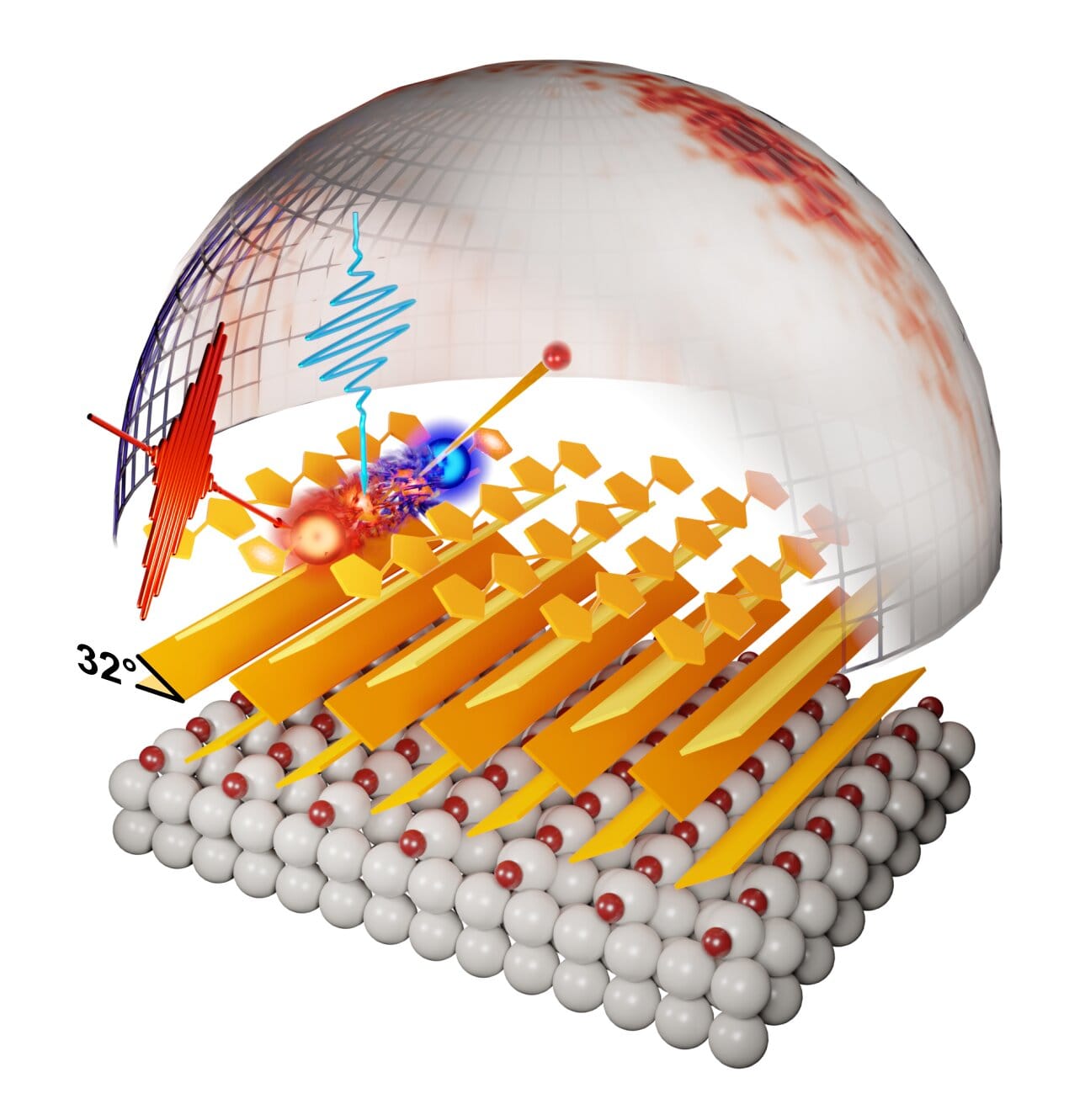
To capture these changes, the researchers used two extremely short laser pulses in a technique based on photoemission.
The first pulse created the exciton, while a second, higher-energy pulse released an electron from the electron-hole pair. Scientists then measured the energy and direction of the emitted electron to determine information about its quantum state.
The team repeated the measurements while changing the time between the two laser pulses. Each delay provided a different snapshot of the exciton’s development, allowing the researchers to reconstruct its evolution over time. The approach effectively turns measurements of emitted electrons into a time-resolved picture of a process occurring at the quantum scale.
The theoretical work was equally important because the measurements alone do not directly show the exciton’s wave function.
Researchers at the University of Graz developed quantum-mechanical simulations and an analytical model that connected the photoelectron measurements to the exciton’s spatial shape and internal quantum phase. Siegfried Kaidisch, who contributed to the work during his Ph.D., helped develop the model used to interpret the experimental images.
Three Groups, One Experiment
The experiment involved three research groups working across Austria and Germany.
Stefan Tautz and his team at Forschungszentrum Jülich produced and characterized the organic semiconductor samples before transporting them to Marburg under ultrahigh-vacuum conditions to preserve their quality. The samples were made from wafer-thin, ordered films of rod-shaped 6T molecules deposited on a specially prepared copper surface.
WATCH ALSO: https://modernmechanics24.com/post/buildroid-ai-expands-robotics-platform/
The molecular arrangement was important because the researchers needed the excitons to remain intact long enough for their formation and early evolution to be measured. Monja Stettner, who prepared the samples during her doctoral research, also contributed to the experiments conducted in Marburg. The Marburg team, led by Ulrich Höfer, carried out the high-precision photoemission measurements and analyzed the resulting data.
The method used in the study is known as Photoemission Orbital Tomography (POT). The technique was developed by Puschnig’s group and has since been expanded with Forschungszentrum Jülich into a tool for studying electronic states in organic materials.
By combining experimental measurements with theoretical calculations, POT allows researchers to investigate electronic structures that are otherwise difficult to observe.
Implications For Solar Technology
The study forms part of the European Union research project ‘Orbital Cinema,’ which aims to visualize electron dynamics in materials with extremely high spatial and temporal resolution.
Understanding these dynamics is particularly relevant to organic solar cells, where the movement and separation of charges directly affect how light energy becomes usable electrical current. Better knowledge of these early processes can help researchers identify where energy is retained, transferred or lost inside photovoltaic materials.
The next stage of the research will focus on donor-acceptor systems, where electrons and holes are separated after light absorption. This separation is a crucial step in converting absorbed light into an electrical current. The researchers say observing that process in real time will provide further information for the development of more efficient organic photovoltaic technologies.
READ ALSO: https://modernmechanics24.com/post/drone-feels-its-way-to-perfect-landing/
The findings, therefore, extend beyond simply observing an ultrafast quantum process. By showing how an exciton forms and changes within hundreds of femtoseconds, the research gives scientists a more detailed framework for studying the first steps of light-to-electricity conversion. Future observations of charge separation may help connect these microscopic events with the practical performance of next-generation solar materials.