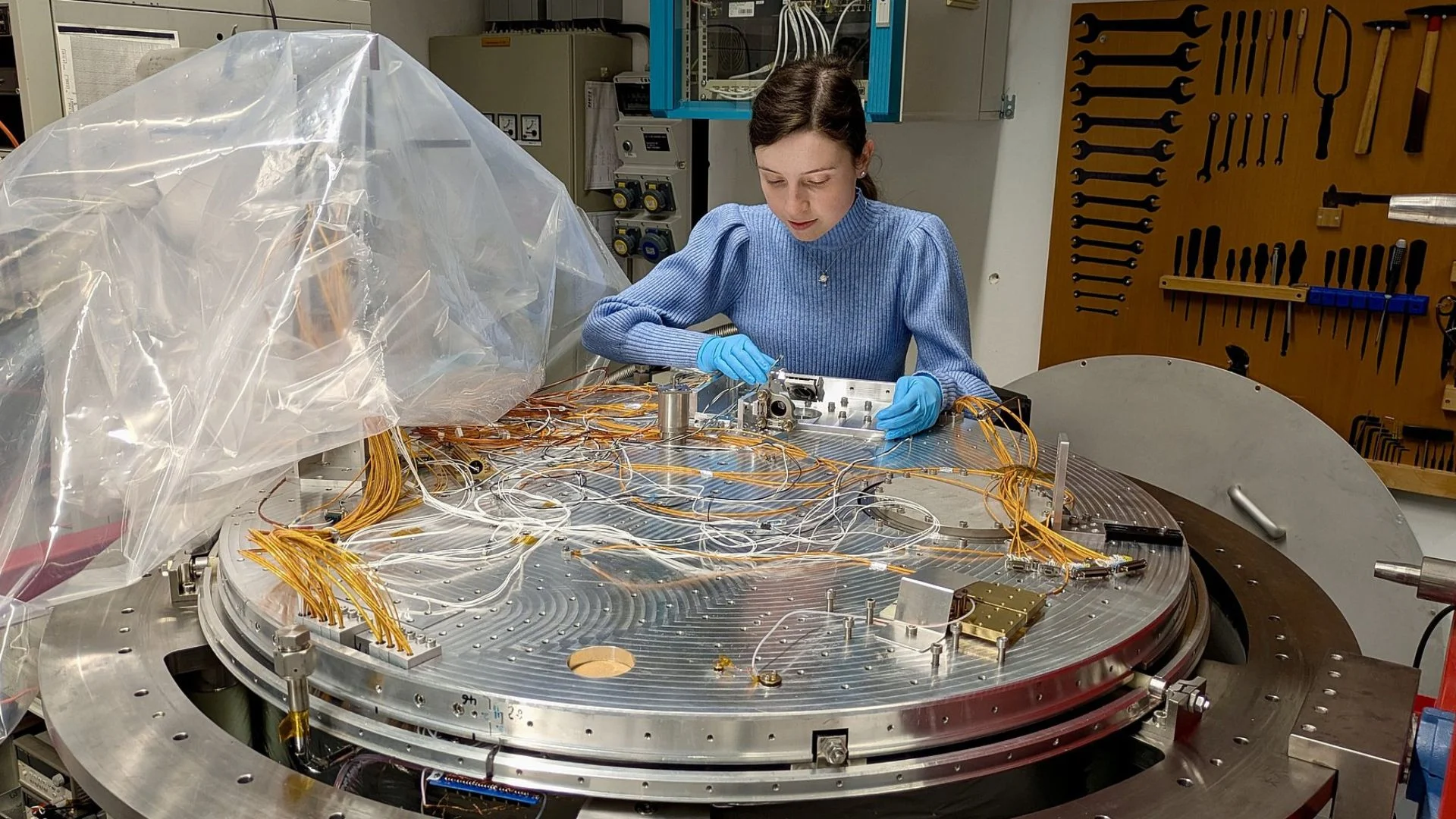
Sarah Pappert, a PhD candidate at the Technical University of Munich(TUM), has received the 2026 Zonta Women in STEM Award.
The international award recognizes outstanding achievements by young women working in science, technology, engineering, and mathematics. Only 16 researchers worldwide were selected for this year’s recognition.
Pappert conducts her research through the TUM School of Natural Sciences and the Max Planck Institute for Extraterrestrial Physics. Her work focuses on understanding supermassive black holes and the galaxies that surround them. She also contributes to the development of advanced astronomical instruments.
The award highlights both her scientific achievements and her commitment to science communication. Pappert regularly engages with students and young people through outreach activities. She hopes to encourage more girls and young women to consider careers in STEM fields.
Scientists have long viewed supermassive black holes as key players in galaxy evolution. These enormous objects sit at the centers of most large galaxies, including the Milky Way. Understanding how they grow and interact with their host galaxies remains one of astronomy’s biggest questions.
Pappert studies how galaxies and their central black holes evolve together over time. Researchers believe black holes influence star formation and other processes within galaxies. Observing galaxies at different stages of development helps scientists piece together this complex relationship.
READ ALSO: Lightweight X-Ray Telescope Designed to Map the Moon’s Chemical Composition From Orbit
Another major focus of her research is the search for galaxies containing two supermassive black holes. Such systems are believed to form when galaxies merge. Studying them can provide valuable clues about how galaxies grow and change across billions of years.
MICADO and the Extremely Large Telescope
Alongside her astrophysics research, Pappert works on MICADO, the first-light camera being developed for the European Southern Observatory’s Extremely Large Telescope (ELT). The telescope is under construction in Chile and is expected to become the world’s largest visible and infrared light telescope. Its primary mirror measures 39 meters across.
Pappert is helping develop a specialized optical system used for high-resolution spectroscopy. Spectroscopy is a technique that separates light into different wavelengths. Scientists use it to learn about the composition, temperature, movement, and history of objects in space.
The technology works much like a prism splitting sunlight into different colors. By studying these patterns, astronomers can determine what stars and galaxies are made of. They can also detect gas and dust that light encounters while traveling across the universe.
MICADO will allow researchers to study the center of the Milky Way with unprecedented detail. It will also observe some of the most distant galaxies ever detected. These observations will help scientists learn more about the early stages of the universe.
Despite the enormous size of the ELT, some of the instrument components Pappert works with are only a few millimeters wide. These tiny parts play a crucial role in analyzing light collected by the telescope. Their size demonstrates how precisely modern telescopes can focus light from distant cosmic objects.
READ ALSO: Autonomous Ships Move Closer as New Rules Enable Seafarers to Operate From Shore
Inspiring the Next Generation of Scientists
Pappert is also known for her dedication to science outreach. She frequently visits schools and participates in educational events designed to spark interest in science. Her goal is to make scientific careers feel more accessible to young people.
One memorable experience came during her first school presentation as a university student. A student asked detailed questions about a detector she had brought for demonstration. The discussion became so technical that she later revisited the instrument’s documentation herself.
She recently had a similar experience during a Girls’ Day event at the Max Planck Institute for Extraterrestrial Physics. Students became deeply engaged in a discussion about the Big Bang and the origins of the universe. Their questions reached the limits of current scientific understanding and reminded Pappert of her own curiosity as a young student.
Pappert believes visibility is important for increasing diversity in science. She says seeing a wider range of role models helps young people imagine themselves in scientific careers. The Zonta award provides her with a larger platform to share that message.
WATCH ALSO: Researchers from German have developed a diving robot that can easily collect underwater waste
Her research is supervised by renowned astrophysicists, Professors Reinhard Genzel and Frank Eisenhauer. Together, they are contributing to efforts to understand some of the universe’s most mysterious objects. Their work combines astronomy, physics, and advanced engineering.
As construction of the Extremely Large Telescope moves forward and new instruments near completion, Pappert‘s research is poised to drive future discoveries. The combination of powerful new technology and unanswered questions about black holes promises to shape the next era of astronomical exploration.