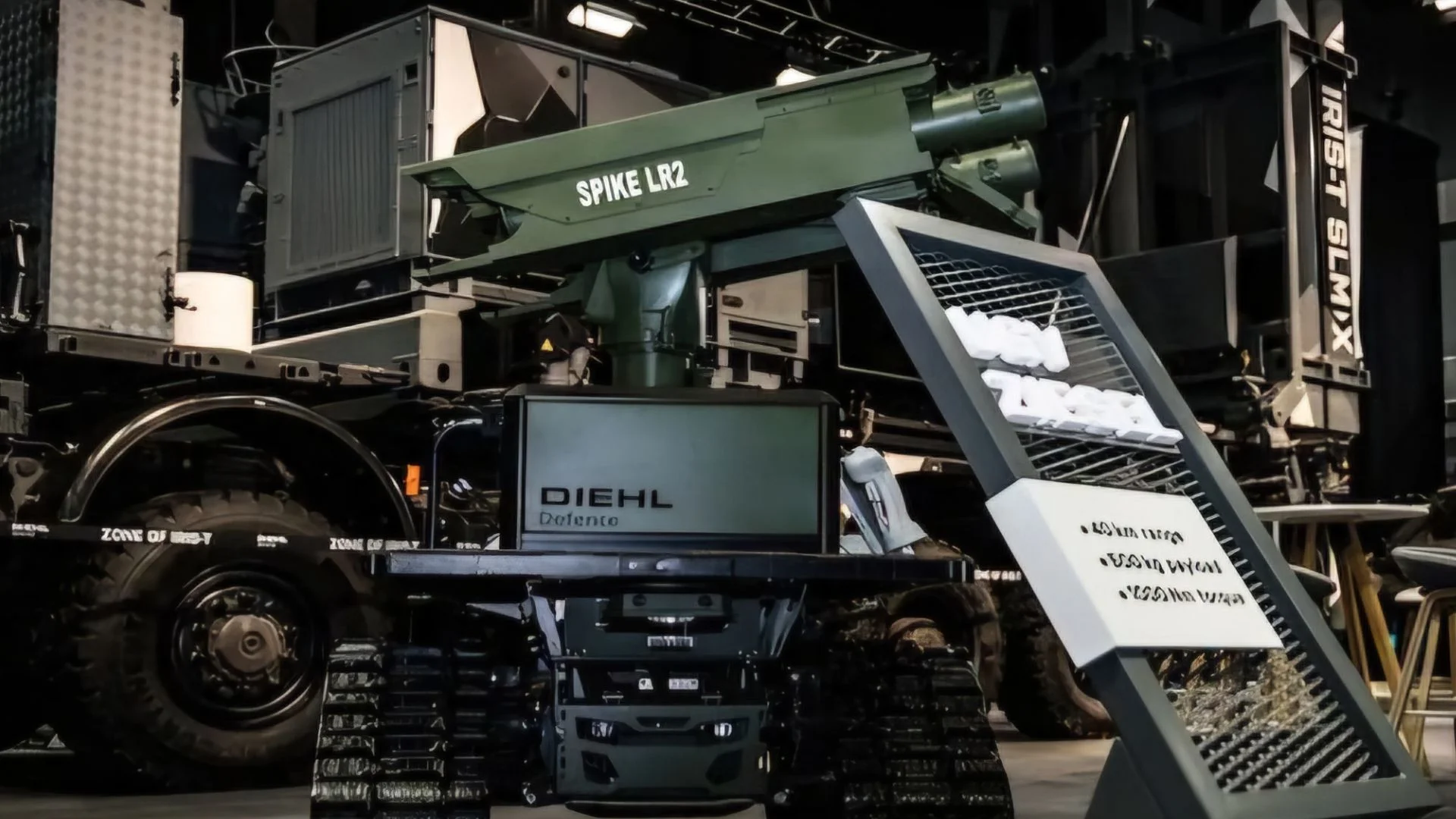
Germany has successfully tested the SPIKE LR anti-tank missile from the Ziesel unmanned ground vehicle, marking a major step in robotic battlefield systems.
The live-fire trials showed that the compact tracked robot can launch precision-guided missiles while operating remotely in combat conditions.
The project highlights NATO’s growing focus on unmanned anti-armor warfare and autonomous land combat technologies.
German defense company Diehl Defence announced the successful live-fire tests on May 15, 2026. The trials were conducted in collaboration with RAFAEL Advanced Defense Systems and EuroSpike GmbH.
The tests confirmed that the lightweight Ziesel robotic vehicle can fire modern anti-tank missiles without damaging its structure or onboard systems.
The Ziesel is a compact tracked unmanned ground vehicle designed for difficult battlefield terrain. During the firing campaign, the system repeatedly launched SPIKE LR missiles under realistic combat conditions.
READ ALSO: Chinese Physicists Tackle Time’s Arrow, Proposing Why We Can’t Travel Back
Engineers focused on testing recoil resistance, vehicle stability, targeting accuracy, and overall operational reliability.
According to Diehl Defence, the vehicle maintained full performance throughout the missile launches. The company said the chassis, suspension system, and onboard electronics withstood repeated firing stress without significant degradation. This result is important because lightweight robotic vehicles often struggle to safely carry heavy weapon systems.
SPIKE LR Missile Expands Robotic Warfare
The SPIKE LR is one of the most widely used anti-tank guided missiles among NATO and allied military forces. Developed by RAFAEL, the missile can strike targets at ranges of up to 5.5 kilometers, depending on launch conditions. It uses electro-optical guidance and supports both fire-and-forget and fire-observe-update combat modes.
The missile is designed to destroy heavy armored vehicles, bunkers and moving targets with high precision. High-tech sensors enable it to operate in different weather conditions and during day or night missions. These capabilities make the SPIKE LR suitable for modern high-intensity warfare environments.
Integrating the missile onto an unmanned vehicle changes how anti-tank operations will be conducted on future battlefields. Armies can position robotic missile carriers closer to danger zones without exposing soldiers directly to enemy fire. This improves the survivability of infantry units operating in areas threatened by drones, artillery, and sniper fire.
The Ziesel platform was originally developed as a robotic support vehicle for multiple battlefield roles. Earlier variants were tested for logistics transport, casualty evacuation, and reconnaissance missions.
READ ALSO: NVIDIA’s Alpamayo AI Family Aims to Give Autonomous Vehicles “Humanlike” Reasoning
The newest version transforms the system into an armed combat platform capable of direct battlefield engagement.
Ziesel Robot Supports NATO Battlefield Plans
The vehicle also uses Diehl Defence’s PLATON autonomy system for navigation and mission management. The autonomy kit enables the robot to follow routes, avoid obstacles, and execute missions with reduced operator input. This reduces workload for soldiers while improving coordination between manned and unmanned forces.
NATO armies are increasingly focusing on manned-unmanned teaming strategies. These concepts allow robotic systems to work alongside conventional armored units and infantry formations during combat operations. Military planners see this approach as a way to improve battlefield endurance while addressing personnel shortages.
The compact size of Ziesel offers several tactical advantages during combat operations. Smaller robotic vehicles are easier to conceal in forests, urban settings and exposed forward positions. Their low profile also makes them harder to detect compared to larger armored combat vehicles carrying similar missile systems.
The latest tests come as European militaries study lessons from the war in Ukraine. Modern combat in Ukraine has shown the growing importance of drones, robotic systems, and electronic warfare technologies.
Unmanned platforms are being used for reconnaissance, logistics, casualty evacuation, and strike missions in contested battle zones.
Diehl Defence confirmed that the Ziesel is already undergoing evaluations with several armed forces, including Germany and Ukraine.
WATCH ALSO: BYD SEAL Delivers Lightning-Fast Acceleration for Effortlessly Smooth Drives
Interest in robotic combat vehicles has increased across Europe as militaries modernize their land warfare capabilities. Defense companies are racing to field operational unmanned combat systems before the end of the decade.
The successful tests also expand deployment options for the SPIKE missile family. Until now, SPIKE missiles have primarily been launched from infantry launchers, armored vehicles, and helicopters. The addition of unmanned ground vehicles creates new possibilities for distributed anti-armor operations across complex battlefields.
Military analysts see robotic missile carriers as part of a broader shift toward networked warfare systems. Instead of relying only on large armored units, armies are developing dispersed strike networks using drones and autonomous vehicles. These systems can attack targets from multiple hidden positions while reducing risks to frontline troops.
European defense manufacturers are rapidly increasing investments in unmanned ground combat technology. Several companies are testing robotic vehicles armed with machine guns, missiles, and surveillance systems.
However, very few lightweight robotic systems have successfully demonstrated repeated guided missile launches under operational conditions.
Diehl Defence said future demonstrations will focus on autonomous operation and cooperative combat missions involving both manned and unmanned systems.
Additional trials are expected for representatives from several armed forces in the coming months. The successful SPIKE LR launch campaign places the Ziesel among Europe’s most advanced robotic anti-tank systems currently under development.
WATCH ALSO: Swiss company’s new ‘brain’ to help robots conduct real-life tasks autonomously
The project reflects the broader transformation in modern land warfare strategies. Autonomous combat systems are becoming increasingly important to military planning as armies prepare for highly contested, technology-driven battlefields.
The growing use of robotic missile carriers is expected to shape future NATO anti-tank operations and battlefield tactics in the years ahead.