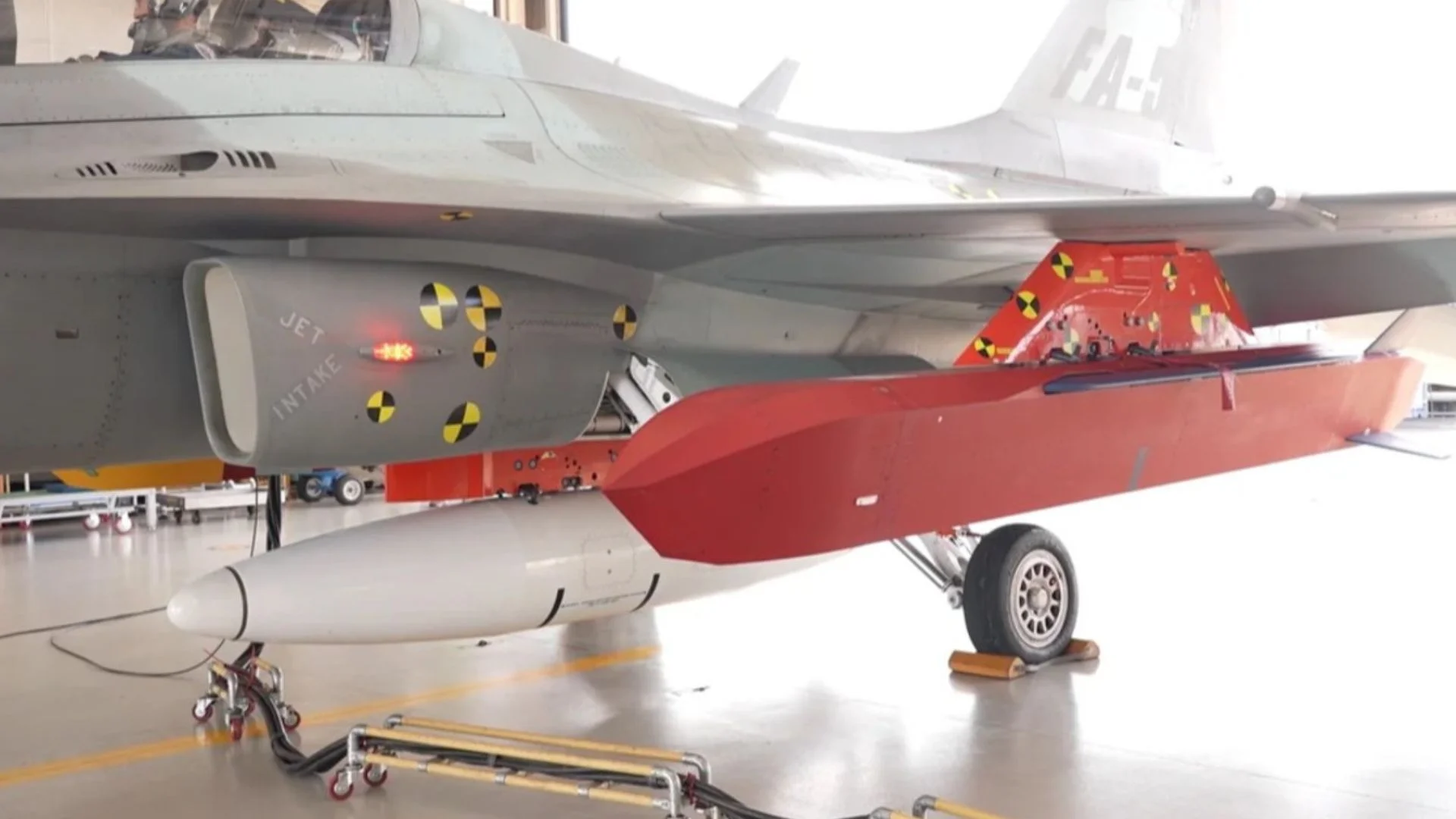
South Korea successfully conducted a technical flight test of the Cheonryong long-range air-to-ground cruise missile.
The test marked an important achievement after two unsuccessful attempts in January and March. Engineers had previously shut down the missile’s engine remotely and safely dropped both prototypes into the Yellow Sea.
The latest test was conducted at the Air Force’s 3rd Training and Combat Wing. During the mission, the missile separated smoothly from an FA-50 light attack aircraft. It then started its jet engine in flight and completed a stable powered flight as planned.
These were the difficult steps that earlier test flights failed to achieve. The successful demonstration confirms that the missile’s basic flight system is working as intended. According to Seoul Economic Daily, the development program remains on schedule.
South Korea plans to complete development by 2028. Mass production is expected to begin in 2029. The missile is scheduled to enter service on the domestically built KF-21 Boramae fighter in the early 2030s.
The name Cheonryong means “Heavenly Dragon” in Korean. It is designed as a long-range precision cruise missile with a special focus on attacking hardened underground facilities. These targets include command bunkers, missile storage sites, and protected military infrastructure.
READ ALSO: Poland Orders Three Saab A26 Submarines in $4.4 Billion Deal to Strengthen Baltic Defense
Cheonryong: Built to Strike Underground
South Korea has increased investment in long-range precision weapons because North Korea continues expanding its underground military network. Many of these facilities are built deep inside mountains and reinforced with thick concrete. They are intended to protect military leaders and critical assets during wartime.
Standard bombs often cannot destroy these deeply buried structures. Bunker-busting missiles solve this problem by penetrating several layers of reinforced concrete before exploding. This allows them to damage command centers hidden deep underground.
South Korea currently operates the German-built Taurus KEPD 350 cruise missile for this mission. The weapon weighs about 1.4 metric tons and carries a 480-kilogram penetrating warhead. It has an operational range of around 500 kilometers.
The Taurus uses its Mephisto warhead system to penetrate up to six meters of reinforced concrete before detonating inside the target. Military analysts consider it one of the world’s most capable conventional bunker-busting cruise missiles. It is often rated higher than Britain’s Storm Shadow in terms of penetration capability.
South Korea purchased 260 Taurus missiles before launching the Cheonryong program. However, the Air Force estimates it needs approximately 600 long-range precision-strike weapons for the opening phase of a conflict. Domestic production will help fill that gap while reducing dependence on imported systems.
Cheonryong has been designed to match or improve on many of the Taurus missile’s capabilities. Reports indicate that its range will exceed 600 kilometers. That gives it roughly a 20 percent range advantage over the German weapon.
The missile reportedly delivers about 90 percent of the Taurus missile’s penetration capability. Engineers have focused heavily on improving its ability to destroy underground military bunkers. This makes it especially suitable for targets protected by multiple layers of reinforced concrete.
READ ALSO: China’s Huajiang Canyon Bridge Hits 625M, World’s Highest With Massive Artificial Waterfall
Advanced Guidance, Faster Readiness
Cheonryong combines several navigation systems to achieve very high accuracy. It uses inertial navigation, terrain contour matching, and image-based terminal guidance during the final stage of flight. These systems help it stay on course even if GPS signals are blocked or jammed.
The missile’s reported circular error probable is between one and two meters. In simple terms, this means it can hit extremely close to its intended target. High accuracy is essential when attacking hardened military facilities.
Cheonryong flies at very low altitude for most of its journey. Flying close to the ground makes it harder for enemy radar to detect the missile. Its airframe also includes stealth shaping and radar-absorbing materials that reduce its radar signature.
Another important improvement involves fuel storage. Unlike the Taurus missile, Cheonryong can remain fully fueled within the weapon for 5 to 10 years without performance loss. This allows the missile to remain ready for immediate use without a lengthy fueling process before launch.
Faster readiness can save valuable time during military emergencies. Aircraft carrying the missile can remain on standby for longer periods. That shortens the time between receiving strike orders and launching the weapon.
Cheonryong is also designed to work with several South Korean combat aircraft. Besides the future KF-21 Boramae fighter, it will also be compatible with the FA-50, KF-16, and F-15K fleets. This gives the Air Force greater flexibility by allowing many different aircraft to carry the same long-range missile.
Using multiple aircraft types increases the number of launch platforms available during a conflict. It also spreads strike capability across the Air Force rather than relying on a single fighter model. That improves operational flexibility and mission planning.
WATCH ALSO: Britain delivers laser-guided Air defense missiles to Ukraine six months ahead of schedule
The missile forms part of South Korea’s Korean Three-Axis System. This defense strategy combines the Kill Chain pre-emptive strike system, the Korea Air and Missile Defense network, and the Korea Massive Punishment and Retaliation plan. Together, these systems are designed to detect, intercept, and respond quickly to military threats.
Within this strategy, Cheonryong supports missions against heavily protected command centers and leadership facilities. Its long-range precision-guidance, stealth features, and bunker-penetrating warhead make it an important addition to South Korea’s future strike capabilities. Domestic production also strengthens the country’s defense industry by reducing reliance on foreign missile supplies.
The successful flight test marks an important step in the missile’s development journey. More testing and system validation will continue before production begins later this decade. If development stays on schedule, Cheonryong will become one of South Korea’s most advanced indigenous long-range precision weapons and play a central role in the country’s future air power.