

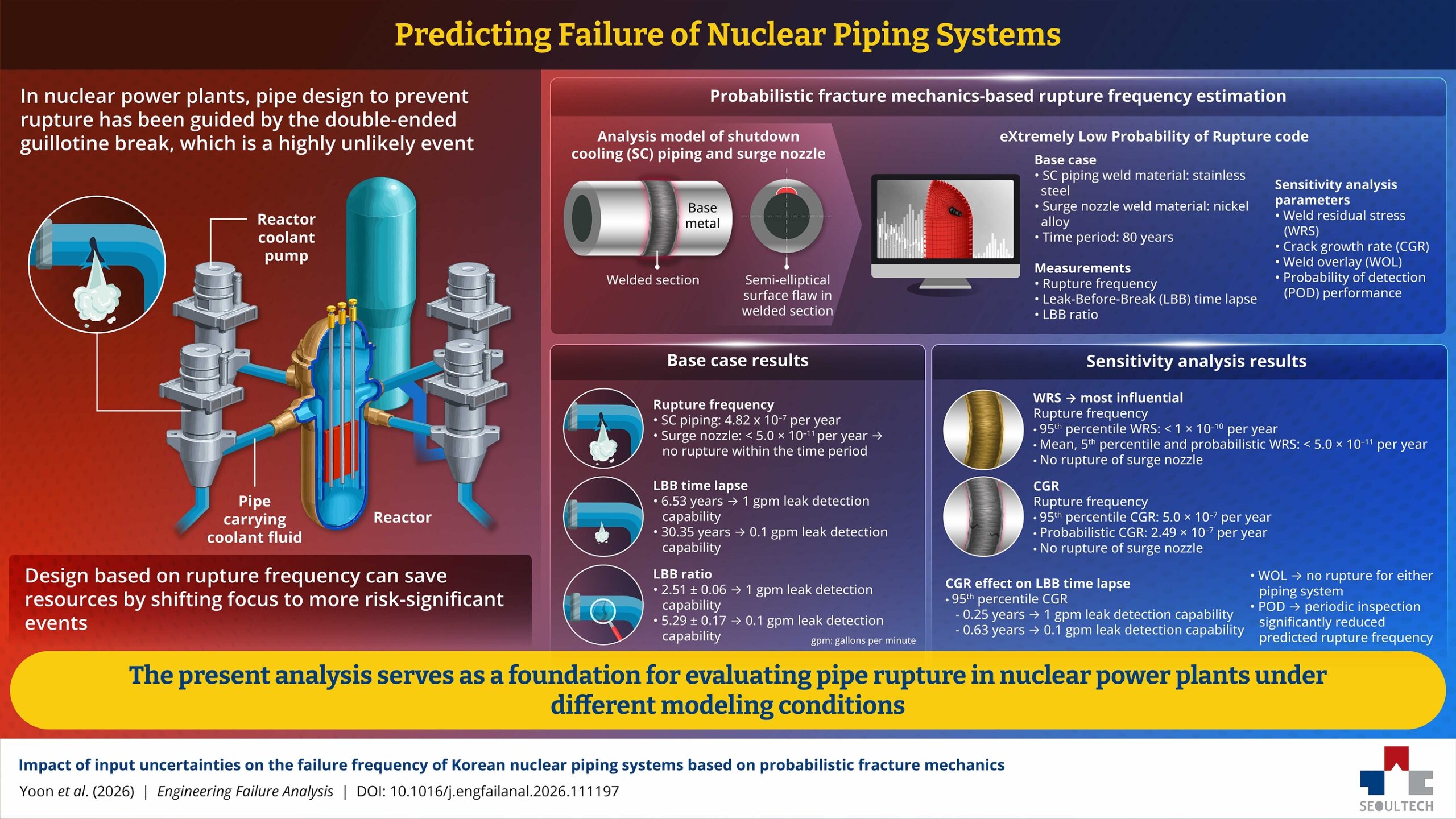
Seoul National University of Science and Technology researchers have developed a probabilistic fracture mechanics model to predict coolant pipe failures in nuclear power plants. This computational approach solves the issue of overly conservative safety estimates by pinpointing actual high-risk mechanical vulnerabilities. By accurately measuring rupture odds, plant operators can prevent dangerous loss-of-coolant accidents while avoiding unnecessary maintenance costs.
The study was conducted by engineers at South Korea’s Seoul National University of Science and Technology. The research effort was directed by Nam-Su Huh, professor at the School of Mechanical Systems Engineering at Seoul National University of Science and Technology.
Traditional nuclear safety standards rely on worst-case assumptions, such as sudden, full breaks of massive primary cooling lines. These older deterministic models ignore how metal degrades gradually over time and fail to account for how individual stress variables interact inside operating reactors.
READ ALSO: https://modernmechanics24.com/post/raytheon-mississippi-defense-plant/
The engineering team used specialized simulation software to model 80 years of continuous nuclear plant operation. The software analyzed how stress corrosion cracking spreads through primary coolant pipes under changing material conditions, residual weld stresses, and periodic maintenance checks.
The analysis revealed that residual stress from welding is the single most critical factor affecting pipe rupture rates. The simulation also confirmed that regular scheduled inspections dramatically cut rupture risks, helping engineers focus safety resources on the most vulnerable pipe segments.
The current simulation focused only on stress corrosion cracking as the sole degradation mechanism over time. Future models will need to incorporate multiple simultaneous wear factors, such as mechanical vibration and thermal fatigue, before the framework can fully evaluate every reactor environment.
WATCH ALSO: https://modernmechanics24.com/post/skybreaker-fighter-pilots-training/
This modeling method gives nuclear plant designers clear data to strengthen pipe safety standards without over-engineering basic components. The research will help utilities safely manage aging reactors and design more reliable, cost-effective infrastructure for next-generation nuclear facilities worldwide.














One Response