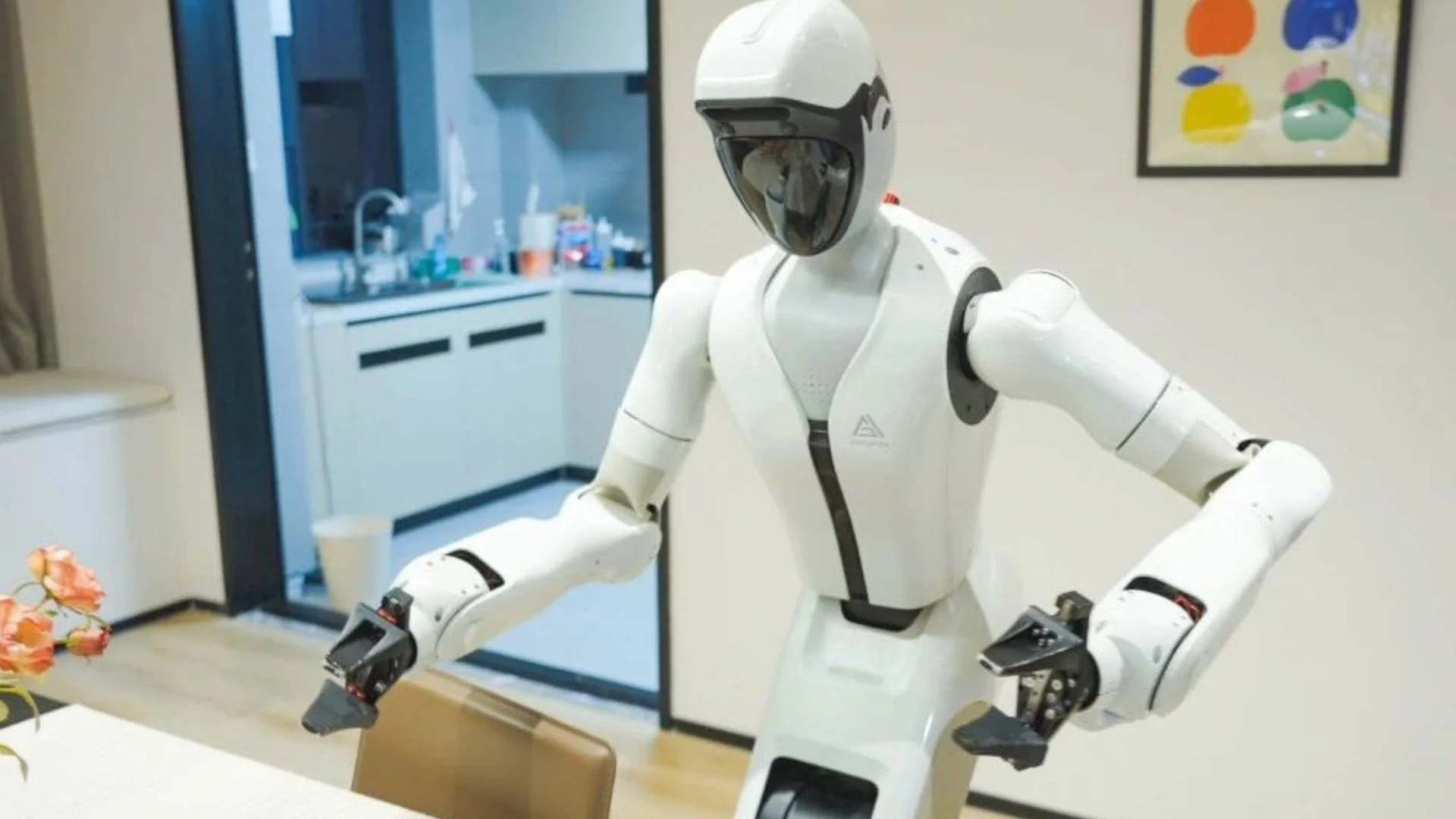
China has unveiled a new humanoid robot designed for household use, underscoring the country’s accelerating push into consumer robotics and embodied artificial intelligence.
The robot, known as SeeLight S1 in English-language coverage and Shiguang S1 in Chinese reports, was introduced on May 20 in Wuhan’s Optics Valley in Hubei Province.
Developed by Chinese robotics company GigaAI in collaboration with the Hubei Humanoid Robot Innovation Center and the Hubei Humanoid Robot Industry Alliance, the humanoid machine is built to operate inside real domestic environments. Developers say the robot can assist with tasks such as cooking, laundry, and home organization while safely interacting with children, elderly residents, and pets.
The launch reflects China’s growing investment in advanced robotics and AI-powered automation as the country seeks to expand the use of humanoid robots beyond industrial settings into everyday household life.
Unlike factory robots that repeat fixed actions, the SeeLight S1 is built for changing home environments. Homes contain moving people, furniture, pets, and objects that constantly create new situations. Developers say the robot uses embodied AI systems to understand tasks and react to surroundings in real time.
Demonstration videos showed the robot performing several household activities. It chopped vegetables, fried eggs, loaded washing machines, and folded clothes. The machine also opened curtains, organized tables, made beds, and handled other basic chores.
READ ALSO: International Team Proposes a 150-Meter ‘Curtain’ to Hold Back the Melting Doomsday Glacier
The robot uses a wheeled base and two robotic arms to move around indoor spaces. Engineers designed the system to navigate narrow home layouts more efficiently. This setup also reduces the balance problems often seen in fully walking humanoid robots.
Safety and Elderly Care Become Key Focus
Safety remains one of the biggest concerns for household robots. GigaAI said the SeeLight S1 includes a compliant control mechanism designed to prevent accidents. The system immediately stops the robot’s movement if it touches a person, child, or pet.
Developers say the robot is also being prepared for elderly care support. The company plans to test the machine in homes with senior citizens, children, and pets. The goal is to study how robots can assist families with daily routines and caregiving tasks.
The first real-world testing phase will begin later this month. Around 100 units will be deployed in employee housing connected to industrial technology zones in Wuhan. The company also plans to launch free household trials across the city during the first half of 2027.
GigaAI CEO Zhu Zheng said the company wants to lower production costs over the next two years. He stated that the target price is below 100,000 yuan, or roughly $14,700, by mid-2027. According to company estimates, that would reduce current hardware costs by nearly half.
The company believes improvements in embodied AI will accelerate commercial adoption by 2028. Embodied AI refers to systems that combine physical movement with intelligent decision-making. In simple terms, it allows robots to understand their surroundings and decide how to complete tasks independently.
READ ALSO: University of Illinois Scientists Crack Code on How Magnetic Fields Control Steel’s Strength
China’s Robotics Race Gains Speed
China’s robotics industry is expanding rapidly as companies compete to develop practical humanoid machines. Many firms are now focusing on home robotics because domestic spaces remain one of the most difficult environments for automation. Unlike factories, homes are unpredictable and constantly changing.
Another Chinese robotics company, OneRobotics, recently launched a major project to collect household data for AI training. Its OneRo H1 robots are being used to gather information from kitchens, bedrooms, bathrooms, and balconies. The project focuses on cleaning, storage, and elderly assistance tasks.
Industry experts say real-world household data is essential for improving robotic intelligence. Robots need extensive practical experience to learn how humans organize homes and perform daily routines. Companies believe this data will help machines become more reliable in future consumer markets.
Despite growing investment, many experts remain cautious about current household humanoid technology. Several researchers say robots still struggle with complex movement, safety, and decision-making inside busy homes. High production costs also remain a major barrier for mass adoption.
WATCH ALSO: United Launch Alliance launches launches third batch of Amazon’s Project Kuiper satellites
Some industry leaders continue to support long-term development despite these challenges. Wang Xingxing previously said household robotics has strong future potential but remains technically difficult today. Western startups are also exploring various business models, including systems that pair remote humans with robots to handle difficult tasks.
China’s latest push into humanoid robotics shows how competition in AI-powered automation is moving beyond factories and warehouses. Companies are now racing to build machines capable of handling everyday household life.