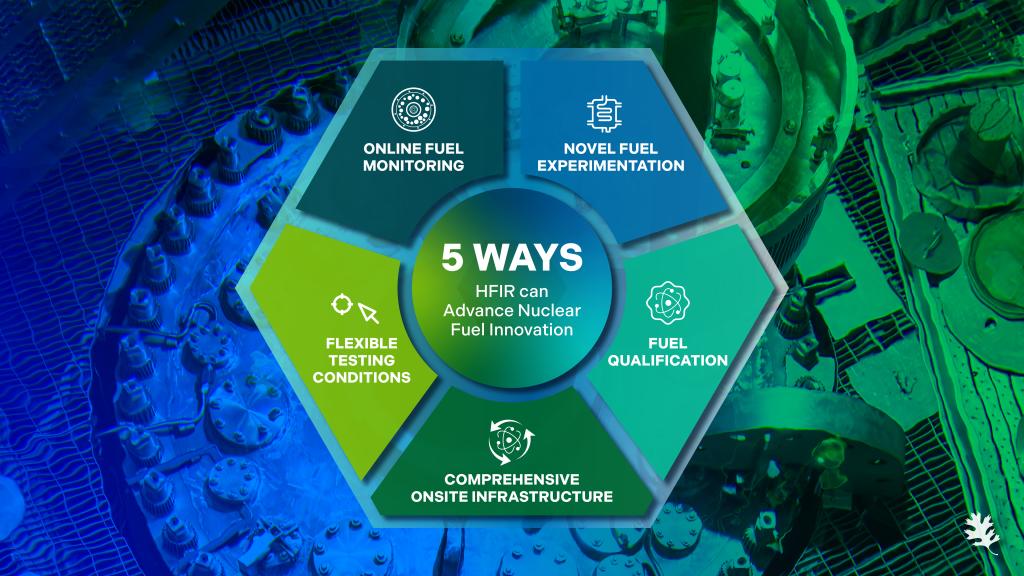
Oak Ridge National Laboratory says its High Flux Isotope Reactor could help speed up the development of new nuclear fuels. The powerful research reactor can test different fuel designs and produce data needed to improve fuel performance and support regulatory approval.
The U.S. is preparing for more nuclear power, but there are only a limited number of research reactors that can test new nuclear fuels. This shortage can slow down the process of developing and approving new fuel designs.
A new paper published in Nuclear Engineering and Design highlights the role of the High Flux Isotope Reactor (HFIR) at Oak Ridge National Laboratory. The reactor can provide the testing data needed to help move new fuels from early designs toward commercial use.
READ ALSO: https://modernmechanics24.com/post/mit-hybrid-aircraft-factory-ohio/
HFIR is operated by Oak Ridge National Laboratory (ORNL) for the U.S. Department of Energy. ORNL researchers have used the reactor for decades to study nuclear fuels and materials.
The latest research explains how HFIR can support fuel development and testing. The work was supported by the U.S. Department of Energy’s Office of Nuclear Energy Advanced Fuels Campaign.
New nuclear fuels must go through extensive testing before they can be used in commercial reactors. Scientists need to understand how fuels behave under high temperatures, intense radiation, and other demanding conditions.
There are fewer research reactors available for this work today. HFIR could help fill that gap by testing several types of fuel and producing detailed data about how they perform.
HFIR produces an extremely strong flow of neutrons, known as neutron flux. This allows researchers to expose fuel samples to conditions that simulate the harsh environment inside a nuclear reactor.
The reactor has three main areas for irradiation experiments. Researchers can use small sample capsules or larger experimental systems with sensors and temperature controls to study different fuel designs.
ORNL has used HFIR to study fuel concepts such as TRISO particles, accident-tolerant fuels, coated fuel particles, and metallic fuels. These tests can show how fuel changes during irradiation and how it interacts with its surrounding cladding.
HFIR also has advanced equipment for monitoring experiments. Its Materials Irradiation Facility can control temperatures and track factors such as pressure and gas composition while experiments are running.
HFIR cannot replace every step in the fuel development process. Testing at the reactor is only one part of the work needed before a fuel can be used commercially.
Researchers must still examine irradiated fuel, analyze the results, perform safety studies, and provide evidence for regulatory review. The number of experiments HFIR can support is also limited by available equipment, reactor space, and research schedules.
The main breakthrough is using HFIR as a high-throughput test platform for new nuclear fuels and materials. Its data can help researchers understand important factors such as gas release, changes inside fuel materials, and interactions between fuel and cladding.
WATCH ALSO: https://modernmechanics24.com/post/deep-humanoid-robot-stair-climbing/
That information can support technical reports used in the U.S. Nuclear Regulatory Commission’s fuel qualification process. As utilities seek longer reactor lifetimes and developers work on advanced reactors, faster fuel testing could help reduce one of the bottlenecks facing the nuclear industry.
HFIR is also part of a larger fuel research system at ORNL. Facilities for fuel development, irradiation testing, and post-irradiation analysis allow researchers to study fuel from early experiments through detailed examination after reactor testing.