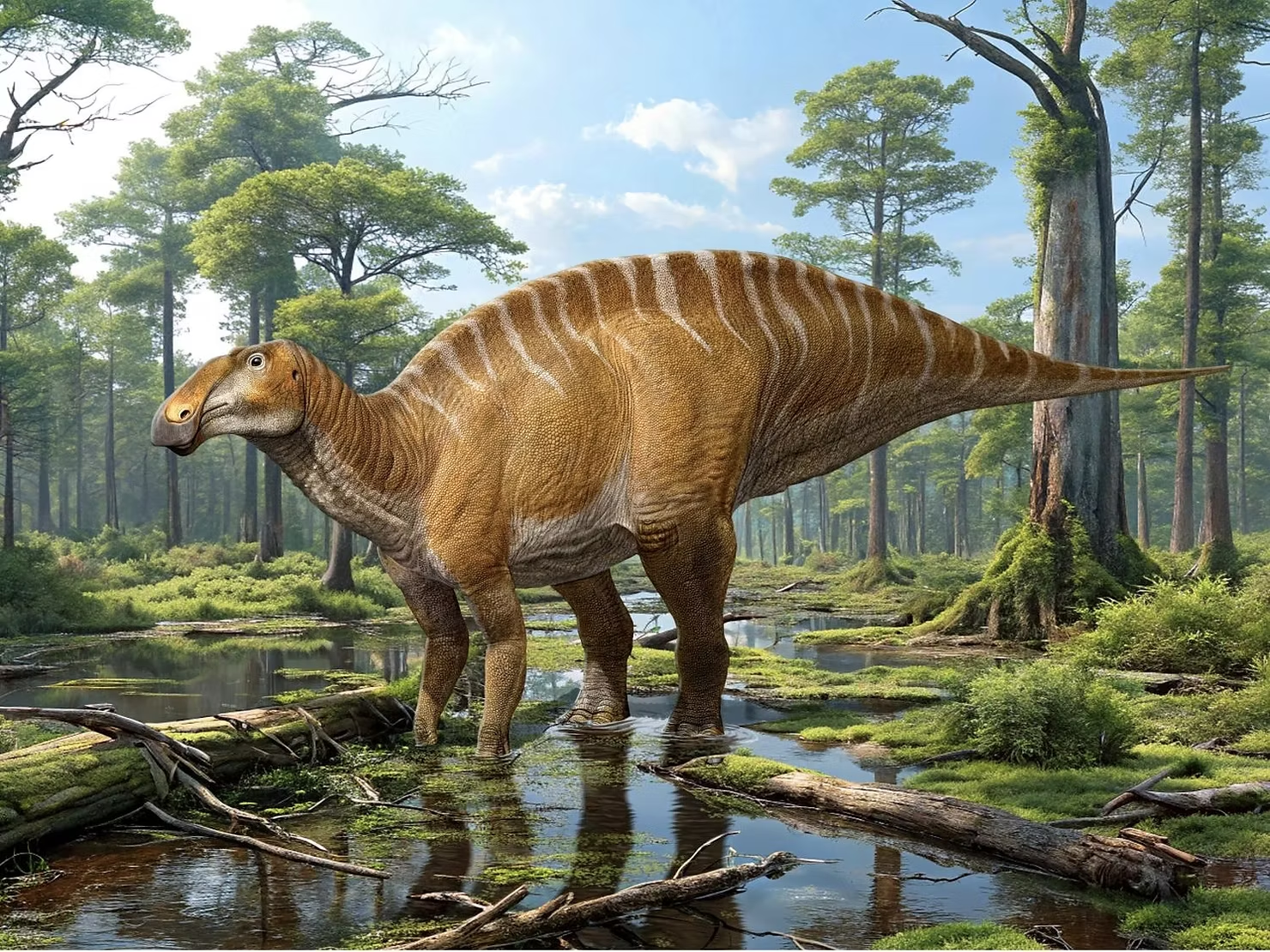
Credit: NMMNHS/Sergey Krasovskiy
A 75-million-year-old fossil, long misclassified as a known dinosaur, has been identified as a brand-new species of massive, duck-billed dinosaur by an international research team. The discovery, involving Penn State Lehigh Valley biologist D. Edward Malinzak, rewrites a chapter of North American paleontology and reveals new patterns of ancient dinosaur migration.
For nearly 90 years, a set of ancient bones sat in a museum collection, labeled as a member of the Kritosaurus genus. Now, a fresh analysis has overturned that classification, introducing the world to Ahshiselsaurus wimani, a newly identified species of hadrosaurid, or duck-billed dinosaur. The research team, which included Dr. D. Edward Malinzak, assistant teaching professor of biology at Penn State Lehigh Valley, worked with the New Mexico Museum of Natural History & Science to make the pivotal re-identification, as reported in their recent publication.
“We took a specimen that was lumped in as an individual of Kritosaurus and determined it had significantly distinct anatomical features to warrant being its own genus and species,” explained Malinzak. The findings were published in the Bulletin of the New Mexico Museum of Natural History and Science, culminating a meticulous process of anatomical comparison and phylogenetic analysis. The team closely examined the fossil’s incomplete skull, jaw bones, and neck vertebrae, comparing them against other known hadrosaurids.
As Anthony Fiorillo, co-author and executive director of the New Mexico Museum of Natural History and Science, noted, skull details are paramount. “When you have a skull and you’re noticing differences, that carries more weight than, say, you found a toe bone that looks different,” he said, according to the team’s report. These cranial distinctions were the key to separating Ahshiselsaurus wimani from its prehistoric cousins.
READ ALSO: https://www.modernmechanics24.com/post/china-discovers-rice-heat-resistance-genes
But this discovery is about more than just a name change. It provides crucial evidence for understanding dinosaur migration across continents. Malinzak described the find as supporting a history of taxonomic exchange between North and South America. The analysis suggests the ancestors of this new hadrosaur group originated in the southern part of the continent, migrated northward into areas like Canada, and even spread into South America, later returning north in a complex biogeographic dance.
“What we’re noticing is the Southwest is a ‘stock’ for some animals that migrate to the North,” Malinzak stated. This movement indicates the region, specifically the area in New Mexico where the fossil was originally found in 1916, was a vibrant hub of dinosaur diversity. The fact that Ahshiselsaurus wimani was found stratigraphically lower—meaning in older rock layers—than true Kritosaurus fossils suggests it represents an earlier lineage that thrived in a changing environment.
“The ecosystem was more diverse than initially considered,” Malinzak said. “It supports the idea that the environment you’re in drives your adaptation. If a new group is well-adapted to an environment it migrates to, it can ‘unseat’ existing species.” This dynamic picture of competition and migration helps scientists better model the ecosystems of the Late Cretaceous, ultimately informing theories about the dinosaurs’ extinction.
WATCH ALSO: https://www.modernmechanics24.com/post/china-humanoid-robot-combat-moves
Beyond reshaping prehistoric timelines, the discovery is shaping modern education. Malinzak integrated the research methods directly into his Penn State Lehigh Valley course, “BIOL 220W: Populations and Communities.” “I was able to show my students what information our team used, how we ran the calculations, and how we were able to determine dispersal and divergence events,” he said. This hands-on approach transforms theoretical concepts into tangible science for the next generation of researchers.
Aníbal Torres, chief academic officer at Penn State Lehigh Valley, praised the work, stating, “Dr. Malinzak brings exceptional passion and commitment to his field. That dedication consistently drives meaningful and high-quality scholarship.” The team’s work is far from over. Malinzak sees this discovery as just one lap in a longer race, prompting a re-examination of other specimens from the Southwest and opening new questions about the evolutionary pressures that shaped the age of dinosaurs.
READ ALSO: https://www.modernmechanics24.com/post/airbus-a320-fleet-action-alert