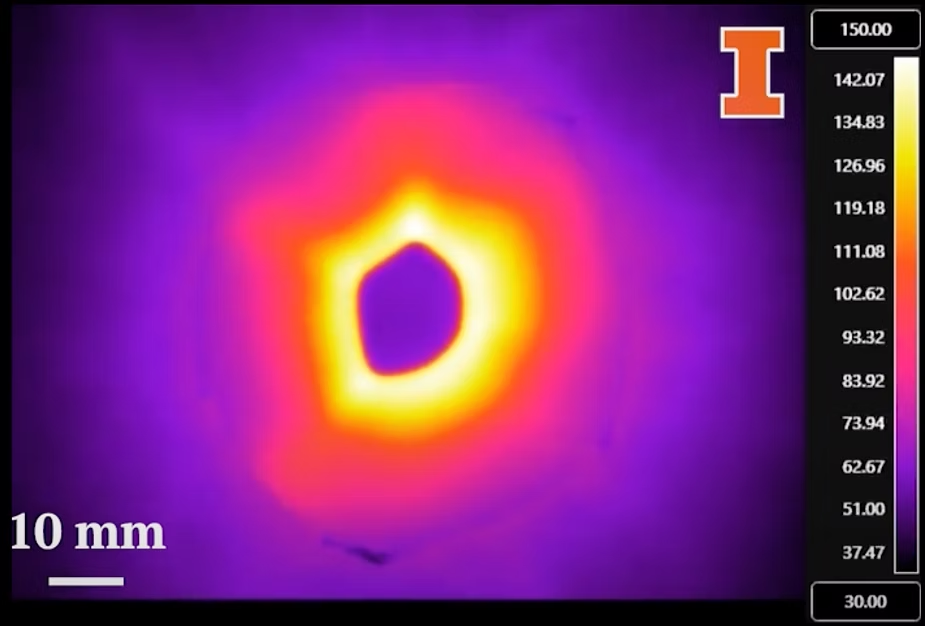
University of Illinois Urbana-Champaign researchers Ivan Wu and Jeff Baur from The Grainger College of Engineering developed an energy-efficient method to transform flat 2D structures into curved 3D shapes in space using continuous carbon fiber 3D printing and frontal polymerization.
The breakthrough combines Beckman Institute’s energy-efficient resin with aerospace-grade composite printing to create five configurations including a parabolic dish for deployable satellites, inspired by Japanese kirigami art.
Because it’s costly and cumbersome to transport large structures such as satellite dishes into space, aerospace Ph.D. student Ivan Wu and his advisor, Jeff Baur in The Grainger College of Engineering, University of Illinois Urbana-Champaign, developed a creative and efficient energy-saving method to morph 2D structures into curved 3D structures while in space.
Wu said what others have done using low energy resulted in shapes with very low stiffness which wouldn’t work for aerospace purposes.
“In this case, our collaborators in the Beckman Institute developed a recipe for a pure resin system that’s very energy efficient. And we have a 3D printer that can print commercial aerospace-grade composite structures. I think the breakthrough was combining those two things into one.”
“We used the continuous carbon fiber 3D printer to print bundles of fiber, with each fiber about the diameter of a human hair,” Wu said. “As the fiber bundles are drawn by the printer onto a bed, they are compressed and exposed to ultraviolet light, which partially cures them.”
READ ALSO: https://www.modernmechanics24.com/post/baguette-sized-missile-to-transform-modern-warfare
The energy efficient liquid resin is molded with the printed carbon fiber design then frozen. When the 3D structure is needed, the resin is activated with a low-energy heat stimulus that sets in motion a chemical reaction to cure it into a curved 3D shape.
This process, called frontal polymerization, eliminates the need for ovens or autoclaves large enough to cure a full-sized satellite dish. Much like a single match can set a sheet of paper or a house on fire, the thermal trigger is the same amount of energy for any size structure, making the process scalable for extra-large structures needed in space.
“For me, the first challenge was to solve the inverse problem,” Wu said. “You have a design for the 3D shape you want, but what is the 2D pattern to print that results in that shape? I had to write mathematical equations to describe the shapes to print the exact pattern. This study solved that problem.”
Wu sourced equations and wrote the code to program the printer to deposit the fiber bundles onto a bed to create five different 3D configurations: a spiral cylinder, a twist, cone, a saddle and a parabolic dish.
“Together, they show the diversity of shapes we can make. But I think the one that’s most interesting and applicable is the parabolic dish, which mimics the smooth, curved shape that’s needed for deployable satellites.”
WATCH ALSO: https://www.modernmechanics24.com/post/humanoid-robot-turns-drummer-plays-songs
Wu said he took inspiration from a Japanese art form called kirigami—similar to origami but includes cuts in addition to folds.
“I see research as very artistic. Sometimes, you get a creative idea and just pursue it. In this case, the parabolic shape begins in 2D with cuts like flower petals that all curve toward the same point. I had to figure out the angles where they overlap. A satellite dish made with just origami folds would need an infinite number of folds to make the smooth curvature required for satellite signals. In our case, rather than using folds, we achieve smooth curvature through controlled bending governed by the printed fiber bundles.”
Because the shape needs to morph, Wu’s fiber infrastructure needed a very low fiber volume fraction. “Space structures need to be very stiff, and the more fiber volume, the stiffer the structure. But they need a lot of energy to morph and could break with large bending. To get a high-morphing degree, we need a low fiber volume ratio so it will be flexible enough to morph into a curved shape.”
The study achieved both lower energy and higher stiffness compared to what’s been done before. But Wu said the stiffness is still not adequate for space structures.
“We suggest using the activated 3D shapes as molds to manufacture high stiffness structures in space. You could manufacture the flat gel material with carbon fiber bundles on Earth, transport it into space and activate the shape through a thermal stimulus.
READ ALSO: https://www.modernmechanics24.com/post/haven-demo-paves-way-for-orbital-habitat
But because it’s not rigid enough, you can further use the 3D shape as a mold, adding high-stiffness plies, activate frontal polymerization again and then peel off the high-stiffness composite that is formed to the shape of the initial design. We show in our work that this process can be repeated numerous times without damage to the mold or deviation from the initial morphed shape.”
The innovation addresses a fundamental challenge in space exploration: launch costs. Every kilogram transported to orbit represents significant expense, making compact, lightweight deployable structures highly valuable. Traditional satellite dishes and other large space structures must either be launched fully formed—requiring massive rocket fairings—or assembled in space through complex robotic or astronaut operations.
Wu’s approach offers a third option: launch flat structures that transform themselves on demand using minimal energy. The frontal polymerization process requires only a small thermal trigger regardless of structure size, making it particularly attractive for large-scale space applications where traditional curing methods become impractical.
The kirigami-inspired design philosophy proves crucial to the system’s functionality.
While origami uses only folds, kirigami incorporates strategic cuts that allow paper to transform into complex three-dimensional forms with smooth curves rather than angular facets. Applying this principle to aerospace composites required Wu to develop novel mathematical models predicting how cut patterns in flexible materials would behave when activated.
WATCH ALSO: https://www.modernmechanics24.com/post/china-astronauts-mice-space-research-mission
The Beckman Institute’s contribution—developing the energy-efficient resin system—solved another piece of the puzzle. Traditional aerospace resins require high-temperature curing in controlled environments. The new formulation undergoes a self-propagating reaction once triggered, eliminating the need for sustained external energy input throughout the curing process.
The dual-use potential extends the technology’s impact beyond space applications. Wu said these same materials and processes could be used to supply needed structures to remote environments on Earth as well. Disaster relief operations, remote construction projects, and military deployments could all benefit from structures that ship flat and deploy on-site with minimal equipment.
Looking forward, the research team envisions scaling the technology for increasingly ambitious space structures. Solar panel arrays, antenna farms, and even habitat components could potentially use similar morphing principles to maximize launch efficiency while providing full functionality once deployed.
READ ALSO: https://www.modernmechanics24.com/post/study-shows-bees-learn-morse-code