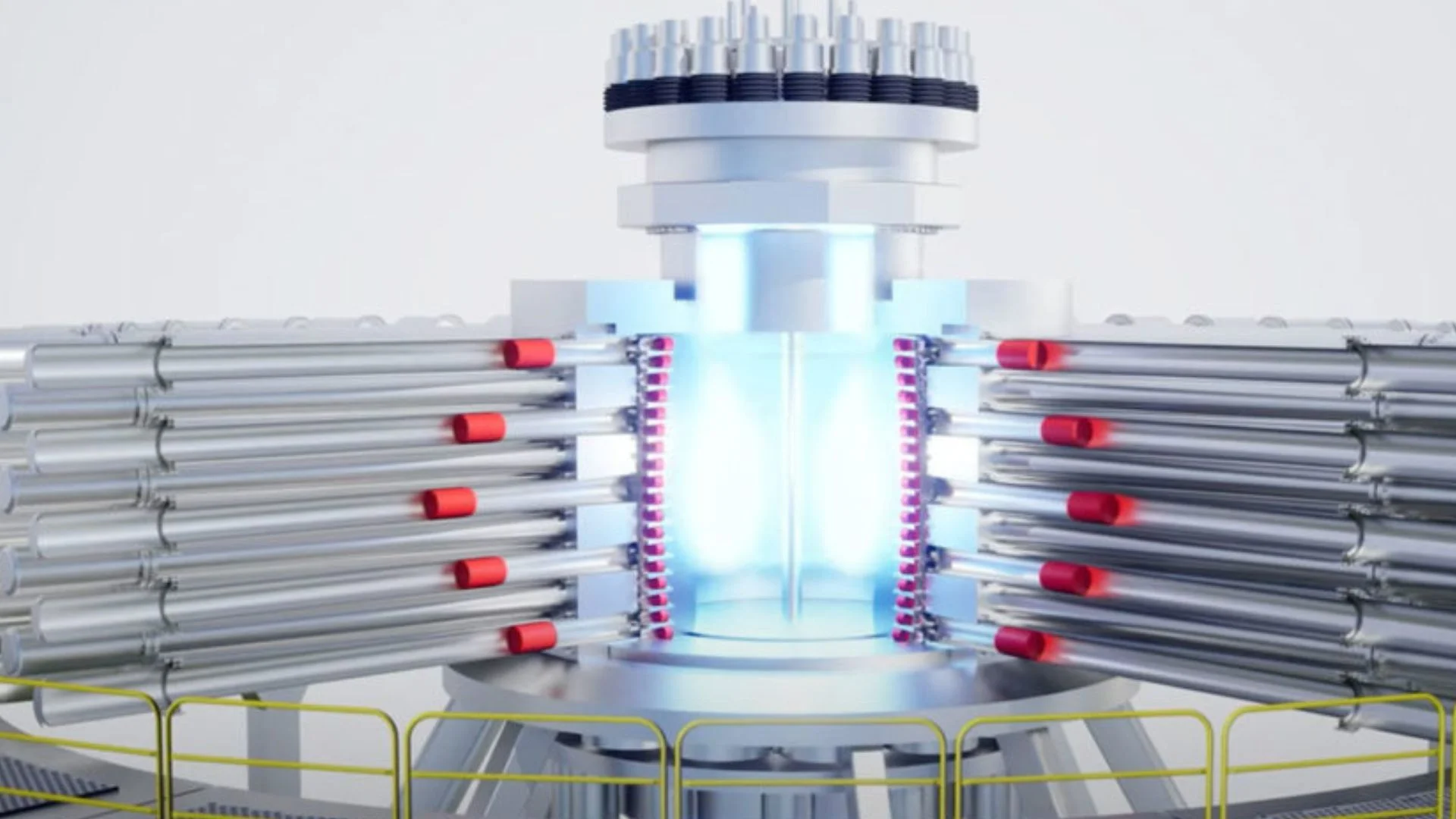
Canadian company General Fusion has reported an important milestone, heating plasma to about 8.4 million degrees Celsius using mechanical compression rather than lasers or giant superconducting magnets.
The result marks another step in the company’s plan to build a practical and commercially viable fusion power system.
General Fusion announced that its Lawson Machine 26 (LM26) successfully heated plasma to around 8.4 million degrees Celsius. That temperature is equal to approximately 0.72 kiloelectronvolts (keV), a standard unit used in plasma physics.
The company achieved this by mechanically compressing plasma rather than relying on expensive laser systems or massive magnetic confinement devices.
The achievement is important because the plasma temperature increased by more than three times during compression. General Fusion said this confirms that its Magnetized Target Fusion (MTF) technology works as designed. The company has now set its next technical goal at 1 keV, or roughly 10 million degrees Celsius.
The research has been submitted for independent peer review. General Fusion also released the findings publicly to allow scientists to examine the results. Independent verification remains an important step before the technology gains wider acceptance.
How Magnetized Target Fusion Works
Most well-known fusion projects use one of two methods. Some, including ITER, rely on giant superconducting magnets to hold plasma in place. Others, such as the US National Ignition Facility, use powerful laser beams to compress fuel and trigger fusion reactions.
READ ALSO: IBM Unveils World’s First Nanostack Sub-1nm Chip Technology With 100 Billion Transistors
General Fusion follows a different approach called Magnetized Target Fusion. The company first creates a magnetized plasma and then squeezes it using a moving lithium liner. Mechanical compression rapidly increases the plasma’s temperature and density until fusion conditions form.
The company believes this method can reduce costs compared with other fusion technologies. It avoids large superconducting magnet systems and high-powered laser facilities. Instead, it uses mechanical equipment and materials that already exist in many industrial applications.
LM26 is the first large-scale demonstration machine built using this concept. According to General Fusion, its diameter is about half that of a future commercial reactor. The company designed, built, and started operating the machine in less than two years.
Since beginning operations in 2025, LM26 has completed several plasma compression experiments. The latest test produced the strongest results so far. The machine is now working toward higher temperature targets and eventually the Lawson criterion, an important condition required for producing practical fusion power.
General Fusion Plasma Breakthrough
The technical report includes several measurements beyond the record temperature. During compression, plasma density increased by roughly ten times. The magnetic field surrounding the plasma also increased by about ten times.
Scientists measured these changes using diagnostic tools including Thomson scattering and Absolute Extreme Ultraviolet (AXUV) systems. These instruments help researchers accurately measure plasma temperature and behavior during extremely fast experiments. The results matched predictions from General Fusion’s computer models.
The company also reported that the plasma stayed stable through most of the compression process. Stability is important because turbulence or disruption can stop fusion reactions before useful temperatures are reached. Maintaining stable plasma has remained one of fusion research’s biggest engineering challenges.
Another positive result involved the lithium liner. Researchers found no significant lithium contamination in the plasma during the stable compression phase. Engineers have long recognized contamination as a potential issue in liner-based fusion systems.
General Fusion also observed an increase in neutron production during compression. Neutrons are one of the expected products of fusion reactions. Their presence indicates that fusion activity increased as the plasma became hotter and denser.
The company emphasized that these results do not represent net energy production. The system still consumes more energy than it produces. However, the latest experiment supports the basic physics behind the company’s design.
READ ALSO: Scientists Build a Flying Robot That Stays Airborne Using Wind Instead of Propellers
General Fusion Chief Executive Officer Greg Twinney said the latest results represent important progress toward the company’s technical milestones.
He added that the findings support the practical design of Magnetized Target Fusion. He also acknowledged support from the UK Atomic Energy Authority, Princeton Plasma Physics Laboratory, and General Atomics for diagnostic development.
Tony Donné, Chair of General Fusion’s Science and Technology Advisory Committee and former CEO of EUROfusion, also welcomed the results.
He said the measured increases in temperature, density, and magnetic field closely matched computer simulations. According to Donné, this agreement gives engineers confidence as they prepare future upgrades.
What Comes Next
The scientific milestone comes during an important period for the company’s business plans. General Fusion has agreed to merge with Spring Valley Acquisition Corp. III through a special purpose acquisition company(SPAC), transaction. If completed, the combined business is expected to trade on the Nasdaq stock exchange under the ticker symbols GFUZ and GFUZW.
Spring Valley shareholders are scheduled to vote on the proposed merger on July 6, 2026. The transaction is expected to close shortly afterward if shareholders approve the deal and other customary conditions are satisfied. The US Securities and Exchange Commission declared the registration statement effective on June 12, 2026.
The company remains privately owned until the merger is completed. Investors are encouraged to review official SEC filings before making any investment decisions. The planned listing has attracted attention because very few pure-play fusion companies are publicly traded.
Most leading fusion developers, including Commonwealth Fusion Systems, Helion Energy, TAE Technologies, and Zap Energy, remain private companies. That has limited direct investment opportunities in the growing fusion sector. General Fusion’s public listing would give investors one of the few direct ways to invest in commercial fusion development.
Several publicly traded companies also provide indirect exposure to fusion technology. American Superconductor supplies high-temperature superconducting wire used in many magnetic fusion projects. Although General Fusion does not use superconducting magnets, the company benefits from broader investment across the fusion industry.
WATCH ALSO: World’s first motorbike backflip between two moving trucks successfully completed
Industrial companies are also preparing for future fusion electricity. Steel producer Nucor has invested in Helion Energy and plans to purchase electricity from a future fusion power plant. Large energy companies such as Italy’s Eni have also invested in fusion developers as part of their long-term energy strategies.
Interest in advanced nuclear technologies extends beyond fusion. Companies including NuScale Power and Oklo continue developing small modular nuclear reactors that provide carbon-free electricity through nuclear fission rather than fusion. Together, these efforts reflect the growing demand for reliable, clean power as electricity consumption worldwide rises.
Demand for electricity continues to increase due to artificial intelligence, data centers, industrial growth, and transport electrification. Governments and businesses are seeking energy sources that provide reliable power with low carbon emissions. Fusion remains one of the long-term technologies expected to help meet that demand.
General Fusion’s immediate goals are clear. Independent scientists will review the latest experimental data, while engineers work toward reaching the 1 keV temperature milestone through planned upgrades.
Success on those objectives, together with completion of the planned Nasdaq listing, will determine the company’s next stage as it continues its effort to develop practical commercial fusion energy.