New research has raised fresh questions about one of the most important discoveries linked to Jupiter’s moon Europa.
Scientists who once reported signs of water vapor erupting from the icy moon now say the evidence is weaker than previously believed.
The findings are important because Europa remains one of the top places in the solar system where scientists are searching for conditions that could support life. Scientists have reexamined 14 years of Hubble Space Telescope observations and found that evidence for water vapor plumes on Europa is less convincing than earlier studies suggested.
The new review focused on ultraviolet data collected between 2012 and 2014. Researchers now believe some earlier signals may have been caused by image noise and measurement uncertainty.
Europa is one of the largest moons orbiting Jupiter. Scientists consider it one of the strongest candidates for hosting extraterrestrial life because it is believed to contain a massive saltwater ocean beneath a thick layer of ice. That hidden ocean may hold key ingredients linked to life, including water, energy, and organic compounds.
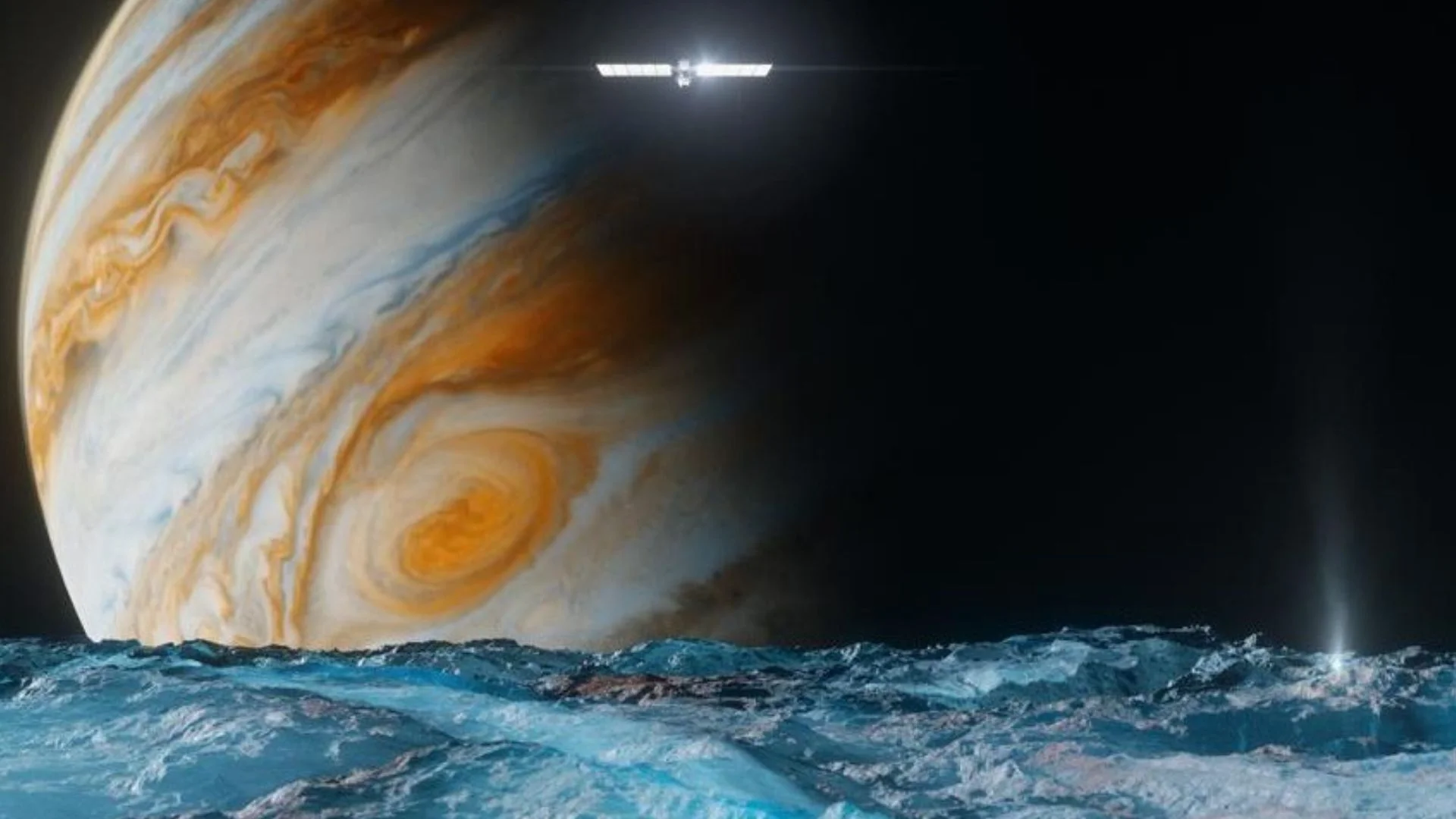
Earlier studies suggested that water from the underground ocean was escaping through cracks in Europa’s icy surface. Scientists believed the moon was ejecting giant plumes of water vapor into space, similar to geysers. These eruptions attracted major interest because spacecraft could potentially study ocean material without drilling through ice.
READ ALSO: SpaceX 407-Foot Starship V3 Launches From Starbase and Splashes Down in Indian Ocean
Hubble Data Reanalysis Changes Earlier Findings
The latest study was led by researchers from the Southwest Research Institute and the KTH Royal Institute of Technology. The team revisited observations made with Hubble’s Space Telescope Imaging Spectrograph (STIS). They specifically studied ultraviolet light signals called Lyman-alpha emissions, which are linked to hydrogen atoms.
Hydrogen signals can help scientists identify water vapor because water molecules break apart into hydrogen and oxygen in space. Detecting these faint signals around Europa is extremely difficult. Researchers said the telescope was operating close to its technical limits during the original observations.
Kurt Retherford from the Southwest Research Institute said small positioning errors affected the earlier interpretation of the data. Even a shift of one or two pixels in Europa’s image placement changed how scientists understood the signals. That uncertainty reduced confidence in the earlier plume claims.
The original research had estimated a 99.9% confidence level for the existence of the plumes. After the new analysis, confidence dropped to below 90%. Researchers said that the level is insufficient to support a firm scientific conclusion.
Despite the revised findings, scientists are not ruling out Europa’s water plumes completely. They say the moon could still produce eruptions that are difficult to detect consistently. Temporary or weaker plumes may explain why observations have remained uncertain for years.
READ ALSO: ISS Astronauts See 16 Sunrises Daily as Orbital Life Forces a Redesign of Human Routines
Why Europa Still Matters in Search for Life
Europa continues to be one of the most closely studied worlds in the solar system. Scientists believe its underground ocean contains more water than all of Earth’s oceans combined. The moon’s icy crust also protects the ocean from harsh space radiation.
Researchers often compare Europa with Enceladus, a moon of Saturn. Enceladus is known for powerful water vapor geysers that spray material far into space. Space missions have directly sampled those plumes and found organic molecules and other chemical ingredients connected to life.
Europa is also compared with Io, another moon orbiting Jupiter. Io is the most volcanically active body in the solar system and regularly ejects sulfur dioxide into space. These examples show that active eruptions are possible on icy and rocky moons around giant planets.
The debate over Europa’s plumes is important for future exploration missions. If water eruptions exist, spacecraft could collect samples from the moon’s hidden ocean without landing or drilling. That would make the search for signs of life much easier and safer for scientists.
NASA’s Europa Clipper mission is expected to provide clearer answers in the coming years. The spacecraft is scheduled to arrive in the Jupiter system around 2030 and will conduct detailed flybys of Europa. Its advanced instruments will study the moon’s ice shell, hidden ocean, and any signs of active water plumes.
WATCH ALSO: Lockheed Martin has converted Black Hawk choppers into pilotless cargo drone
The latest findings were published on May 5 in the journal Astronomy & Astrophysics.
Scientists say future missions and stronger observations will be necessary to settle the question of Europa’s mysterious water eruptions. The answer could shape the next phase of humanity’s search for life beyond Earth.