Researchers at Oak Ridge National Laboratory have developed a new automated system that improves the accuracy of large-scale 3D printing.
The technology uses sensors, thermal cameras, and computer vision to detect printing problems and correct them in real time. The project aims to help manufacturers reduce waste, lower production costs, and improve the quality of large composite parts.
AI and Sensors Improve 3D Printing Quality
Large-scale 3D printing is used to create big plastic composite structures for industries such as transportation and construction. These parts include aircraft wings, car bumpers, building walls, and industrial molds. The process works by pushing heated plastic material through a robotic nozzle layer by layer.
Keeping the right temperature during printing is one of the biggest challenges in additive manufacturing. If the material cools too quickly, the layers do not bond properly. If it stays too hot, the structure can lose its shape during printing.
READ ALSO: Jupiter’s Europa Water Plumes Questioned After 14-Year Hubble Observation Reanalysis
To solve this problem, ORNL researchers designed an automated controller that continuously monitors the printing process.
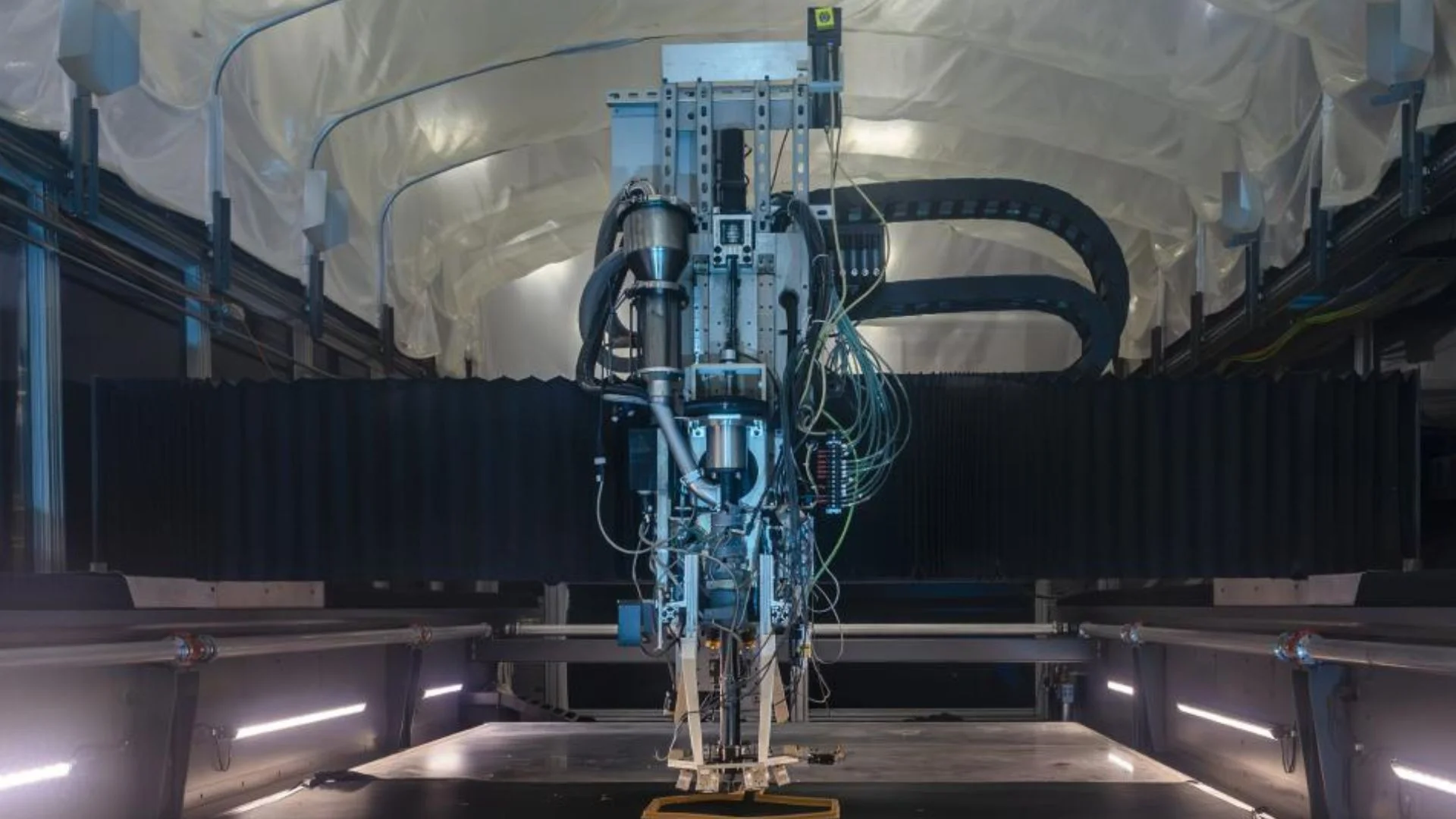
The system tracks nozzle position, print speed, and material temperature during printing. It also uses six low-cost thermal cameras mounted around the nozzle to monitor how the material cools after placement.
The controller uses computer vision technology to study live thermal images in real time. Computer vision is a form of artificial intelligence that allows machines to analyze and understand visual information. In this case, it helps the system detect hot areas and temperature changes during printing.
When the controller notices that the printed layer is cooler or hotter than the target temperature, it automatically changes the print speed. This adjustment helps each layer cool correctly before the next layer is added. The process improves bonding between layers and reduces the chance of failed prints.
Kris Villez, the project’s lead researcher at ORNL, said the system behaves much like a human operator. He explained that the controller observes the process and continuously adjusts settings until the desired result is reached. The automated system removes the need for constant manual supervision.
Real-Time Error Correction During Full-Scale Testing
Researchers tested the system using a large industrial printer inside ORNL facilities. The machine printed a hexagon structure larger than a truck tire to demonstrate the controller’s capabilities. Engineers intentionally started the print at a slower speed to create a temperature problem during the process.
WATCH ALSO: Tesla’s Optimus humanoid robot steals spotlight at ‘Tron: Ares’ premiere
Because of the slower speed, the plastic layers became about 30% cooler than the target temperature before the next layer was added. The controller immediately detected the issue using the thermal cameras and computer vision system. It then increased the printing speed automatically to restore the correct temperature balance.
Chris O’Brien, a graduate student from the University of Tennessee who worked on the project, said the system can detect temperature differences of only a few degrees. Small temperature changes often lead to weak bonds between layers and damaged parts. Detecting these changes early helps prevent costly production failures.
Unlike some monitoring systems, the ORNL controller does not need retraining every time manufacturers create a new design. This saves computing resources and reduces setup time for companies using the technology. Researchers also said the system works with a wide range of plastic materials and printer designs.
The project also includes a digital twin model of the printing process. A digital twin is a virtual copy of a real manufacturing system. Researchers use it to test new materials, shapes, and print settings without risking damage to physical equipment.
ORNL Expands Advanced Manufacturing Research
The latest controller builds on earlier ORNL research into automated quality control for additive manufacturing. Previous studies with Purdue University and the University of Maine focused on identifying printing problems using thermal imaging and statistical analysis. More recent work with the University of Tennessee showed the system could reliably detect print speed changes as small as 15%.
The new controller goes beyond fault detection by correcting problems while printing continues. This reduces wasted material and shortens production delays. It also lowers the amount of manual monitoring required during large manufacturing jobs.
READ ALSO: Robotics Push: Hyundai Plans 25,000 Atlas Robots Across US Factories by 2028
Researchers believe automation will help manufacturers scale up large-area 3D printing for industrial production. Industries are increasingly using additive manufacturing to build large custom parts faster and at lower cost. Improved reliability could support wider use in sectors such as aerospace, shipping, automotive production, and construction.
Villez compared the technology’s future goal to baking bread in an oven. He explained that users should eventually be able to set the process, leave the machine running, and return when the job is complete without constant supervision. That level of automation would allow skilled workers to focus on improving product design and manufacturing efficiency.
The project received funding from the US Department of Energy’s Advanced Materials and Manufacturing Technologies Office. Additional ORNL researchers involved in the work included Katie Copenhaver and Alex Roschli. UT-Battelle manages ORNL for the US Department of Energy’s Office of Science.
The new system highlights growing efforts to make large-scale 3D printing smarter, faster, and more dependable for industrial use.