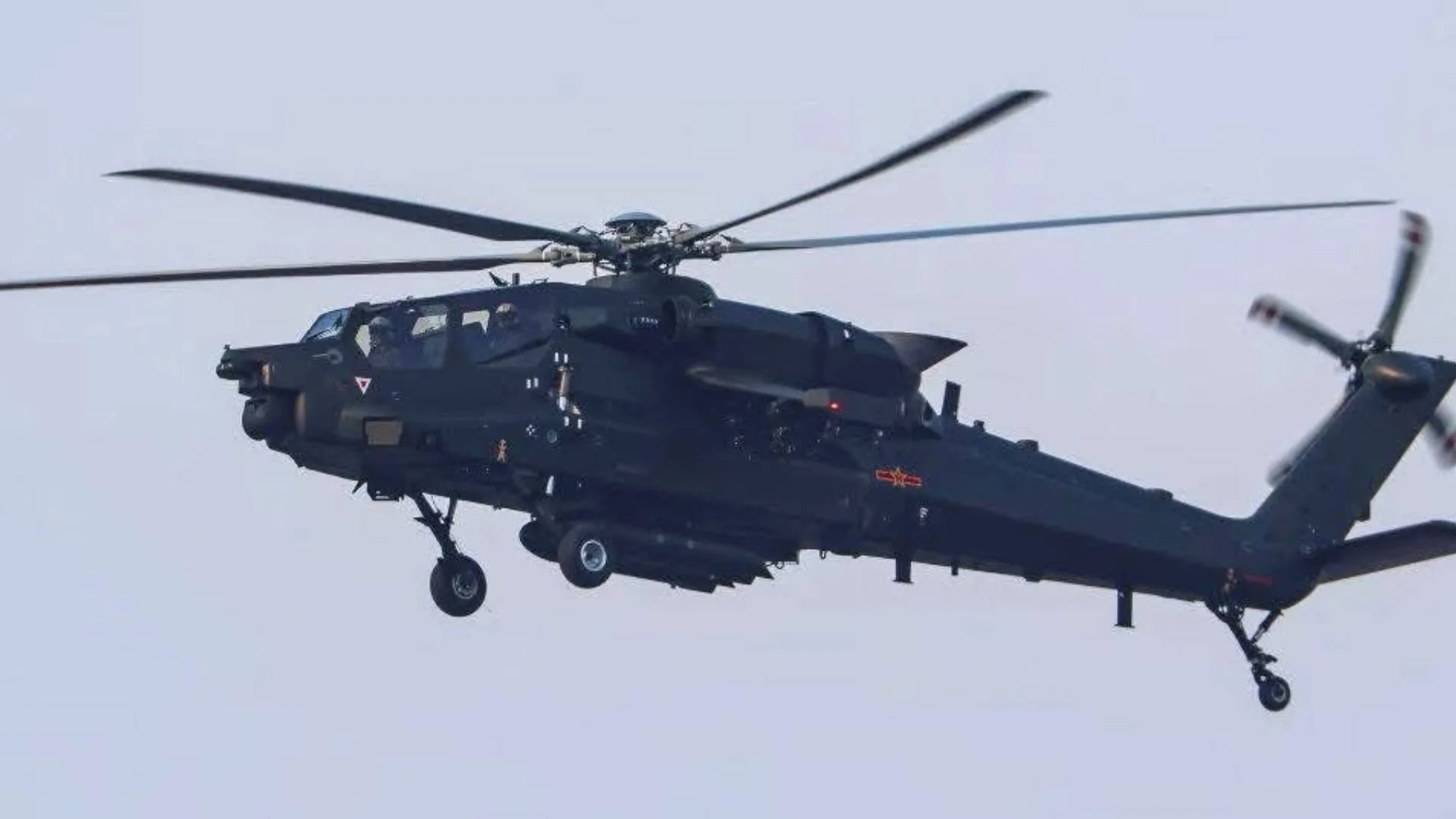
Fresh footage of China’s Z-21 attack helicopter has provided the clearest look yet at one of the country’s most important military aviation projects.
The aircraft appears larger, more heavily armed, and better protected than China’s current Z-10 attack helicopter. The new images have sparked interest among defense analysts because they suggest that China is developing a new generation of attack helicopters for modern battlefield operations.
New video footage circulating online since June 6, 2026, has provided the clearest public view yet of China’s Z-21. The aircraft remains officially undisclosed by Beijing. However, the footage offers enough visual detail to support a deeper assessment of its design and intended role.
The Z-21 appears to represent a major step beyond the PLA’s existing Z-10 attack helicopter. The aircraft appears larger, heavier, and better able to carry a wider range of weapons. Its overall design suggests a focus on survivability, firepower, and operations in heavily contested combat environments.
The footage’s appearance is important because previous sightings only showed the helicopter from a distance. The latest video offers close-up views of the fuselage, cockpit, sensors, wings, and engine installation. These details help analysts better understand the aircraft’s potential capabilities.
Although official specifications remain unavailable, the Z-21 appears designed for several battlefield missions. These include armed reconnaissance, close air support, long-range strike operations, and escort duties for air assault forces. The aircraft also appears intended to operate in areas protected by modern air-defense systems.
READ ALSO: NASA Successfully Acquires GPS Signals on Moon
Design Points to Heavier Attack Helicopter
One of the most noticeable features is the helicopter’s larger airframe. Compared with the Z-10, the Z-21 has a broader fuselage and larger engine housings. The stub wings also appear bigger and capable of carrying more weapons.
The aircraft features a tandem-cockpit layout similar to that of many modern attack helicopters. The cockpit glazing uses angular surfaces that may help reduce visibility and improve crew protection. The narrow front profile also helps reduce exposure during low-altitude combat missions.
Some early reports suggested the helicopter carries a mast-mounted radar similar to the Longbow radar used on the AH-64 Apache. However, the circular structure above the rotor hub does not clearly confirm that assessment. Based on available imagery, it appears more consistent with a protective fairing covering rotor components.
This distinction is important because it suggests China may be following a different path for target acquisition. Instead of relying on a large radar above the rotor, the helicopter may depend on advanced optical sensors and battlefield networks. Unmanned aircraft and external surveillance assets could also provide targeting information.
READ ALSO: General Atomics Sets Global Strategy for Swift Development of Uncrewed Combat Jets
The nose of the helicopter carries a large electro-optical sensor turret. Such systems typically combine thermal imaging, daytime cameras, laser rangefinders, and laser target designators. These sensors allow crews to identify and engage targets at long distances and in poor visibility conditions.
Several small apertures are also visible around the aircraft. These may form part of a defensive system designed to detect incoming threats. Possible functions include missile-warning sensors, radar-warning receivers, laser-warning systems, and electronic countermeasure equipment.
Unusual Ventral Structure
One of the most discussed features is a large rectangular structure mounted beneath the forward fuselage. This component is unlike anything seen on existing Chinese attack helicopters. Its purpose remains unknown.
The structure appears fully integrated into the aircraft rather than added temporarily for testing. That suggests it plays an important role within the helicopter’s mission system architecture. However, its exact function cannot be confirmed solely from imagery.
Analysts have proposed several possibilities. It could house a surveillance sensor, terrain-following radar, electronic warfare equipment, communications systems, or signals intelligence hardware. Another possibility is that it contains additional fuel to extend operational range.
If the feature remains part of the final design, it would indicate a broader mission set for the aircraft. The helicopter would then serve not only as a strike platform but also as a battlefield support asset. Such capabilities would increase its value in complex military operations.
READ ALSO: China’s 3D-Printed Mini Jet Engine Succeeds in Historic Flight
The wing arrangement also attracts attention. Each wing appears to contain three weapon stations. This gives the helicopter a total of six external hardpoints.
That configuration offers greater flexibility than many existing attack helicopters. It allows the aircraft to carry different combinations of missiles, guided rockets, fuel tanks, reconnaissance equipment, and electronic warfare pods. Some stations could also support short-range air-to-air missiles for self-defense.
The visible weapons in the footage cannot be identified with certainty. However, they appear to be guided munitions designed for precision strikes. Such weapons allow helicopters to engage targets while remaining farther from enemy defenses.
Z-21 Comparison With Apache
The engine and exhaust arrangement suggests a strong emphasis on survivability. Exhaust outlets appear partially concealed within the upper fuselage. This design helps reduce the aircraft’s infrared signature and makes it harder for heat-seeking missiles to lock onto the helicopter.
Modern conflicts have highlighted the importance of such protection measures. The war in Ukraine demonstrated the growing threat posed by portable air-defense missiles, drones, and radar-guided systems. Attack helicopters now require advanced protection systems in addition to firepower.
Within China’s military aviation structure, the Z-21 appears positioned above the Z-10. The Z-10 remains the PLA’s primary attack helicopter and performs anti-armor and escort missions. However, it falls into the medium-weight category and offers limited room for future growth.
The Z-21 appears designed to create a heavier attack helicopter tier. A larger aircraft can carry more fuel, more weapons, and additional mission equipment. It can also support operations over longer distances and in more demanding environments.
WATCH ALSO: Humanoid robot folds towel autonomously after observing human
The helicopter is expected to work alongside the Z-20T assault helicopter. The Z-20T focuses on troop transport, air assault operations, and rapid insertion missions. In contrast, the Z-21 appears dedicated to escort, reconnaissance, and battlefield strike operations.
Together, the two aircraft would create a more complete rotary-wing combat force. Transport helicopters could move troops into contested areas while attack helicopters provide protection and suppress enemy positions. This combination is common in modern air assault doctrine.
The aircraft also has potential significance beyond coastal operations. China’s Western Theater Command operates in mountainous regions where altitude affects aircraft performance. A heavier and more powerful attack helicopter would offer advantages in these challenging conditions.
Comparisons with the US AH-64E Apache are inevitable. Both aircraft occupy the heavy attack helicopter category and appear intended for similar mission types. However, important differences remain.
The Apache is a combat-proven platform with decades of operational experience. It has undergone continuous upgrades and is deeply integrated into US military networks. Recent improvements even allow Apache crews to deploy drones that extend surveillance, communication, and strike capabilities.
The Z-21 has not yet demonstrated comparable operational maturity. No official performance figures, combat history, or production details have been released. As a result, direct comparisons remain premature.
The aircraft may also reflect China’s broader approach to military development. Open-source reports have linked the program to organizations involved with the Z-20 helicopter family. Reusing existing components and manufacturing experience could reduce costs and accelerate production.
WATCH ALSO: China’s new massive battle tank takes part in live-fire test
Many important questions remain unanswered. Information about engines, armor protection, range, endurance, weapon systems, and radar equipment has not been disclosed. It is also unclear whether the aircraft shown is a prototype, a pre-production model, or a near-final version.
Despite those uncertainties, the latest footage offers valuable insight into China’s future military aviation plans. The design points toward greater emphasis on survivability, battlefield networking, and multi-role combat operations. It also suggests the PLA is building a more layered helicopter force that combines attack, transport, reconnaissance, and electronic warfare capabilities.
As development continues, the Z-21 is expected to remain one of the most closely watched military aviation programs in Asia. Future testing and official disclosures will determine how the helicopter performs in practice.
For now, the aircraft stands as a clear sign of China’s effort to expand its heavy attack helicopter capabilities for future high-intensity operations. The Z-21 remains an aircraft with many unanswered questions, but the latest footage offers a valuable glimpse into China’s evolving military aviation strategy.