Researchers from Australia and Thailand are developing 3D-printed bioplastic pods to improve seagrass restoration in Thailand.
The project focuses on increasing the survival of young seagrass plants that often fail to establish in coastal waters. Researchers believe the new approach can strengthen marine ecosystems while supporting local fishing communities.
Protecting Young Seagrass
The work is a joint effort between Murdoch University in Australia and Walailak University (WU) in Thailand. The project targets seagrass meadows around Koh Lidi, located within Mu Ko Phetra National Park in Satun Province. These underwater grasslands provide an important habitat for shrimp, crabs and many fish species.
Healthy seagrass meadows also support the livelihoods of nearby coastal communities that depend on fishing. The plants act as natural nurseries where young marine animals can grow before moving into open waters. Losing these habitats affects both marine biodiversity and local economies.
Seagrass is also the main food source for Thailand’s dugongs, whose population has declined in recent years. Many dugongs have been found dead along Thailand’s Andaman Coast after large areas of seagrass disappeared. Environmental pressures have damaged these underwater ecosystems, making restoration important.
Traditional seagrass restoration often faces major challenges during the earliest stages of plant growth. Young shoots are regularly washed away by waves, buried under shifting sediment or eaten by marine animals before their roots develop. As a result, many restoration projects struggle to achieve long-term success.
Bioplastic Pod Design
To solve this problem, researchers designed protective pods using 3D printing technology. Walailak University PhD candidates Patsakorn Jeenchuay and Leoniel Jude Giray are leading the research under the supervision of Professors Mullica Jaroensutasinee and Krisanadej Jaroensutasinee. Scientists from Murdoch University’s Bioplastics Innovation Hub are also supporting the project.
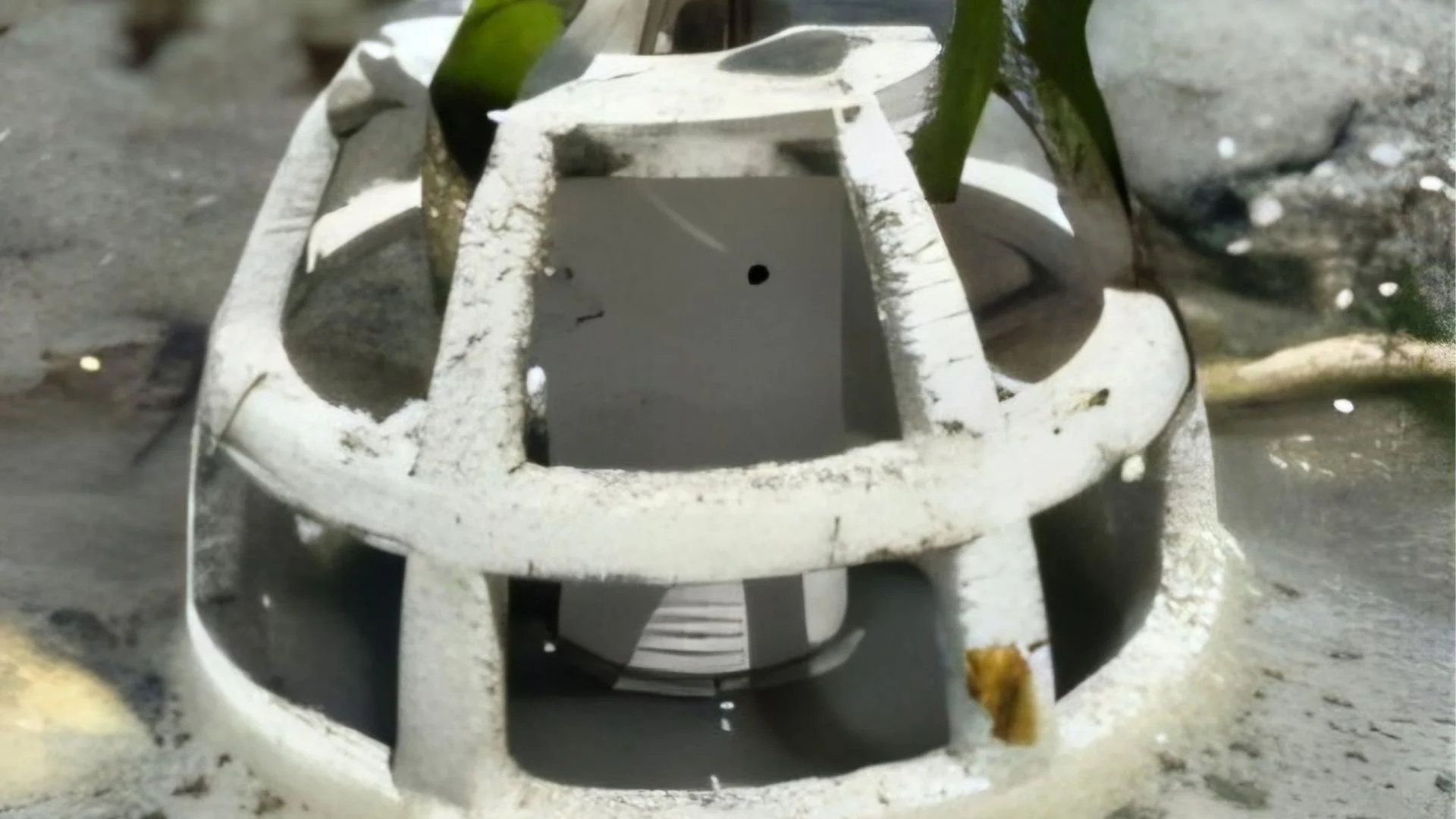
The pod features a dome attached to an anchor that is placed into the seabed. A young seagrass shoot sits safely inside while the structure shields it from waves and grazing animals. Open slots around the dome allow the roots to grow naturally into the surrounding seabed.
Researchers selected this design because it balances protection with healthy plant growth. The dome prevents damage during the critical early weeks while still allowing water and nutrients to reach the plant. Once the roots become established, the seagrass can continue growing without assistance.
Professor Andrew Macrae from Murdoch University said young plants need protection until they form stable root systems.
He explained that waves, moving sediment and marine animals are among the biggest reasons restoration efforts fail. He said the biodegradable pods are designed specifically to reduce those risks during the most vulnerable stage.
READ ALSO: Gallium Nitride Powers China’s Geosynchronous Radar Satellite for Nonstop Earth Monitoring
Natural Material Choice
The protective pods are made from a biodegradable bioplastic called polyhydroxyalkanoate(PHA). This material naturally breaks down after the seagrass becomes established, leaving no long-term plastic waste behind. The approach combines environmental protection with practical restoration methods.
Researchers produce the PHA through bacterial fermentation using locally sourced microbial strains in Western Australia. Scientists adjust the material’s properties so it remains strong enough to survive marine conditions before gradually decomposing. This removes the need to recover the pods after the plants mature.
The required PHA can be manufactured at Murdoch University’s Bioplastics Innovation Hub. It can also be produced at the Joint Laboratory of Waste and the Circular Economy at Naresuan University in Thailand. Local production may support future large-scale restoration programmes across the region.
Dr. Alexandra Gulizia said researchers carefully tailor the material to balance durability and biodegradability. She explained that the pods must remain intact long enough to protect young plants before safely breaking down. This design reduces environmental impact while supporting restoration goals.
Preparing Field Testing
Murdoch University researchers visited Koh Lidi this month to inspect the restoration site alongside the Thai research team. Professor Andrew Macrae, Dr. Alexandra Gulizia and Dr. Samantha Vijjoen met local researchers during the visit. The team assessed conditions before moving to the next phase of the project.
The pods are currently at the prototype stage and remain under evaluation. Researchers are carrying out safety assessments and packaging tests before beginning field trials. These tests will confirm whether the pods perform as expected in real coastal environments.
READ ALSO: UK Unveils £20M Hypersonic Target Program to Strengthen Future Missile Defence Testing
Professor Jennifer Verduin, a leading seagrass specialist at Murdoch University, will guide the research throughout the project. She said the technology offers an environmentally friendly way to improve seagrass restoration if testing proves successful. Her expertise will help evaluate results and refine future designs.
The project highlights how advanced manufacturing and biodegradable materials can support marine conservation. If field trials achieve positive results, similar systems may be used across Southeast Asia and other coastal regions facing seagrass loss. The research also demonstrates how international partnerships are developing practical solutions for protecting vital marine ecosystems in the years ahead.