

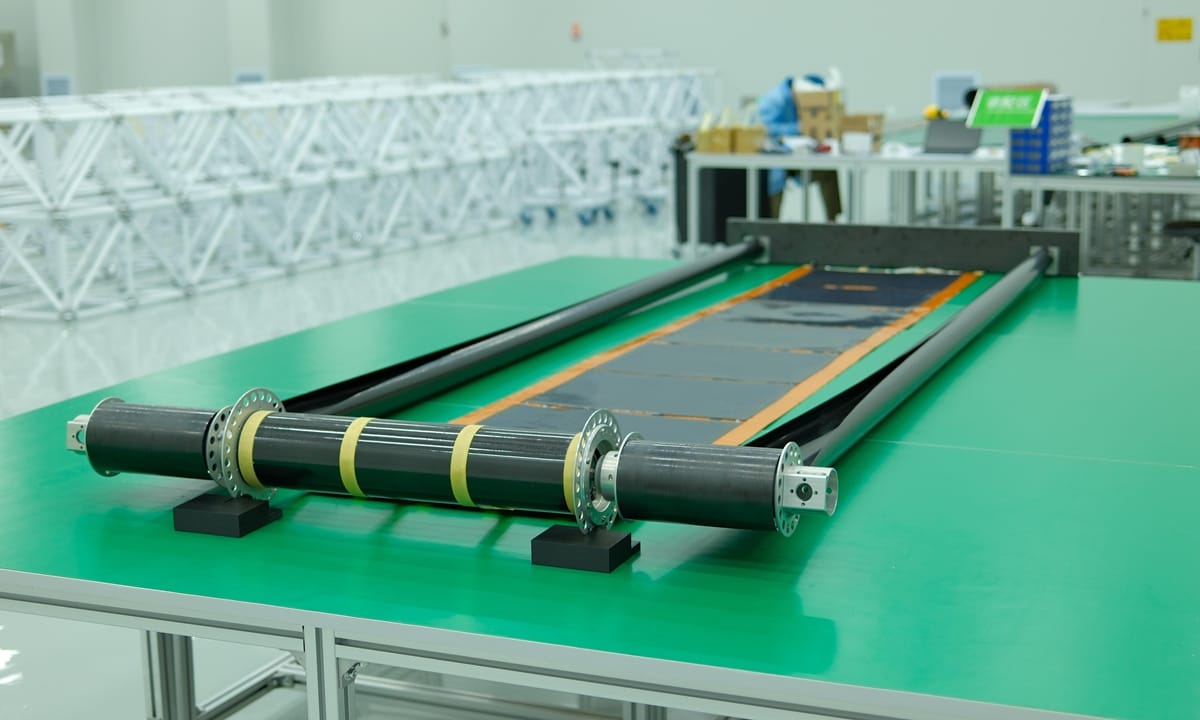
China is preparing to test a new type of rollable solar wing in orbit, marking a step toward lighter and more compact power systems for satellites.
Developed by Beijing-based photovoltaic technology company Yanhe Tech, the prototype uses perovskite solar cells and a flexible structure that can be rolled into a compact reel during launch. The company says the system is now moving from laboratory and ground testing toward engineering applications in space.
The prototype, named Xingyun, is designed to address one of the practical challenges facing the growing small-satellite industry: how to generate enough electricity without taking up too much launch space.
Unlike conventional solar wings that fold into several sections, Xingyun rolls into a compact form and is mounted along the side of a spacecraft. Once the satellite reaches orbit, the wing is designed to deploy outward in a controlled motion.
READ ALSO: https://modernmechanics24.com/post/defendeye-funding-scale-ai-drone/
Rollable Design Saves Space
During launch, the Xingyun solar wing can be rolled into a reel roughly the diameter of a thermos flask. This allows it to occupy less space on a satellite and can make it easier to arrange multiple spacecraft inside a launch vehicle. The company says the design has a storage ratio of 35:1, meaning the deployed structure can be stored in a much smaller volume.
The solar wing is made with a super-elastic memory composite material that allows it to remain rolled during launch and return to its working shape after deployment. A passive drive mechanism controls the deployment once the spacecraft reaches orbit.
According to Yanhe Tech, the mechanism is designed to provide smooth extension and precise control without requiring the complex sequence of movements used by many traditional folding solar arrays.
The company estimates that Xingyun is 25% to 30% lighter than conventional foldable solar wings. Lower structural weight can free additional capacity for instruments, communications equipment or other payloads. The compact design is also intended to make satellite stacking and multi-spacecraft launches more efficient.
Perovskite Cells Face Challenges
The project combines the rollable structure with perovskite photovoltaic technology, a solar-cell technology that has attracted attention for its potential to provide high power while using relatively lightweight materials.
In simple terms, photovoltaic cells convert sunlight into electricity, allowing satellites to generate the power required for communications, computing, sensors and other onboard systems.
Yanhe Tech says a single Xingyun wing can supply power for micro-nano satellites and CubeSats. Multiple wings can also be arranged together when a spacecraft requires greater electrical output. The company identifies low-Earth-orbit communications and remote-sensing constellations, space computing nodes and deep-space missions as potential applications.
However, the technology remains at an early stage. Feng Fan, founder and CEO of Yanhe Tech, said perovskite solar wings still face major challenges related to operating life and resistance to the harsh conditions of space.
The company currently expects the perovskite cells intended for space use to have a service life of about six months, meaning further testing and development will be necessary before large-scale deployment.
Space Industry Drives Demand
The development comes as China expands its commercial space sector and deploys growing numbers of small satellites, CubeSats and low-Earth-orbit constellations. These missions place greater emphasis on reducing spacecraft size, weight and launch costs while maintaining sufficient power generation. Traditional solar wings remain widely used, but their folded structures can require more storage space and mechanical components.
Xingyun is intended to address some of those limitations by changing how solar arrays are stored and deployed. Instead of folding multiple rigid sections, the wing can remain rolled until it reaches orbit and then extend primarily in one direction. This simpler deployment concept is designed to improve space efficiency while reducing structural weight.
WATCH ALSO: https://modernmechanics24.com/post/buildroid-ai-expands-robotics-platform/
Yanhe Tech is also using artificial intelligence in its development work. Feng said the company is applying high-throughput AI methods to study material formulations for perovskite cells and accelerate improvements in performance. The approach is aimed at helping engineers test and refine materials more efficiently as the technology moves toward space qualification.
Xingyun Heads Into Orbit
The next major step for Xingyun is an in-orbit test, which will provide data that cannot be fully obtained through laboratory or ground-based experiments.
Space testing will help assess how the solar cells and flexible structure perform under actual orbital conditions, including radiation, temperature changes and prolonged exposure to the space environment. The results will be important in determining whether the technology can move toward wider commercial use.
Yanhe Tech has also announced a longer-term 2030 space power station plan. The proposal envisions a phased space-based energy network extending across low-Earth orbit, medium-to-high Earth orbits and lunar space.
Feng said China’s extensive photovoltaic manufacturing base provides a foundation for developing space-based solar power technologies.
However, Xingyun remains an experimental system, and its upcoming orbital tests will determine how effectively its lightweight design and perovskite cells perform outside the laboratory.









One Response