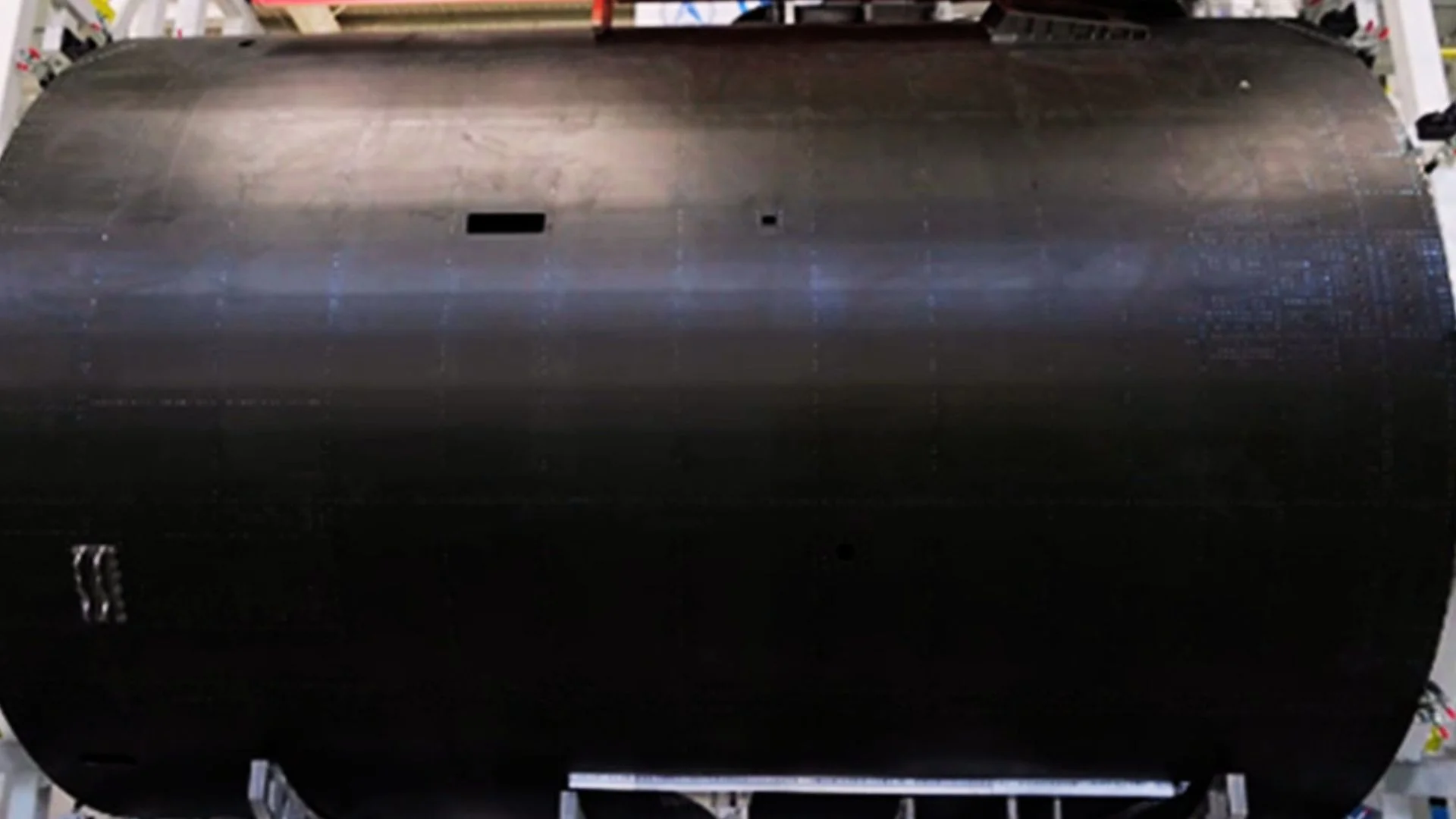
China has unveiled a key component of its reusable space program, marking a major step toward cost-effective, frequent space missions.
The country has developed its first 5-meter-diameter composite material rocket cabin, now the largest of its kind in China’s aerospace sector.
The module, also known as a power cabin, was developed by the China Academy of Launch Vehicle Technology (CALT) in Beijing. The academy confirmed that the structure has officially rolled off the production line and will be used in an important national space project.
According to CALT, this is the largest integrated composite cabin section ever built in China for a reusable launch vehicle. The development reflects the country’s growing focus on advanced materials and modern manufacturing techniques for space exploration.
READ ALSO: MirrorBot Reveals What Happens When Strangers Finally Look Up
The newly developed cabin uses more than 60 percent composite materials. This makes it lighter than traditional metal structures while maintaining strong durability. Engineers designed the module to handle extreme stress during rocket launches and operations.
The academy said the lightweight wall panels can withstand axial compressive loads of several thousand tons. At the same time, the module features self-adaptive adjustment interfaces. These allow the structure to adjust during operations, improving performance and flexibility.
CALT highlighted the complexity of building such a large composite structure. Engineers followed a highly coordinated, parallel approach throughout both design and manufacturing. This helped them manage multiple processes simultaneously without compromising quality.
WATCH ALSO: Hyundai’s Atlas humanoid robot wins top honor for its advanced design and capabilities
The team overcame several technical challenges. These included ensuring high precision in large-scale structures and maintaining consistent quality throughout the process. They also managed complex technical coordination under a highly collaborative production model.
Despite these challenges, the entire process from conceptual design to final production and delivery was completed in just seven months. CALT described this timeline as a reflection of efficient planning and advanced manufacturing capabilities.
The use of composite materials is becoming more common in the global space industry. According to the European Space Agency, materials such as carbon fiber reinforced polymers are widely used in spacecraft structures. These materials combine a polymer base with layers of carbon or glass fibers, creating a structure that is both strong and lightweight.
The agency noted that such materials are also corrosion-resistant and can reduce waste generated during space missions. They are considered especially suitable for reusable launch systems, where durability and repeated use are critical.
China is currently accelerating efforts to develop reusable launch vehicles, aiming to reduce costs and increase launch frequency. A key focus is on the first stage of rockets, which must endure multiple launches and re-entry cycles.
READ ALSO: US $200M MQ-4C Triton With 50,000 ft Eye Vanishes Mid-Air Over Strait of Hormuz
Song Zhongping said that reusable rocket systems require materials that can handle extreme conditions. “The first stage must survive repeated flights and re-entry. This demands materials with high temperature resistance, corrosion resistance, and fatigue strength,” he explained.
He added that composite materials are among the most effective solutions for meeting these demands. Their successful application is expected to support the long-term growth of China’s reusable rocket program.
The newly unveiled 5-meter cabin is expected to play a key role in this effort. Its combination of lightweight design, strength, and adaptability makes it suitable for next-generation reusable launch vehicles.
WATCH ALSO: Boston Dynamics Atlas humanoid robot demonstrates remarkable mobility, balance
CALT is now preparing for the next phase of testing. The academy plans to carry out a major recovery test of its reusable rocket model in the coming months. This will help evaluate how well the system performs under real mission conditions.
With this development, China continues to strengthen its position in the global space race. The focus on reusable technology signals a shift toward more sustainable and efficient space operations, where advanced materials like composites are set to play a central role.