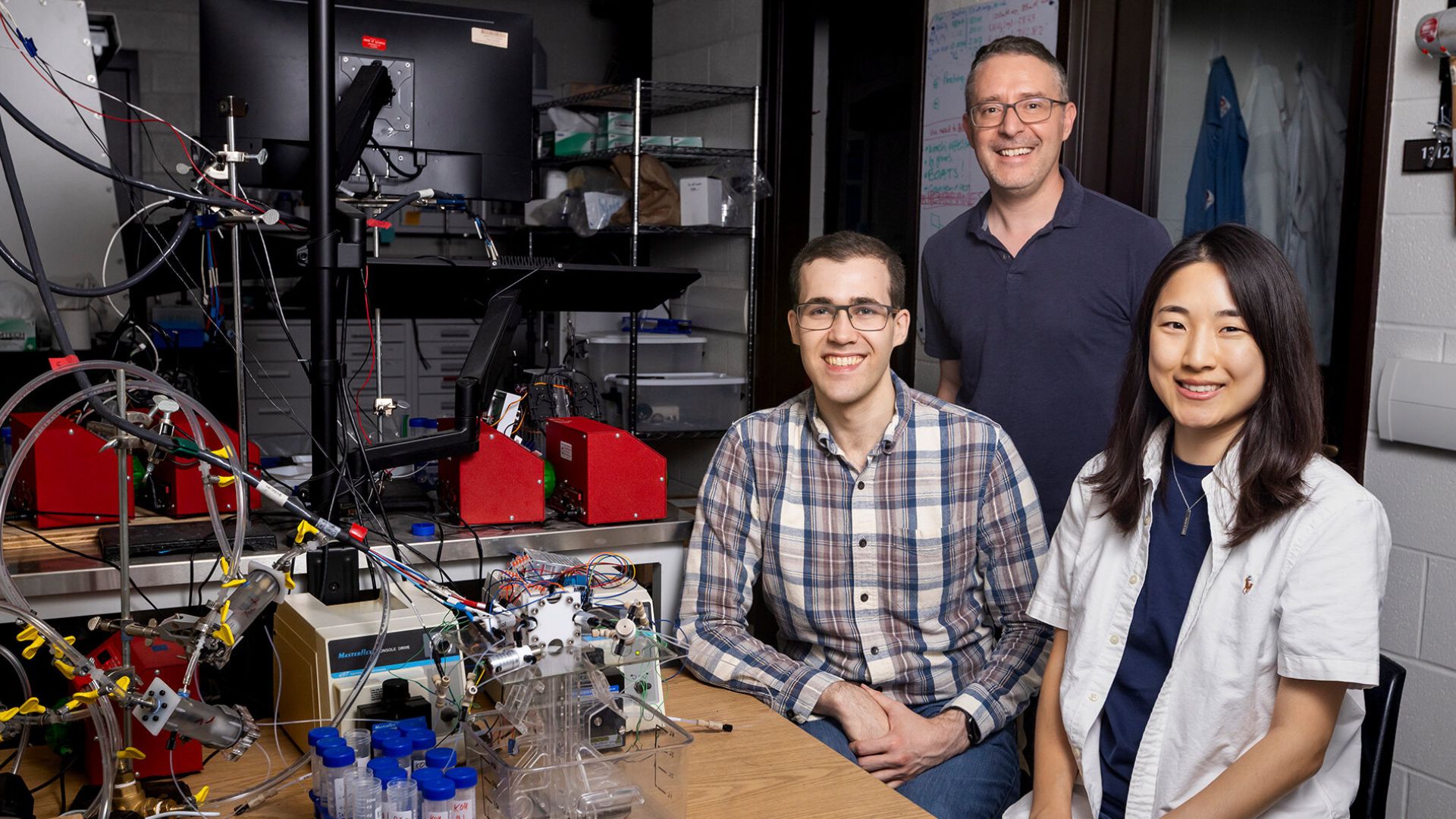
Researchers have developed a battery-like carbon capture device that removes carbon dioxide directly from the air using electricity instead of heat.
The system uses a saltwater solution and an electrochemical process to capture carbon dioxide from the atmosphere, then release it in concentrated form for storage or reuse.
The technology is designed to improve direct air capture, an approach aimed at removing carbon dioxide that has already accumulated in the atmosphere. Unlike many existing carbon capture methods that rely on heat, the new system uses electricity to drive the process, which may improve energy efficiency.
The research was carried out by scientists from the University of Illinois Urbana-Champaign and the Toyota Research Institute of North America. Their findings, published in the journal Environmental Science & Technology, highlight a new approach that combines electrochemistry and process design to advance carbon capture technologies.
The researchers say further improvements will be needed before the system can be deployed on a large scale.
Carbon Capture Goes Electric
Direct air capture focuses on removing carbon dioxide that has already accumulated in the atmosphere over many decades. Unlike traditional carbon capture systems that collect emissions from factories or power plants, this method targets carbon dioxide already mixed into the air. Although atmospheric carbon dioxide is present at much lower concentrations, removing it is considered important for meeting long-term climate goals.
Most existing carbon capture systems rely on heat to absorb and later release carbon dioxide. Those systems generally consume large amounts of energy because they require repeated heating and cooling cycles. The newly developed method replaces heat with electricity, making the overall process different from many current technologies.
The research team designed a device that operates similarly to charging and discharging a rechargeable battery. Instead of storing electrical energy, the system changes the chemistry of a saltwater solution. These chemical changes allow the liquid to capture carbon dioxide and later release it in a purified form.
READ ALSO: Ukraine Deploys Armed Ground Robot from Drone Boat in World-First Combat Attack
Electricity Drives Process
The system uses specially designed potassium-stabilized manganese dioxide electrodes inside an electrochemical cell. When electricity passes through the cell, it changes the acidity, or pH, of the saltwater solution. This shift determines whether the liquid absorbs carbon dioxide from the surrounding air or releases it again.
During one stage, the solution becomes more alkaline, allowing it to absorb carbon dioxide more effectively. In the next stage, electricity changes the solution back to a less alkaline state. As a result, the captured carbon dioxide separates from the liquid as a concentrated gas that can be stored or reused.
Professor Kyle Smith said the team’s design uses proton-intercalation electrodes in a cation-compensated cell. He explained that this allows the system to operate within an alkaline range, where carbon dioxide dissolves more readily. According to Smith, that feature is important for making direct air capture more practical.
Improving Energy Efficiency
The researchers also examined the system as a thermodynamic cycle to reduce energy losses. Instead of using traditional engineering measurements such as pressure and volume, they tracked changes in dissolved carbon and potassium ions within the solution. This approach helped the team identify where energy was being wasted during operation.
Graduate researcher JeongA Lee said mapping the process in this way revealed opportunities to redesign the cycle for better performance. The team used those insights to improve the device’s overall efficiency. Their work shows how process design can play an important role alongside new materials.
The study involved graduate students Paul Rozzi and JeongA Lee, together with Toyota researchers Chip Roberts and Tim Arthur. The collaboration combined expertise in electrochemistry, engineering, and materials science. The project aimed to develop practical solutions for long-term carbon removal.
Scaling Future Systems
The researchers said several challenges remain before the technology can be used on a commercial scale. One major issue involves keeping two separate liquid streams from mixing during operation. When some mixing occurs, the system loses efficiency and requires more energy.
Rozzi said reducing this unwanted mixing is one of the team’s main priorities. He explained that solving this issue would improve both productivity and energy performance. Future research will focus on refining the design to overcome this limitation.
Toyota Research Institute’s Chip Roberts said the project demonstrates how materials science, electrochemistry, and engineering can work together to solve difficult carbon separation problems. He added that the research supports Toyota’s broader efforts to explore technologies that contribute to long-term decarbonization.
As scientists continue improving the system, battery-like carbon capture technologies may become an important addition to global efforts to reduce atmospheric carbon dioxide.