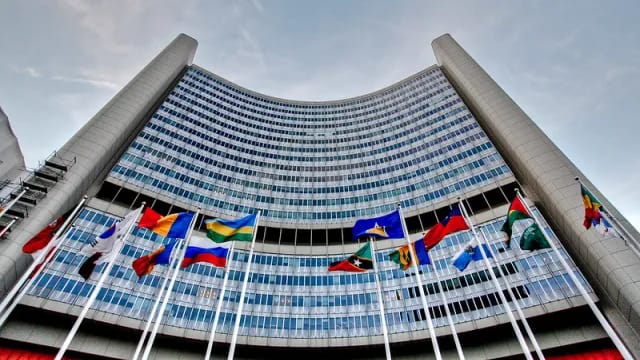
The International Atomic Energy Agency has raised its long-term nuclear power forecast again, pointing to a major expansion in small modular reactors by 2060.
Under its high-case scenario, global nuclear capacity reaches 1,284 GWe by 2060, with 284 GWe coming from small modular reactors (SMRs). That capacity would represent roughly 946 reactors if the average SMR produces 300 MWe, or about 1,136 units at an average of 250 MWe.
The figures come from the IAEA’s annual Energy, Electricity and Nuclear Power Estimates for the Period up to 2060. The latest edition extends the agency’s projections to 2060 for the first time. It also marks the sixth consecutive year in which the IAEA has increased its forecast for future nuclear capacity.
At the end of 2025, 413 nuclear reactors were operating worldwide. Together, they provided 377.1 GWe of generating capacity. The IAEA’s latest high-case scenario puts global nuclear capacity at 1,045 GWe by 2050, before rising further to 1,284 GWe in 2060.
READ ALSO: https://modernmechanics24.com/post/marine-bacteria-fucoidan-breakdown/
Nuclear Forecast Moves Higher
The IAEA’s high-case projection represents more than a threefold increase from the nuclear capacity operating at the end of 2025. The agency had projected 992 GWe by 2050 in last year’s forecast. Its latest figure is therefore about 53 GWe higher for that year.
The low-case scenario presents a more limited expansion. It places global nuclear capacity at 641 GWe in 2050 and 696 GWe in 2060. Even that outcome would represent substantial growth compared with the 377.1 GWe operating at the end of 2025.
The forecasts consider reactors already operating, possible licence extensions, planned retirements and projects that are considered plausible or already planned.
The low case assumes that current trends continue with limited changes to policies, regulations and laws. The high case takes into account national plans to expand nuclear power while remaining within what the agency considers technically feasible and plausible.
The IAEA said several conditions will influence whether the higher projection is reached. These include government policy, investment, workforce development and cooperation between regulators. Greater international harmonisation of nuclear regulations is also expected to help projects move forward.
IAEA Director General Rafael Mariano Grossi said the projections show nuclear power taking a larger role in meeting rising global electricity demand. He added that investment in new plants and extensions of existing reactor lifetimes will be essential to realise that potential.
SMRs Take Larger Role
Small modular reactors are central to the IAEA’s latest outlook. The agency defines an SMR as a reactor with a capacity of up to 300 MWe. More than 100 SMR designs are currently in development, with capacities ranging from about 20 MWe to the 300 MWe limit.
Under the high-case scenario, SMRs account for 28% of the 1,017 GWe of new nuclear capacity added through 2060. That translates into about 284 GWe of SMR capacity. At an average output of 300 MWe, that would require about 946 reactors.
WATCH ALSO: https://modernmechanics24.com/post/china-five-destroyers-firepower-drill/
A lower average reactor size produces a larger unit count. If the average SMR capacity is 250 MWe, the same 284 GWe would correspond to roughly 1,136 reactors. The figures therefore describe a range of possible deployments rather than a fixed number of future projects.
The low-case scenario also assigns a significant role to SMRs. The agency projects 120 GWe of SMR capacity by 2060 in that scenario. That equals about 400 reactors at an average capacity of 300 MWe, or roughly 480 units at 250 MWe.
The projected regional distribution is also notable. In North America, SMRs are expected to provide about 60% of new nuclear capacity under the IAEA’s outlook. In South-Eastern Asia and Latin America and the Caribbean, SMRs account for about 40% of new nuclear capacity in both the high and low scenarios.
The figures show how the technology is becoming part of broader nuclear planning. The first SMRs are now operating or under construction, although many proposed designs remain at earlier stages of development. Their smaller size is intended to provide an alternative to building large conventional reactors as single, very large projects.
Existing Reactors Remain Important
New construction is only one part of the IAEA’s long-term nuclear outlook. Extending the operating lives of existing reactors is also expected to have a major effect on future capacity. The agency considers lifetime extensions particularly important for countries with ageing nuclear fleets.
Under the high-case scenario, about 70% of today’s operating nuclear capacity remains in service in 2060. The low-case scenario assumes the opposite trend, with almost two-thirds of currently operating reactors retired by that time.
The difference highlights the importance of decisions being made about existing nuclear plants. Keeping reactors in operation generally requires safety assessments, regulatory approval and investment in upgrades. Where extensions are technically and economically viable, the IAEA describes them as among the most cost-effective sources of low-emission baseload electricity.
READ ALSO: https://modernmechanics24.com/post/swarm-aero-gamera-drone-mq9-replacement/
Energy Security Shapes Outlook
The IAEA linked its higher nuclear projections to growing attention to energy security and long-term economic growth. Energy disruptions since 2022 have increased concerns about dependence on oil and gas supplies. Those concerns have encouraged governments to examine a wider mix of electricity sources, including nuclear power.
Financial institutions are also showing greater interest in nuclear projects. The IAEA pointed to renewed engagement from organisations such as the World Bank Group and the Asian Development Bank. It said this reflects a wider shift among international financial institutions toward considering nuclear energy as part of future electricity systems.
Nuclear generation itself increased by about 1% in 2025 compared with 2024. Global electricity generation grew faster, at 2.7%. As a result, nuclear power’s share of global electricity generation declined from 8.7% in 2024 to 8.4% in 2025.
The IAEA’s outlook comes as other industry forecasts also point to significant nuclear expansion. The World Nuclear Association’s latest World Nuclear Outlook Report estimates that global nuclear capacity could reach 1,457 GWe by 2050 if countries achieve their stated nuclear targets and existing reactors continue operating.
The different forecasts underline the uncertainty surrounding the pace of nuclear development. Government policies, financing, construction schedules, regulation, supply chains and reactor lifetimes will all affect the final outcome. The IAEA’s high and low cases are therefore best understood as planning scenarios rather than firm predictions.
For SMRs, the next phase will depend on whether designs now being developed can move into commercial deployment at scale. Their contribution to the global nuclear fleet will also depend on construction costs, licensing timelines and the ability of manufacturers to establish reliable supply chains.
By extending its outlook to 2060, the IAEA is placing these technologies within a much longer view of how countries may meet rising electricity demand while maintaining low-emission generation.
The coming decades will show whether the projected expansion materialises across established nuclear markets and emerging ones.
If investment, regulation and industrial capacity develop in line with the IAEA’s high-case assumptions, SMRs may become a substantial part of the global nuclear fleet by 2060. The agency’s latest figures place that possibility within a broader nuclear expansion that would more than triple worldwide capacity from its 2025 level.