

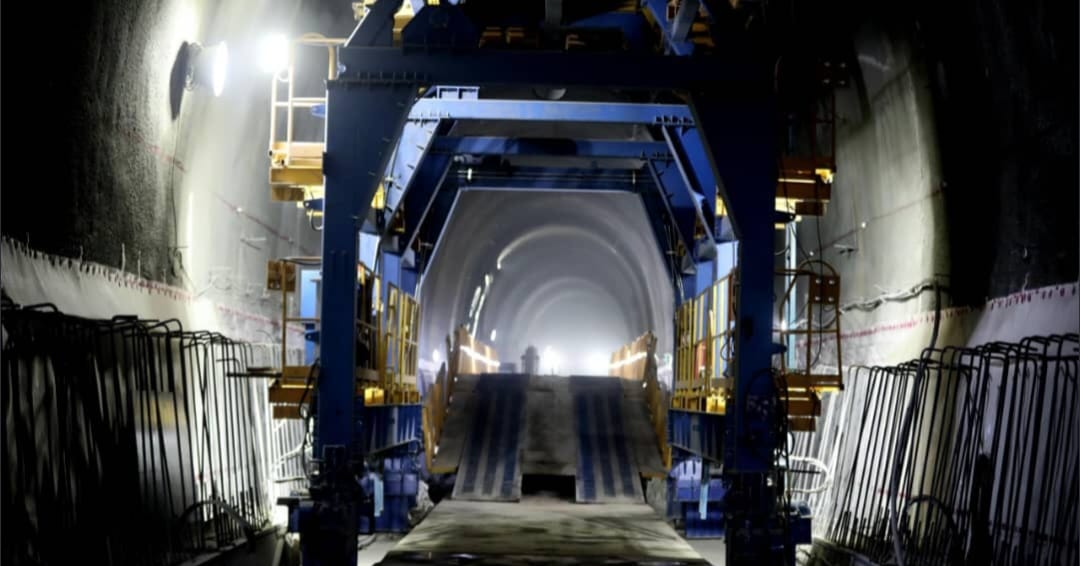
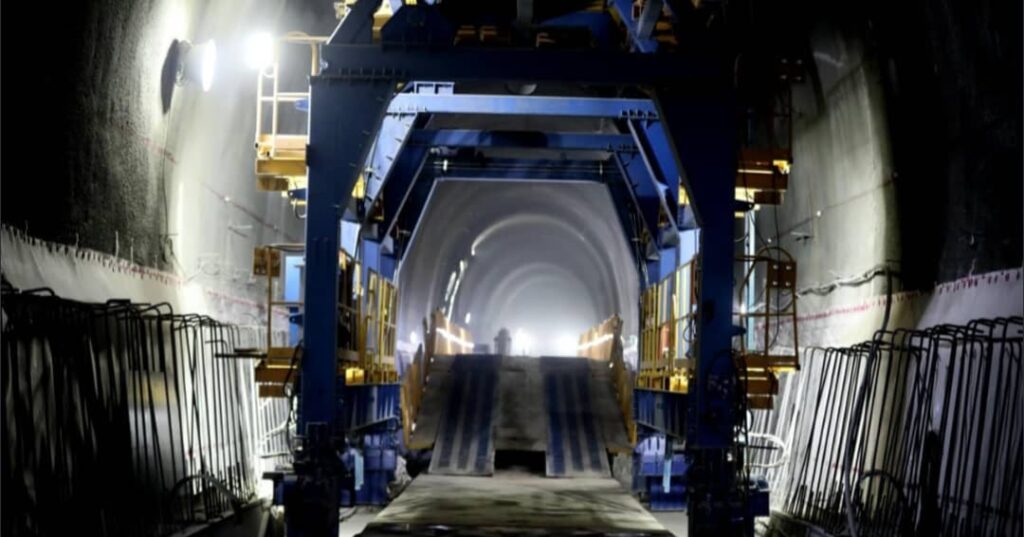
China has reached a key construction milestone on the long-delayed China-Kyrgyzstan-Uzbekistan railway, marking the first tunnel breakthrough in the Kyrgyz section since full-scale work began in June 2025.
The 210-metre tunnel is part of a planned rail corridor spanning more than 500km from western China through Kyrgyzstan to Uzbekistan. The project is designed to give China a shorter overland trade route to the Middle East and Europe while reducing reliance on routes through Russia and Kazakhstan.
Chinese state broadcaster CCTV reported that workers completed drilling the 210-metre tunnel in Kyrgyzstan on Saturday. It is the first tunnel to be drilled through the Kyrgyz section since full-scale construction started in June 2025. CCTV said construction progress across the section had reached 17 percent.
The railway will begin in Kashgar in China’s western Xinjiang region. It will cross the mountainous terrain of Kyrgyzstan before reaching Andijan in eastern Uzbekistan. More than 305km of the line will run through Kyrgyzstan, making the country the largest part of the route outside China.
READ ALSO: https://modernmechanics24.com/post/nanjing-iron-sodium-ion-batteries/
Construction is advancing across several parts of the project. Work has started on 27 tunnels, 43 bridges and 88 roadbed sections, according to China’s state news agency Xinhua. Workers are also building 20 railway stations along the route.
Shorter Route Through Central Asia
The CKU railway was first conceived in 1997. The project then spent decades facing delays linked to difficult mountain terrain, disagreements over railway gauges and wider geopolitical concerns.
Once operational, the line is expected to provide the shortest land route from China to the Middle East and Europe. Chinese state media said it can reduce travel time by up to eight days compared with the China-Europe Railway Express.
The existing China-Europe Railway Express operates on three main routes. All of them pass through Russia or Kazakhstan. The CKU line will instead travel south through Kyrgyzstan and Uzbekistan before connecting with wider regional transport networks.
The route also has economic importance for southern Xinjiang. It is expected to create a new connection between the region and markets in Central Asia and beyond. Kyrgyzstan and Uzbekistan, both landlocked countries, will gain direct rail access toward China and the wider Asia-Pacific region.
Gauge Plan Solves Rail Challenge
One of the major technical issues has been the difference between railway gauges used across the region. China uses a standard gauge of 1,435 millimetres, while much of the former Soviet railway network uses a wider gauge.
The project has adopted a dual-gauge arrangement to address the problem. A 167.5km section from the Chinese border to Makmal in Kyrgyzstan will use China’s standard gauge, while almost 140km from Makmal toward Uzbekistan will retain the Soviet-era broad gauge.
WATCH ALSO: https://modernmechanics24.com/post/black-hawk-ai-hunter-killer-drone/
A transshipment hub at Makmal will connect the two sections. Cargo can therefore be transferred between trains using different gauges rather than requiring the entire railway to use one system.
Li Lifan, director of the Centre for Shanghai Cooperation Organisation Studies at the Shanghai Academy of Social Sciences, told CCTV that the arrangement will bring China’s standard railway gauge into Central Asia for the first time. The decision is aimed at overcoming one of the technical obstacles that contributed to the project’s long delays.
Geopolitics Shape Railway Plans
The railway is also being built against a changing political and economic backdrop in Central Asia. Its route provides an alternative to established corridors that cross Russia or Kazakhstan, giving the project wider significance for regional trade.
The railway has reportedly attracted attention in Moscow because of China’s growing economic presence in Central Asia.
At the same time, Russia remains closely linked to China through trade, while Western sanctions imposed after Moscow’s 2022 invasion of Ukraine have pushed Russia toward deeper economic cooperation with Beijing.
Kyrgyzstan has increasingly sought alternative sources of foreign investment as it works to strengthen its transport links. A Times of Central Asia report during President Sadyr Japarov’s visit to Beijing in February 2025 said Bishkek was placing greater emphasis on attracting foreign capital.
Russia is also expanding its transport capacity with China. Russian outlet Izvestia reported on Sunday that Moscow was upgrading existing railway crossings and discussing new highways to handle rising bilateral trade.
The project also carries regional political importance because China, Kyrgyzstan, Uzbekistan and Russia are members of the Shanghai Cooperation Organisation. The group marked its 25th anniversary at a leadership summit in Bishkek last week.
During Chinese President Xi Jinping’s recent state visit to Kyrgyzstan, the two countries issued a joint statement promising to support the railway’s smooth construction. Project chief engineer Xi Jihong said the line is expected to be ready for operation by June 2031.
Uzbekistan is seeking an earlier completion date. Deputy Transport Minister Jasurbek Choriev said in June that the country wanted to accelerate construction and finish the railway by 2028.
READ ALSO: https://modernmechanics24.com/post/figure-nscale-nvidia-gpus-humanoid-ai/
The different target dates show that the construction schedule remains an important issue for the three countries. For now, the completed tunnel provides a concrete sign that work has moved from planning and negotiations into large-scale construction on the Kyrgyz section.
However, the CKU railway will add a new east-west transport link across Central Asia. Its eventual opening will determine how quickly China, Kyrgyzstan and Uzbekistan can shift more cargo toward this southern route and how much traffic it attracts from existing Eurasian corridors.











2 Responses