

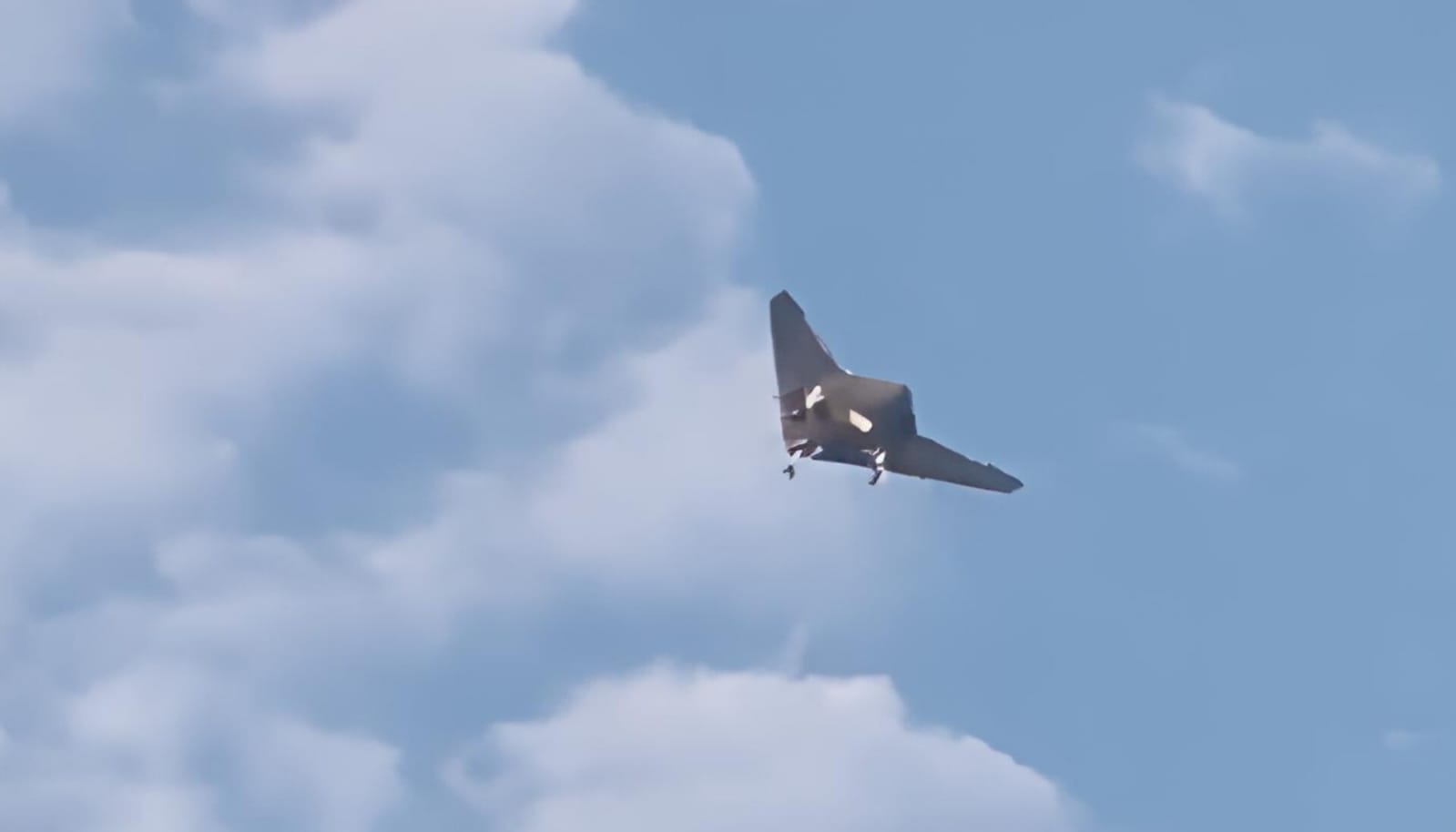
China’s GJ-21 large stealth attack drone has appeared in a series of flight-test videos as the country’s first Type 076 amphibious assault ship, the Sichuan, moves closer to entering naval service.
The drone was spotted flying over Liaoning province in northeastern China. Videos shared on Chinese social media this month showed the aircraft near a highway service area in Huludao.
One clip appeared online on Thursday, while another, dated August 19, showed the aircraft flying over the same area from a different direction. A third video captured the drone from another angle.
The South China Morning Post reported that it had geolocated the locations shown in the videos and identified the aircraft as the GJ-21.
The footage appears to show flight testing, although the exact dates and purpose of the flights have not been independently confirmed. The repeated sightings are significant because the GJ-21 has remained largely hidden since it was first publicly revealed.
READ ALSO: https://modernmechanics24.com/post/china-first-bamboo-floating-solar-farm/
The aircraft is understood to be a naval version of China’s GJ-11 stealth attack drone. The GJ-21 was first displayed during China’s Victory Day military parade in September 2025. Since then, public sightings of the aircraft have been rare.
Its design features a low-observable shape intended to reduce its radar signature. Its larger size also gives it greater capacity for sensors, fuel and weapons than smaller unmanned aircraft. The drone is expected to perform missions that require long-range surveillance, strike capability or operations in heavily defended areas.
Sichuan Moves Toward Naval Service
The GJ-21 sightings come as the 40,000-tonne Sichuan advances through sea trials.
Chinese state broadcaster CCTV reported in July that the Type 076 ship had entered its final testing phase, citing a military expert. The People’s Liberation Army Navy is expected to receive the vessel by the end of 2026.
The Sichuan is a new class of amphibious assault ship that combines traditional troop and equipment transport with advanced aviation capabilities. It has a full-load displacement of more than 40,000 tonnes and can carry landing craft, troops, armoured vehicles and aircraft.
Its most notable feature is an electromagnetic aircraft-launch system, or catapult. The technology allows aircraft to be accelerated from the deck during take-off. It follows the same basic principle used by modern aircraft carriers, but its presence on an amphibious assault ship gives the Type 076 a wider aviation role.
CCTV footage released this month showed the Sichuan launching a red test vehicle from its electromagnetic catapult. Other footage showed deck markings and decoys being used during testing.
The ship is expected to operate helicopters alongside crewed and uncrewed fixed-wing aircraft. The GJ-21 is among the unmanned systems expected to benefit from the vessel’s aviation facilities.
A Hybrid Between Assault Ship and Carrier
The Sichuan marks a shift from the traditional role of amphibious assault ships.
Earlier vessels of this type were mainly designed to transport troops, armoured vehicles and landing craft while supporting helicopter operations. The Type 076 adds the ability to launch fixed-wing aircraft, giving it a much broader role at sea.
That combination could allow the ship to support amphibious operations while also conducting surveillance, strike and air-support missions. The use of stealth drones could further expand its reach without putting pilots at risk.
Satellite imagery shared on August 25 by X user MT Anderson appeared to show the Sichuan operating near Qingdao alongside two Type 052 destroyers and three Type 054 frigates.
The imagery also appeared to show China’s first aircraft carrier, the Liaoning, at a nearby naval base. However, the South China Morning Post said it had not independently verified the imagery. It was also unclear whether the accompanying warships were directly involved in the Sichuan’s trials or were conducting routine operations.
Qingdao is home to the naval headquarters of the People’s Liberation Army’s Northern Theatre Command, making the area an important location for Chinese naval activity.
WATCH ALSO: https://modernmechanics24.com/post/china-trains-hq17-type-625-air-defense/
Taiwan Adds Strategic Context
The Type 076’s development is being closely watched because of China’s military planning around Taiwan.
Beijing claims Taiwan as part of China and has not ruled out the use of force to achieve reunification. Military activity around the Taiwan Strait has increased in recent years. The United States, Taiwan’s main international security partner, opposes any attempt to change the island’s status through force.
The Sichuan is not designed exclusively for a Taiwan contingency. Its capabilities could support a range of amphibious and naval missions. However, its combination of troop transport, aviation facilities and fixed-wing aircraft operations could give China another platform for projecting power close to its coastline and beyond.
The integration of large stealth drones is particularly notable. Unmanned aircraft can conduct surveillance and strike missions without exposing pilots to enemy air defences. Operating such systems from a ship could also extend China’s ability to gather information and conduct operations far from its land bases.
The GJ-21 and Sichuan therefore represent two parts of a broader change in Chinese naval aviation. The ship is expanding the range of aircraft that can operate from an amphibious platform, while the drone offers a stealthy unmanned option for missions that may require greater range and survivability.
As the Sichuan completes its remaining sea trials, its electromagnetic catapult and aviation systems will provide a clearer picture of how China intends to use the new vessel. Continued GJ-21 flight testing could also reveal how Beijing plans to integrate large stealth drones into its growing naval aviation fleet.










One Response