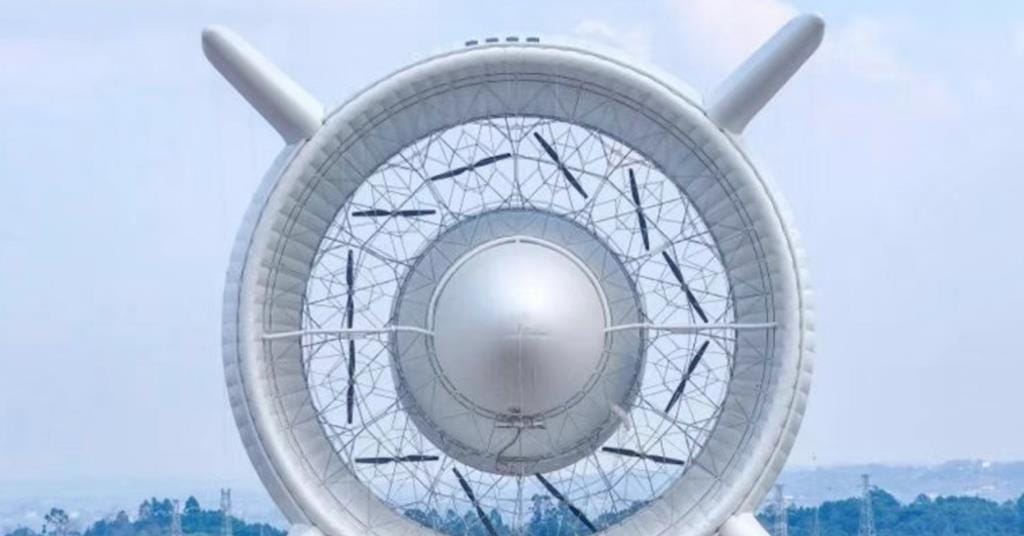
China has completed a full-process flight test of its S4000 Stratosphere Airborne Wind Energy System, an airborne platform designed to generate electricity by harnessing high-altitude winds.
During testing at a base in Northwest China, the system reached an operational altitude of 4,000 metres (13,123 feet). The trial covered the complete operating cycle, including ascent, station-keeping, electricity generation and controlled recovery. According to CCTV News, all key indicators met the required standards.
The test marks an important step in the development of airborne wind power as the technology moves toward engineering deployment.
S4000 Completes Full Flight
The S4000 is an upgraded version of the earlier S2000 airborne wind power system. Its developers have introduced a new configuration aimed at improving overall performance while increasing the operating altitude.
READ ALSO: https://modernmechanics24.com/post/china-discovery-hidden-rare-earths/
Unlike conventional wind turbines, which use large towers to position their blades at height, the S4000 uses an airborne platform connected to the ground by a tether. This allows its energy-harvesting equipment to operate thousands of metres above the surface without requiring a permanent tower of comparable height.
The system is designed to operate at up to 4,000 metres and connect with mainstream electricity grids. Its stated design service life is up to 20 years, suggesting that developers are targeting long-term power generation rather than short-duration demonstration flights.
How Airborne Wind Power Works
Airborne wind energy systems use flying platforms to reach wind resources that are difficult to access with conventional infrastructure.
The S4000 remains connected to the ground through a tether that helps control its position and provides a route for transferring generated electricity. The airborne equipment captures the movement of the wind and converts it into electrical power.
The approach is based on the same fundamental principle as conventional wind turbines, but the energy-harvesting equipment operates at a much greater altitude. Winds at higher elevations can be stronger and more consistent, potentially providing access to additional renewable energy resources.
The technology could therefore offer an alternative to conventional wind farms in locations where constructing large towers, foundations and associated infrastructure is difficult or uneconomical.
S2000 Provided the Foundation
The S4000 builds on earlier testing of the S2000 system. In January, the S2000 climbed to around 2,000 metres (6,560 feet) during a real-world test and generated 385 kilowatt-hours of electricity. The power was delivered directly to the local grid, demonstrating the system’s ability to produce usable electricity outside a laboratory environment.
WATCH ALSO: https://modernmechanics24.com/post/chinese-calligraphy-3d-ground-illusion/
The S2000 uses a helium-filled aerostat to lift lightweight wind-power equipment into the air. Once airborne, the equipment captures wind energy and converts it into electricity before the power is transmitted toward the ground.
Its developer, Beijing Linyi Yunchuan Energy Technology, described the S2000 as the world’s first megawatt-level airborne wind power system designed for use near urban areas.
The S4000 doubles the altitude reached during the earlier S2000 test, providing a larger operating envelope for the technology while retaining its connection to ground-based electricity infrastructure.
Moving Toward Engineering Deployment
Airborne wind power could provide another pathway for expanding renewable electricity generation. By moving the energy-harvesting equipment into the air, such systems can reduce dependence on the enormous towers and foundations required by conventional turbines.
However, large-scale deployment will depend on more than achieving a higher altitude. Developers will need to demonstrate reliable operation over long periods while addressing weather exposure, maintenance, operating costs, flight control, tether durability and consistent electricity delivery.
The latest test is significant because it evaluated the S4000 as an integrated system rather than testing an individual component. Successfully completing the climb, maintaining position, generating electricity and returning to the ground provides a broader assessment of its operational capabilities.
READ ALSO: https://modernmechanics24.com/post/galbot-robots-complete-100-tennis-match/
Further testing across different weather conditions and locations will be needed to establish whether the technology can achieve the reliability and economics required for commercial use.
The S4000’s successful 4,000-metre flight represents a further step in China’s development of high-altitude airborne wind power. If subsequent trials confirm its long-term reliability and power-generation performance, the technology could eventually complement conventional wind farms by accessing wind resources at elevations that fixed turbines cannot easily reach.