

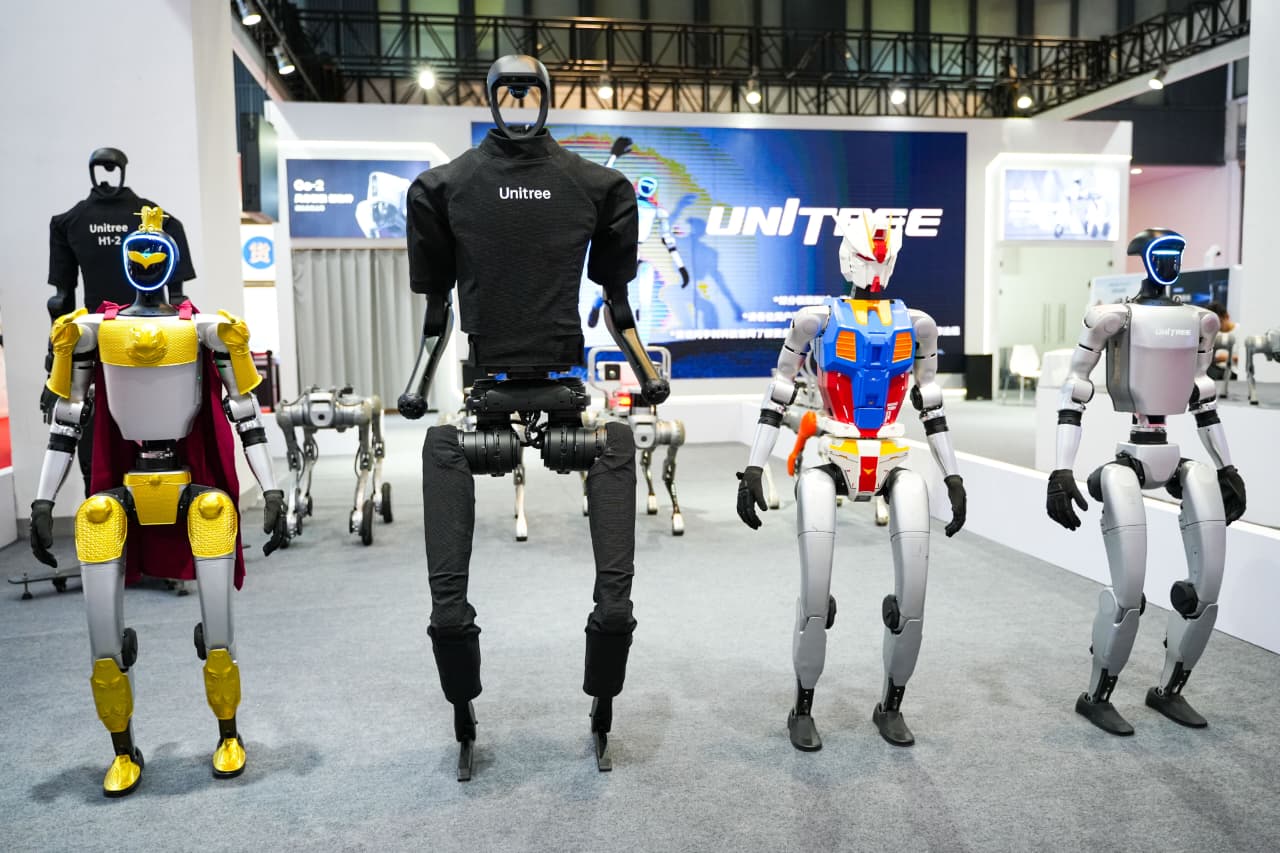
Hundreds of robotics companies gathered in Beijing on Wednesday for the opening of the World Robot Conference, showcasing machines designed for homes, shops, warehouses and factories.
Demonstrations included robots sorting parcels, serving food, handling objects and playing table tennis against human visitors. The event offered a look at how China’s investment in robotics is translating into increasingly practical applications.
China Pushes Robotics Development
The Chinese government has identified robotics as a strategic industry and companies across the country have invested heavily in embodied AI.
The term refers to artificial intelligence that allows machines to understand their surroundings and perform physical tasks rather than simply generate information on a screen. The technology is considered important for developing robots that can operate in environments designed for people.
READ ALSO: https://modernmechanics24.com/post/china-tests-rollable-solar-satellites/
Thousands of Chinese and international visitors moved through the exhibition halls on the first day of the event.
Beijing-based investor Kang Yu, who has attended the conference for three consecutive years, said the main question is when robots will enter thousands of industries and homes. She said machines need to reach a certain level of intelligence before that wider adoption becomes practical.
At one booth, visitors watched a humanoid robot wearing an apron pick up a toy chicken drumstick and place it into a bucket. Another demonstration featured a five-metre-tall humanoid whose large arms moved slowly as visitors gathered around it. A sign beside the machine asked whether such a system should be viewed as a machine or a human, suggesting that the distinction may become more complicated as robots develop.
Robotic Hands Gain New Skills
The exhibition featured hundreds of robotics startups, including companies that were established only a few years ago.
Soumodip Sarkar, executive president of a science park in Portugal, said the improvements in Chinese robotics were visible compared with previous years. He was visiting the conference as part of a tour of factories in China.
Sarkar said robotic hands had made particularly noticeable progress. He pointed to advances that allow robots to handle objects such as fruit, a task that some machines struggled with at last year’s event. Better object handling is important for industries such as agriculture, where robots may eventually need to pick and move products without damaging them.
Other demonstrations focused on food preparation and logistics. At the booth of Unitree, a Chinese robotics company, a robot assembled a simple sandwich by placing a single lettuce leaf between two slices of bread. Elsewhere, robotic arms moved packages along conveyor belts, demonstrating how machines can support warehouse and delivery operations.
WATCH ALSO: https://modernmechanics24.com/post/hyundai-atlas-humanoid-robot-wins-honor/
Humanoids Face Practical Limits
Visitors also saw robots designed for more familiar settings. One humanoid was demonstrated as an emotional companion, while another played table tennis against a human opponent. The table tennis robot, roughly the height of a 10-year-old child, remained connected to the internet while responding to the movement of the ball.
Despite the progress, companies acknowledged that significant technical problems remain. Kang said poor internet connections can cause slow response times, an issue that matters when robots need to react quickly to people or objects around them. Reliable communication, fast processing and accurate movement will be necessary if humanoids are to operate safely outside controlled environments.
Safety was also visible during the demonstrations. At one point, a staff member quickly moved toward a small robot in a T-shirt after it appeared likely to collide with a human child. Such incidents highlight the difference between a robot successfully completing a demonstration and operating independently in busy homes, workplaces or public spaces.
Global Interest Meets Geopolitical Barriers
The growing interest in Chinese robotics is taking place alongside wider geopolitical tensions. Unitree and dozens of other Chinese technology companies have been placed on a US blacklist over allegations that they support military activities. The restrictions add another layer of uncertainty for companies seeking to expand their technologies into international markets.
European customers are also examining questions surrounding data security and possible unauthorised transfers, according to Sarkar.
At the same time, Yang Qian, chief operating officer of X Square Robot, said foreign customers, including visitors from the United States, frequently come to the company to study its technology. She said this indicates that perceptions of China’s broader technology ecosystem are changing.
READ ALSO: https://modernmechanics24.com/post/norinco-fuxi-robot-remote-control/
Unitree attracted particular attention at the conference after its shares rose more than 600% on their debut in Shanghai on Wednesday. The company has become one of the most closely watched names in China’s growing humanoid robotics sector. Its performance also reflects the increasing interest from investors in companies developing robots for commercial and consumer applications.
Yet the industry is still waiting for a defining moment that would bring humanoid robots into widespread public use.
Yu Chao, founder and chief executive of Lumos Robotics, compared the current stage of the sector with the period before ChatGPT transformed public awareness of generative AI. He said he expects the robotics industry to reach a similarly disruptive stage in about three years.
The Beijing conference shows that robotics development is shifting from laboratory experiments toward practical tasks involving food, logistics, agriculture and household activities.
However, reliable connectivity, safety, intelligent movement, cost and international market access remain important challenges. How quickly companies solve those problems will determine whether humanoid robots become common tools across industries or remain largely limited to controlled demonstrations.















4 Responses