

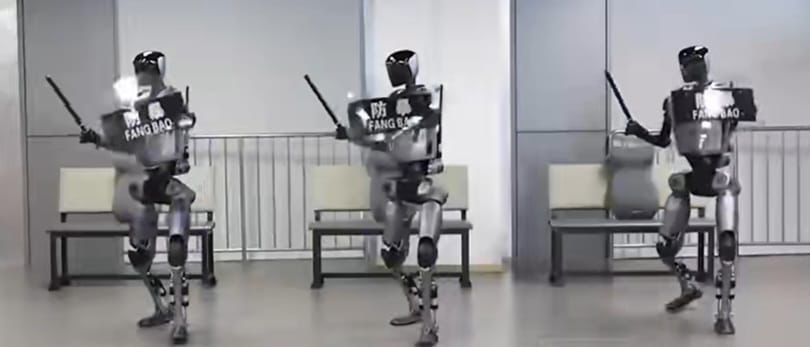
China’s NORINCO Group is preparing to unveil the Fuxi, a full-size humanoid robot designed to let people remotely perform tasks in hazardous environments.
The state-owned defense company says the system combines real-time human control with robotic operations on the ground, covering reconnaissance, patrol duties and specialized missions. The robot will make its public appearance at the 2026 World Robot Conference in Beijing as China places greater attention on practical uses for humanoid robotics.
Fuxi Robot Enters Public View
The Fuxi has been developed by NORINCO’s innovation institute using technologies developed domestically, according to the company.
Its design focuses on sensing human movements, transferring those movements to different robotic platforms and coordinating the robot’s entire body. In simple terms, an operator can move naturally while the robot reproduces those actions remotely at the location where the task is being carried out.
READ ALSO: https://modernmechanics24.com/post/hanwhas-k9mh-howitzer-us-army-prototype/
The robot is designed to perform personnel identification and raise alerts when it detects unusual situations during sentry duties. NORINCO also lists all-weather reconnaissance, intelligent patrols and operations in hazardous areas among its intended applications. These functions are aimed at situations where sending a human directly into the operating area may be difficult or unsafe.
The Fuxi system is not limited to individual operations, as several robots can work together in formation. NORINCO plans to demonstrate this capability through nighttime urban inspection activities during the exhibition. The demonstration is expected to show how multiple robots can coordinate management, assess situations and respond as part of a connected operational process.
Remote Control Extends Human Reach
A major part of the system is a teleoperation platform called
external avatar, which connects the human operator with the full-size humanoid robot.
NORINCO describes it as an independently controllable teleoperation solution developed for humanoid robots weighing about 90 kilograms. The technology allows human movements to be captured, processed and transferred to the robot in real time.
The approach keeps decision-making with a human while placing the physical robot in the environment where the work needs to happen. This is different from a fully autonomous robot because the machine can receive direct human input rather than relying entirely on pre-programmed actions or artificial intelligence.
The company says the system is intended for remote reconnaissance, unmanned operations and specialized responses in complex or high-risk locations.
WATCH ALSO: https://modernmechanics24.com/post/iceye-expands-europe-space-power/
The technology also points to a broader direction in robotics, where humans and machines perform different parts of the same task. A person can remain at a safer location while the robot handles physical movement, inspection or other operations at the site. Such systems can be useful when an environment is too dangerous, difficult or unpredictable for direct human access.
NORINCO Expands Robotic Portfolio
The Fuxi will be part of a much larger NORINCO display at this year’s World Robot Conference and World Robot Expo.
Eighteen NORINCO-affiliated organizations are expected to participate, presenting 68 products covering humanoid robotics, intelligent equipment and other emerging technologies. The wider exhibition reflects the company’s effort to connect robotics with defense, security, mobility and industrial applications.
Among the other technologies is a lightweight protective equipment system featuring ballistic helmets and ballistic plates. NORINCO says the equipment meets several domestic and international protection standards and is intended for uses ranging from counterterrorism and emergency response to overseas peacekeeping and special-operations training.
The company is also displaying enhanced-vision glasses that combine an augmented-reality display, low-light and infrared thermal imaging, spatial positioning and hands-free controls.
The Hangzhou Zhiyuan Research Institute has also developed a mobile edge-cloud computing system for large-scale unmanned operations.
Edge-cloud systems process and distribute information closer to where it is being generated, helping connected machines exchange data and coordinate their activities. NORINCO describes its product as the first edge-cloud product in China’s defense industry to receive trusted-cloud certification.
READ ALSO: https://modernmechanics24.com/post/taiwans-first-live-fire-drone-rehearsal/
Robotics Moves Toward Applications
The exhibition will also feature several products outside conventional humanoid robotics. These include a walking-assistance exoskeleton, a wearable ducted-fan aircraft, a two-seat intelligent hybrid aircraft, a power-assisted towing robot and an intelligent robotic guide dog. The products show how robotics research is being extended into wearable systems, transportation, mobility assistance and human-machine cooperation.
The 2026 World Robot Conference is placing particular emphasis on moving robotics from demonstrations toward practical applications.
Organizers plan to launch a Global Robot Application Exploration Initiative, under which companies will bring mass-produced humanoid robots, quadruped robots and dexterous robotic hands into real-world trials. More than 2,000 exhibits from over 300 exhibitors are expected at the event, with more than 150 products scheduled to make their debut.
NORINCO will lead the central state-owned enterprise exhibition area, where its robotics and intelligent equipment will be displayed alongside products from affiliated institutes.
The opening ceremony will also include a video announcement about the creation of a central SOE robot innovation consortium led by NORINCO. The initiative adds an organizational dimension to China’s wider push to develop and apply robotics across different sectors.
The Fuxi demonstration therefore comes at a time when humanoid robots are moving beyond laboratory research and controlled demonstrations toward specific operational roles. Its remote-control system places particular emphasis on keeping people involved while using robots to physically enter and work in challenging environments.
As real-world trials expand, systems such as Fuxi will provide another example of how human judgment and robotic mobility can be combined for tasks that require both.
NORINCO’s presentation also highlights the growing overlap between robotics, artificial intelligence, sensing, communications and unmanned systems. The company’s broader portfolio suggests that humanoid robots are being considered not as standalone machines, but as part of larger networks that can share information and coordinate with human operators.
However, the next stage will depend on how effectively these technologies perform outside exhibition environments and adapt to the demands of real operational settings.















One Response