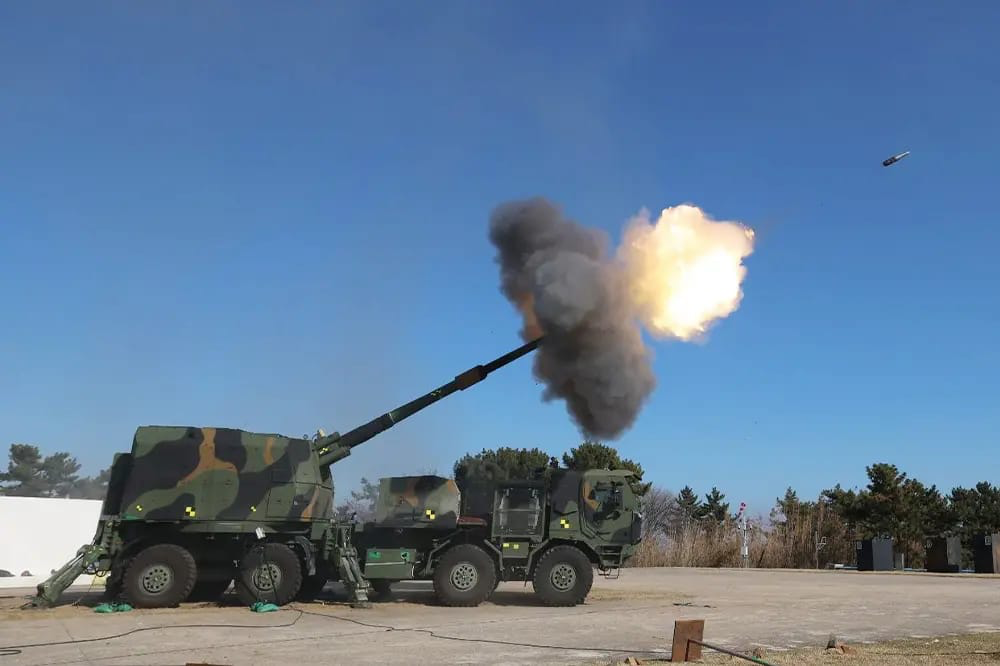
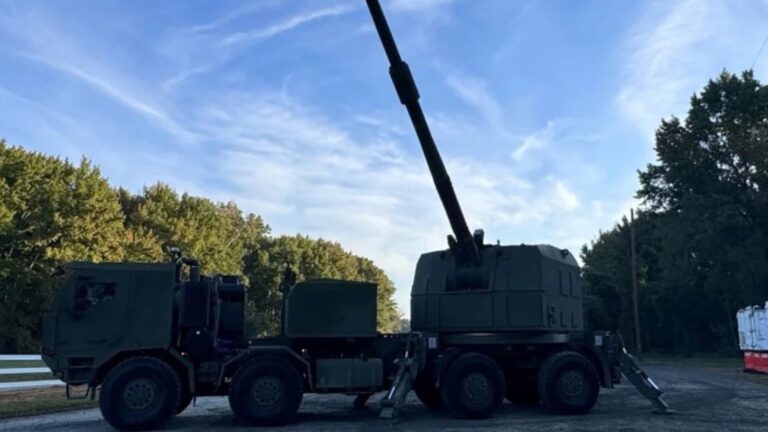
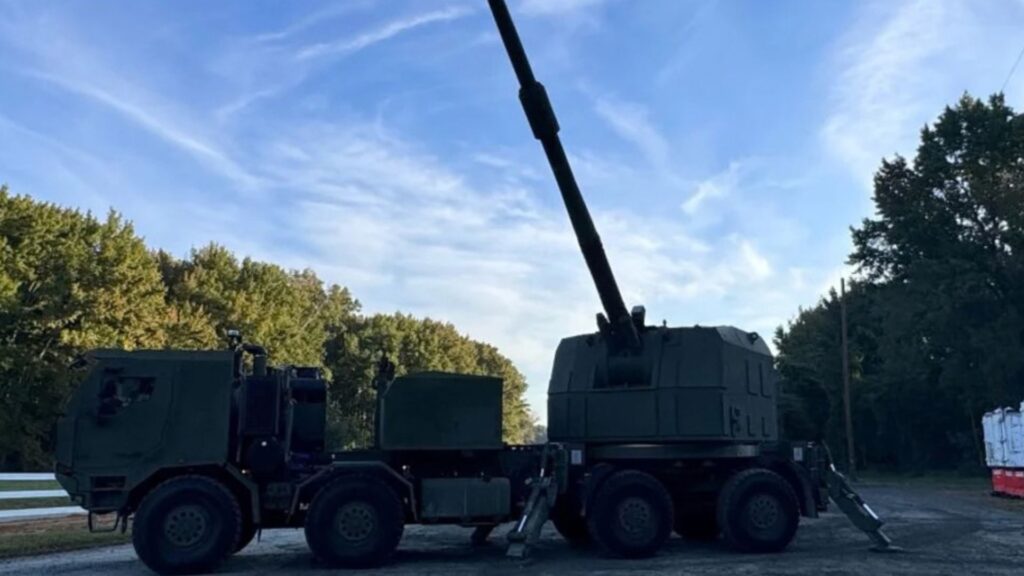
The US Army has selected Hanwha Defense USA to develop prototypes of a wheeled 155mm self-propelled howitzer for its Mobile Tactical Cannon program.
The decision moves South Korea’s K9 Mobile Howitzer(K9MH), into a new phase of testing that may eventually lead to the replacement of some of the Army’s M777 towed artillery systems. The program reflects the Army’s growing focus on artillery that can move quickly, relocate after firing and operate more effectively on a battlefield extremely exposed to drones and long-range weapons.
Hanwha Enters Testing Phase
Under the agreement, Hanwha Defense USA will provide up to 18 wheeled self-propelled howitzer systems for rapid prototyping, testing and soldier experimentation. The initial order covers six prototype systems, while the Army has an option to acquire another 12 during an estimated four-year performance period. The agreement has an initial value of $100.3 million and a total cumulative face value of about $262.9 million.
The Army awarded the agreement competitively through an Other Transaction Authority mechanism, a contracting route frequently used by the US government to speed up research, development and prototype programs.
The Army described the Mobile Tactical Cannon( MTC), as part of its wider effort to modernize long-range fires and adapt its forces to changing battlefield conditions. Soldiers will operate and evaluate the prototypes in realistic exercises, allowing the service to gather information on performance, reliability and logistical support.
READ ALSO: https://modernmechanics24.com/post/china-robotic-fortress-south-china-sea/
The Army’s announcement did not identify the K9MH by name, but Hanwha Defense USA confirmed that its K9 Mobile Howitzer is the system being supplied for the program. Hanwha had previously announced the K9MH as its entry for the competition in March, putting it among several designs considered for the Army requirement. American Rheinmetall, BAE Systems, General Dynamics Land Systems and Elbit Systems USA were also involved in the competition.
The Army stressed that selecting Hanwha for prototype development does not mean that the K9MH has been chosen for eventual production or deployment. Instead, the prototype phase will give soldiers and Army officials an opportunity to assess the system before making decisions about future fielding. The service said information from the experiments will directly support senior leaders as they determine the next steps for the Mobile Tactical Cannon program.
Why The K9MH Stands Out
The K9MH is a wheeled version derived from Hanwha’s established K9 family of tracked self-propelled howitzers. K9 variants are already operated by South Korea and several overseas customers, including Australia, Egypt, Estonia, Finland, India, Norway, Poland and Turkey. The K9MH combines an 8×8 wheeled chassis with a 155mm gun and is designed to provide artillery firepower while reducing the time needed to move between firing positions.
Both the tracked K9 and the K9MH use a 52-caliber 155mm cannon. In simple terms, caliber describes the barrel length compared with the diameter of the projectile, so a 52-caliber 155mm barrel is roughly 26.5 feet long. The M777 uses a shorter 39-caliber barrel of about 16.7 feet, and longer artillery barrels generally allow shells to achieve higher velocities and greater ranges.
Hanwha states that the K9MH has a maximum range of more than 37 miles, or about 60 kilometers. The exact conditions behind that figure are not clear from the available information, including whether it depends on rocket-assisted or other specialized ammunition. By comparison, the M777 has a stated maximum range of slightly less than 20 miles even when using specialized ammunition.
Mobility is another major difference between the two systems. The M777 is a towed howitzer, meaning it needs another vehicle to transport it between locations, while the K9MH carries its gun and propulsion system on the same platform. Hanwha says the K9MH can move from a firing position in less than 30 seconds, supporting the so-called “shoot and scoot” approach in which artillery crews fire and relocate quickly.
WATCH ALSO: https://modernmechanics24.com/post/alpamayo-2-super-ai-autonomous-driving/
The K9MH can also carry 40 rounds of ammunition onboard. A K10 resupply vehicle can support rapid ammunition replenishment in the field, giving the system an integrated approach to moving, firing and rearming. These features are particularly relevant to modern artillery units that need to limit the amount of time they remain exposed after firing.
M777 Replacement Takes Shape
The Army has examined replacing the M777 with a wheeled self-propelled system since at least 2019. The service has previously conducted comparative testing involving different artillery designs as it looked for ways to improve the mobility of units equipped with towed guns. The current MTC effort provides a more structured path toward testing a new system with soldiers before any decision on procurement is made.
The initial focus is expected to involve formations equipped with M777 systems, particularly Stryker Brigade Combat Teams. Airborne, airmobile and infantry brigades that operate M777s could also eventually be considered, although the Army has not announced a final list of formations that would receive a new Mobile Tactical Cannon. The service has specifically said that the current program is intended to replace M777 systems in selected formations rather than immediately replace every towed howitzer.
The MTC program also sits within a broader Self-Propelled Howitzer-Modernization effort. That wider effort may include the development or acquisition of another tracked self-propelled 155mm howitzer, meaning the Army is examining more than one approach to modernizing its artillery fleet.
Wheeled and tracked systems offer different advantages, with tracked platforms generally providing stronger off-road mobility and greater protection while wheeled vehicles are typically lighter and easier to move over roads.
The Army’s recent thinking has also been influenced by combat experience in Ukraine. Both Ukrainian and Russian forces have used tracked, wheeled and towed artillery, while drones have increased the ability of opposing forces to detect and target artillery positions. This has made rapid movement an increasingly important consideration because artillery systems that remain in one location for too long face a greater risk of being detected and attacked.
Army Secretary Dan Driscoll highlighted concerns about the speed and mobility of existing tracked artillery during a House Appropriations Committee hearing earlier this year.
He said the M109 Paladin family would remain in service for some time, but indicated that future purchases should provide a different capability to complement the platform. His comments came as the Army proposed no funding for additional M109A7 systems in its Fiscal Year 2027 budget request.
READ ALSO: https://modernmechanics24.com/post/mit-lincoln-laboratory-lighthouse-moon-missions/
From M109 To New Fires
The Army’s search for a new self-propelled howitzer has a long history. One major attempt was the XM2001 Crusader, an advanced artillery system that was canceled in 2002 amid rising costs. A later effort, the XM1299 under the Extended Range Cannon Artillery program, was also canceled in 2024 after the Army demonstrated a range of about 40 miles with a 58-caliber gun.
The XM1299 program faced technical challenges associated with its unusually long gun barrel. Its cancellation did not end the Army’s pursuit of longer-range artillery, however, as the service has continued investing in advanced ammunition designed to extend the reach of existing and future artillery systems. Among those efforts are new long-range projectiles that use technologies such as ramjet propulsion.
The K9MH therefore enters the MTC program at a time when the Army is examining both the gun platform and the ammunition it uses.
A modern artillery system must provide sufficient range while also moving rapidly, surviving on a contested battlefield and receiving ammunition and maintenance support without excessive logistical demands. The prototype trials will help determine how well the K9MH meets those requirements under conditions that resemble operational use.
The Army’s approach also places greater emphasis on direct soldier feedback. Rather than selecting a system solely through technical demonstrations, the service plans to have troops operate the prototypes and assess them during operational experiments.
This process is intended to identify practical issues involving reliability, maintenance, movement, ammunition handling and battlefield employment before any larger procurement decision.
South Korea Gains US Opening
For Hanwha, the MTC agreement represents another significant step in expanding its defense business in the United States. The company has already established the K9 family as an international artillery product, with customers across Europe, Asia, the Middle East and the Pacific.
Poland has become one of the most important customers for South Korean defense equipment, including K9-based systems, while Hanwha has also expanded production and industrial partnerships in several countries.
WATCH ALSO: https://modernmechanics24.com/post/iceye-expands-europe-space-power/
Hanwha Defense USA says it plans to establish a US-anchored manufacturing network for the K9 Mobile Howitzer. The company has identified Opelika, Alabama, as the initial Phase I location for that effort. Hanwha says its experience with local production in Australia, Egypt, Poland and Romania will support its approach to building defense manufacturing capacity in the US.
Localization is an important part of the company’s broader strategy because major defense contracts often involve more than delivering finished equipment.
Domestic production can create opportunities for American manufacturing, maintenance, supply chains and workforce development while giving the customer greater control over long-term support. For the US Army, the extent of domestic production and sustainment would therefore be an important consideration if the K9MH progresses beyond the prototype stage.
The next phase will focus on testing rather than immediate deployment. Soldiers will examine how the K9MH performs in realistic conditions, while Army leaders will use the resulting data to decide whether the system should move toward fielding.
However, the Mobile Tactical Cannon would give selected formations a faster-moving 155mm artillery capability and mark another step in the Army’s effort to adapt its fire forces to modern combat conditions.


One Response