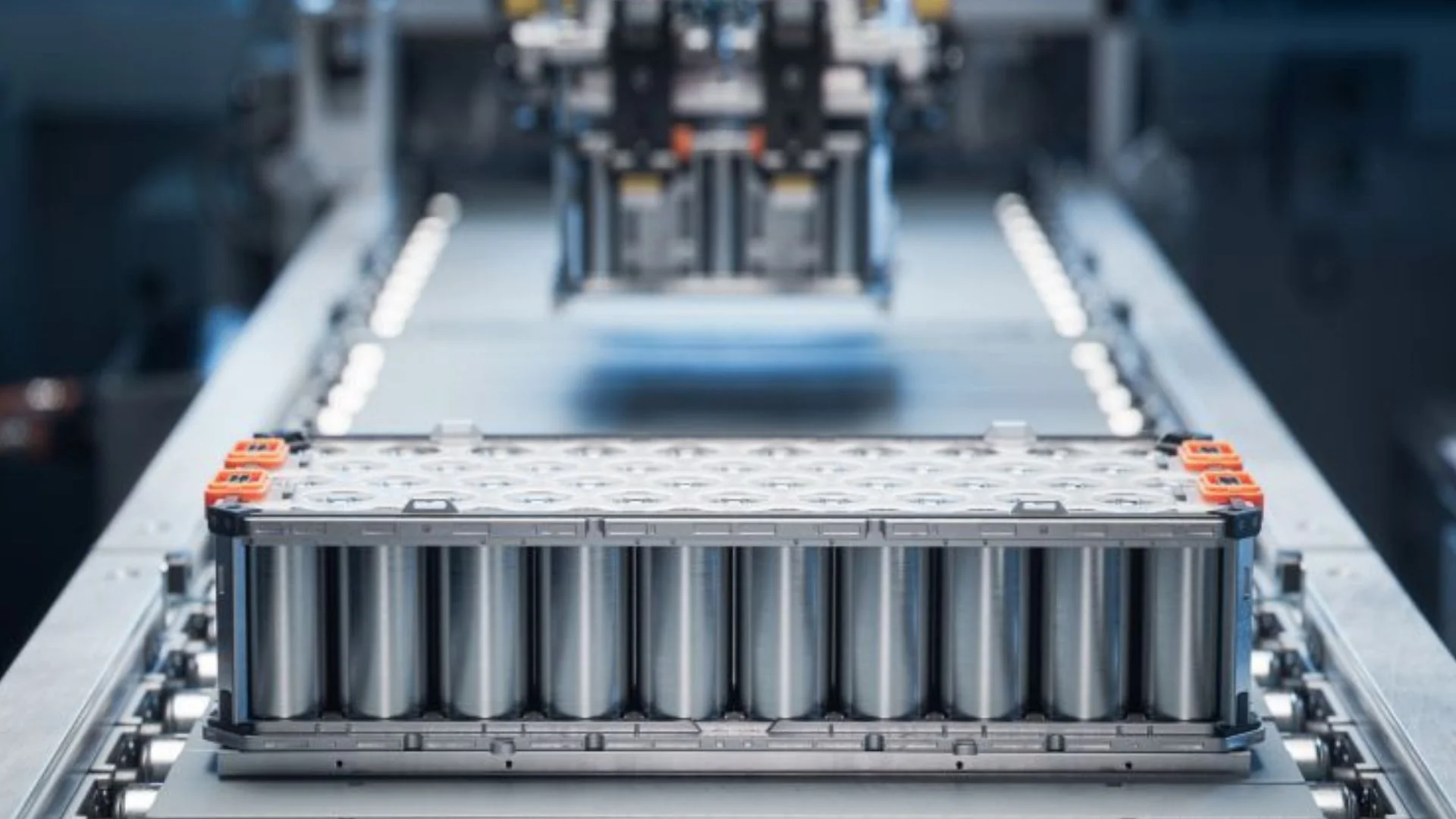
Researchers at the Korea Advanced Institute of Science and Technology (KAIST) have developed an advanced Battery Scan technology that detects extremely small variations in lithium-ion battery electrodes without disassembling or damaging the battery.
The system identifies defects at the nanoscale while leaving the battery completely intact. Researchers believe the method can improve battery safety and strengthen quality control in electric vehicle manufacturing.
Dr. Guseon Kang led the study from the KAIST Department of Mechanical Engineering and is now with the Korea Institute of Industrial Technology. Professor Young-Jin Kim from KAIST served as the corresponding author of the research. The findings were published in Nature Communications on June 10.
Why Thickness Matters
Lithium-ion batteries power most modern electric vehicles because they store large amounts of energy in a compact size. Inside these batteries, electrodes carry electric current during charging and discharging. Their thickness must remain uniform across the entire surface to ensure the battery operates safely and efficiently.
Even a very small difference in electrode thickness can cause electrical current to gather in certain areas. That concentration creates extra heat during battery operation. If the heat continues to build, it can trigger thermal runaway, a dangerous condition where the battery temperature rises rapidly and may result in fire or explosion.
Battery manufacturers already inspect electrodes during production, but existing methods face practical challenges. X-ray computed tomography produces detailed internal images but requires too much time for fast production lines. Ultrasonic inspection needs direct contact with liquid, while laser-based systems work quickly but cannot accurately measure the internal structure of battery electrodes.
Battery Scan Spots Defects
The KAIST team addressed these limitations by combining terahertz waves with an optical frequency comb. Terahertz waves sit between radio waves and visible light in the electromagnetic spectrum and can pass through many materials without causing damage. An optical frequency comb acts like an extremely accurate ruler by dividing light into evenly spaced reference points for precise measurements.
READ ALSO: China Achieves 6N-Grade Hydrogen Fluoride Production for Advanced Chipmaking
The researchers directed terahertz waves toward battery electrodes and collected the signals reflected from inside the material. These reflections bounced repeatedly between the front and back surfaces of the electrode. The team then compared the signals with the optical frequency comb to calculate electrode thickness with exceptional accuracy.
The measurement relies on a principle known as Fabry-Pérot interference. As the terahertz waves travel back and forth inside the electrode, they form a regular interference pattern. By studying this pattern, researchers determined both the electrode thickness and its complex refractive index, which describes how the material transmits and absorbs electromagnetic waves.
One important advantage of the method is that it does not require a separate calibration step. The system measures thickness and material properties during the same inspection process. This reduces inspection time while maintaining high measurement accuracy.
Fast And Precise
The research team tested electrodes ranging from 50 to 150 micrometers thick, roughly the diameter of a human hair. During production-speed testing, the inspection required only 0.2 seconds for each measurement. Even at that speed, the system detected thickness differences as small as 70.1 nanometers in anodes and 465.5 nanometers in cathodes.
When researchers increased the inspection time to 25.6 seconds, measurement precision improved significantly. The system detected thickness differences of just 7.8 nanometers in anodes and 25.2 nanometers in cathodes. According to the researchers, this represents up to a 100-fold improvement over conventional time-domain analysis methods.
The technology also creates a three-dimensional thickness map across the entire electrode instead of measuring only one location. This allows manufacturers to monitor gradual thickness changes across large battery components. The system also maintained accurate measurements when the electrode was tilted at about 45 degrees, showing that it can work under practical production conditions.
Future Manufacturing Benefits
The new inspection system offers manufacturers a way to identify microscopic defects before batteries leave the production line. Detecting problems early can reduce manufacturing waste while improving product consistency. Better inspection also supports safer batteries for electric vehicles and other energy storage applications.
Researchers expect the technology to support not only today’s lithium-ion batteries but also next-generation all-solid-state batteries. Unlike conventional batteries that use liquid electrolytes, all-solid-state batteries rely on solid materials that promise higher energy density and improved safety. Reliable inspection tools will play an important role as manufacturers expand production of these advanced battery designs.
READ ALSO: US Warns Iran-Linked Hackers Target Water and Energy Systems With Industrial Cyberattacks
Professor Young-Jin Kim said the platform measures both electrode thickness and material properties simultaneously without requiring additional calibration.
He added that the technology is designed for real-time quality control on production lines for both lithium-ion and all-solid-state batteries. The research highlights how more accurate inspection methods can strengthen battery manufacturing as demand for electric vehicles continues to grow worldwide.
As battery makers increase production to meet global electric vehicle demand, inspection technologies that combine speed, accuracy, and non-destructive testing are becoming increasingly important. Systems capable of detecting hidden defects before batteries reach consumers can improve manufacturing efficiency while supporting safer and more reliable energy storage. The KAIST technology represents another step toward smarter battery production for the next generation of electric mobility.