AGIBOT introduced four new embodied AI products at the World Artificial Intelligence Conference (WAIC) 2026 in Shanghai, expanding its portfolio of humanoid robots, industrial automation systems, and dexterous robotic hands.
The company also demonstrated how its robots are already working in factories, public venues, and commercial environments, rather than remaining limited to laboratory testing.
Alongside the product launches, AGIBOT showcased more than 30 robots performing real tasks across the conference, highlighting its focus on practical deployment and large-scale operations.
The launches include the AGIBOT A3 Ultra humanoid robot, the X2 EDU education platform, the G2 Max industrial robot, and the OmniHand 3 Ultra-M dexterous robotic hand.
Each product is designed for a different application, ranging from public services and education to industrial manufacturing and precision object handling. Together, they represent the company’s effort to build a complete embodied AI ecosystem.
Embodied AI combines artificial intelligence with physical machines that can observe their surroundings, make decisions, and perform actions in the real world. Unlike software that operates only inside computers, embodied AI systems interact directly with people, tools, and physical environments. This approach is becoming increasingly important as industries look for smarter automation solutions.
AGIBOT Robots Built Purposefully
At its 200-square-meter exhibition booth in the Shanghai World Expo Exhibition and Convention Center, AGIBOT displayed the new products alongside live demonstrations and industrial deployment examples. Visitors also encountered AGIBOT robots throughout the WAIC venue, where they provided directions, answered questions, and supported event operations. More than 30 robots were deployed across the exhibition and nearby conference areas.
AGIBOT Co-founder, President, and Chief Technology Officer Peng Zhihui said the robotics industry should judge embodied AI by reliable manufacturing and long-term deployment rather than one-time demonstrations.
He said the company’s latest products focus on three important areas: humanoid platforms, industrial task execution, and dexterous manipulation. He added that recent production milestones and factory deployments show AGIBOT’s commitment to delivering practical robotic systems at scale.
The AGIBOT A3 Ultra is the company’s latest full-size humanoid robot built for extended operation in commercial and service settings. The robot stands 1.74 meters tall, weighs 60 kilograms, and features 51 active joints that allow complex body movements. Each arm can carry up to five kilograms, and the system can operate for up to eight hours using charging, battery replacement, or autonomous charging options.
READ ALSO: 29,193 Dominoes Set New Guinness World Record in Stunning 3D Pyramid Display
The A3 Ultra combines several sensing technologies to understand its surroundings. It uses 3D LiDAR, depth cameras, fisheye cameras, binocular vision, GPS, RTK positioning, and ultra-wideband navigation to move safely in different environments. NVIDIA Thor processors provide the computing power needed to process information and support advanced AI functions.
The X2 EDU targets universities, research institutions, and robotics competitions. Standing around 1.3 meters tall, it includes 29 degrees of freedom, including seven movable joints in each arm. The platform supports payloads of up to three kilograms at its end effectors, allowing students and researchers to test different robotic tasks.
Its modular design allows users to disassemble and reconfigure hardware components according to project requirements. Open hardware interfaces and motion-control systems also simplify software development and hardware expansion. Developers can integrate additional sensors, robotic tools, or computing modules without redesigning the entire platform.
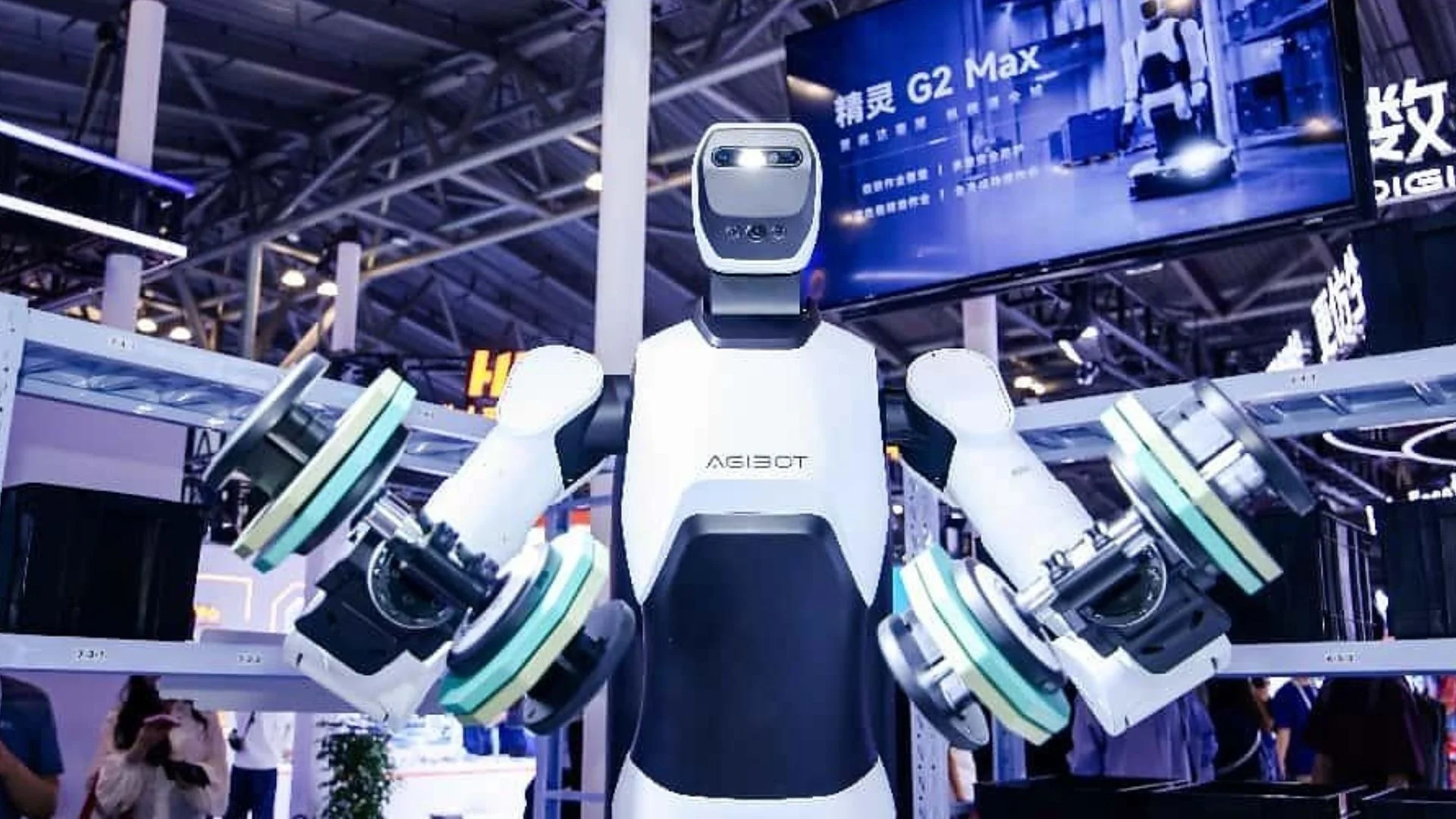
The G2 Max represents AGIBOT’s entry into heavy-duty industrial robotics. The robot combines force-controlled arms, adjustable working height, and omnidirectional wheels to perform repetitive manufacturing tasks. It also supports battery replacement and autonomous charging to reduce production downtime during continuous factory operations.
The OmniHand 3 Ultra-M serves as the company’s latest dexterous robotic hand for advanced manipulation tasks. The direct-drive hand contains 20 active joints inside a human-sized structure weighing only 630 grams. It can grip objects weighing up to five kilograms while opening or closing in approximately 0.3 seconds with positioning accuracy of plus or minus 0.2 millimeters.
The robotic hand also includes vision-based tactile sensors on each fingertip and additional sensors in the palm. These components allow the hand to detect pressure, contact, and object movement while automatically adjusting grip strength. Such capabilities support applications including teleoperation, AI training, demonstration recording, and complex object handling.
Factories Already Using
Beyond product launches, AGIBOT highlighted existing industrial deployments developed with partners including Longcheer Technology and PIA Automation. These projects involve tablet inspection, semiconductor handling, material transportation, and other repetitive manufacturing processes. The company emphasized that its robots are already working alongside existing production equipment.
One major deployment operates at Longcheer Technology’s manufacturing facility in Nanchang. AGIBOT G2 robots handle material collection, product placement, equipment operation, and finished-product return within a tablet quality inspection line. Engineers completed production integration within 36 hours, allowing the robots to enter active service quickly.
According to AGIBOT, the deployment processes around 3,000 tablet units during each production shift. The robots have accumulated more than 64 hours of continuous operation while keeping downtime losses below four percent. These figures demonstrate sustained operation rather than isolated testing.
Industrial environments present challenges that differ from controlled demonstrations. Robots must repeat tasks consistently, adapt to changing object positions, and coordinate with surrounding machines throughout the production process. AGIBOT said its systems perform these functions without requiring manufacturers to redesign existing factory layouts.
The company also displayed projects developed for tourism, transportation, and commercial services. Partnerships with Sichuan Cultural Tourism and Guangzhou Railway have introduced robots into visitor-facing environments. These robots provide guided tours, route assistance, visitor interaction, and information services.
Such deployments reflect a broader shift in robotics adoption. Earlier generations of humanoid robots often focused on exhibitions or demonstrations. Current systems increasingly perform defined operational tasks that deliver measurable value to organizations.
READ ALSO: US Navy Diverts Five Ships Near Strait of Hormuz as Iran Maritime Operation Intensifies
Live Demonstrations Continue
AGIBOT organized several live demonstrations throughout WAIC 2026 to illustrate different robotic capabilities. The demonstrations covered sports, teleoperation, and commercial service applications. Each scenario combined multiple AI technologies into complete workflows.
One demonstration featured a robot playing table tennis using computer vision and motion prediction. The robot tracked a fast-moving ball, calculated its path, and adjusted its movements in real time. This showcased the integration of perception, planning, and physical control.
Another presentation focused on robotic boxing through teleoperation. A human operator controlled the robot remotely while the system translated body movements into coordinated physical actions. The demonstration highlighted whole-body coordination and low-latency response.
AGIBOT also presented a beverage preparation demonstration that resembled a real commercial service task. The robot identified cups, operated beverage-making equipment, and delivered finished drinks to visitors. Instead of highlighting a single robotic movement, the demonstration connected several actions into one continuous process.
The company expanded its demonstrations beyond its exhibition booth by deploying robots throughout the conference venue. Visitors encountered robots performing guidance, navigation, and information services across busy public spaces. Operating in crowded environments tested their ability to avoid obstacles, interact with people, and maintain reliable performance.
These public deployments exposed robots to constantly changing conditions that differ significantly from laboratory testing. The systems needed to respond to unpredictable human movement while continuing assigned tasks. Such environments provide valuable operational data for future improvements.
Future Deployment Focus
Another section of the AGIBOT exhibition highlighted its manipulation foundation models. These AI models connect perception, reasoning, planning, and physical movement into a unified system for completing complex tasks. The company explained how these technologies help robots make decisions during real-world operations.
During WAIC 2026, AGIBOT also hosted an Embodied AI Forum at the Shanghai World Expo Center. Researchers, robotics companies, and technology leaders discussed the future of physical AI and the requirements for scaling robotic systems beyond research laboratories. The discussions covered both technical development and practical deployment challenges.
The robotics industry has increasingly shifted attention from impressive demonstrations toward reliable long-term performance. Businesses now seek machines that can work safely alongside employees while fitting into existing operations. This trend has encouraged manufacturers to focus on durability, consistency, and easier deployment.
Humanoid robots remain one of the fastest-growing areas within artificial intelligence and advanced manufacturing. Improvements in sensors, computing hardware, batteries, and AI software have expanded the range of practical applications across factories, logistics, healthcare, education, and public services. Companies worldwide are investing heavily as demand for intelligent automation continues to grow.
AGIBOT‘s latest announcements reflect this broader industry direction by combining new robotic hardware with existing commercial deployments. Instead of presenting individual technologies in isolation, the company demonstrated how multiple AI systems work together in factories and public environments. That approach may shape how embodied AI moves from research laboratories into everyday industrial and service operations in the years ahead.