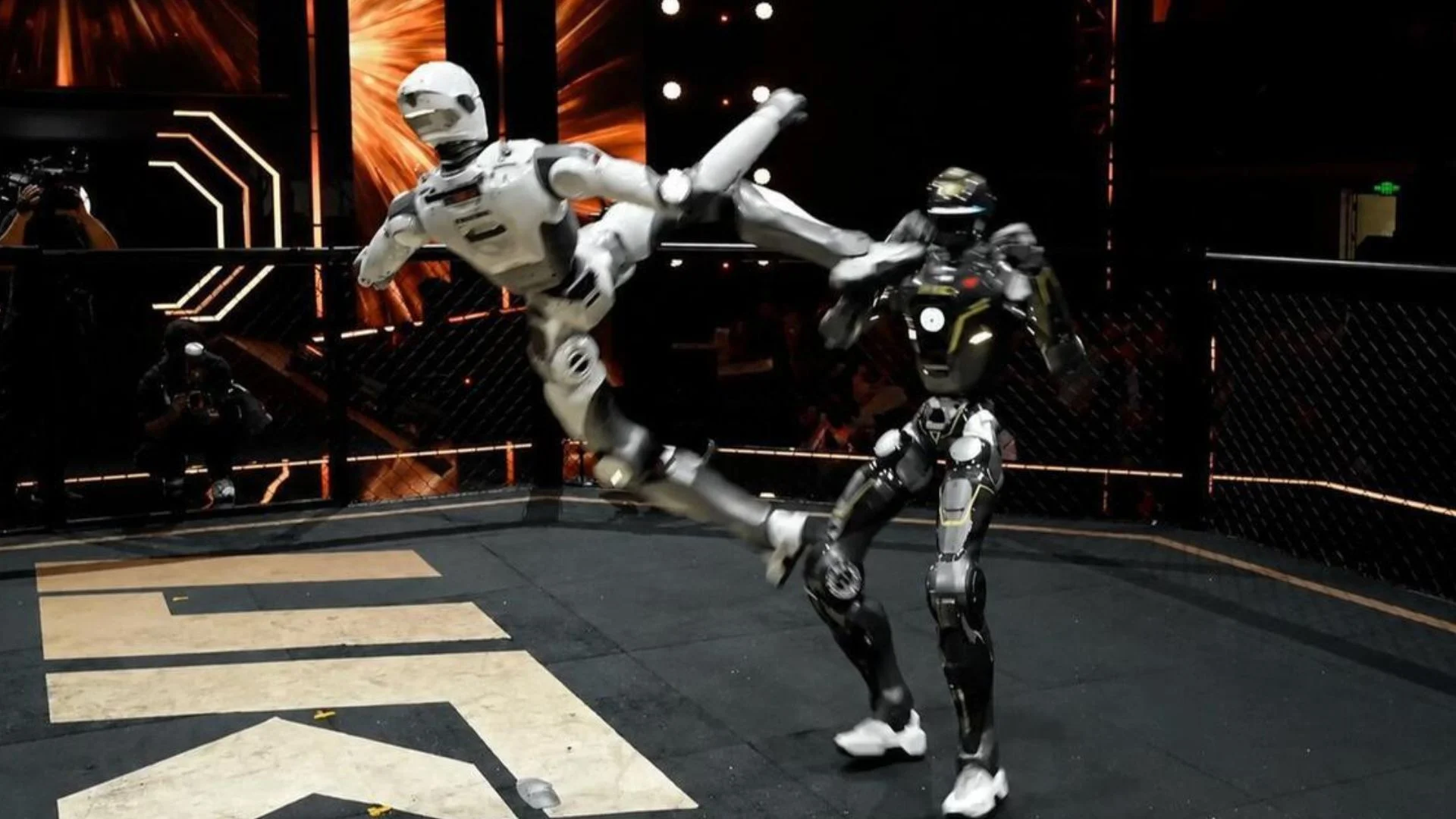
Shenzhen hosted the world’s first freestyle humanoid robot fighting competition, bringing full-sized robots into a live combat arena.
The event introduced the Ultimate Robot Knock-out Legend (URKL), a new tournament designed for humanoid machines. Organizers said the competition aims to support robotics research while creating a global platform for advanced humanoid technology.
Global Teams Compete
The tournament took place at the Shenzhen Nanshan Cultural and Sports Center in Guangdong Province. A total of 32 teams from different parts of the world participated in the inaugural contest. Every team competed using the same EngineAI T800 humanoid robot to ensure fair competition and consistent performance standards.
The opening match quickly drew attention when a white robot named “White Eagle” landed a high kick on its opponent, “Matador.” The robots also exchanged punches, blocked attacks, and performed evasive movements throughout the contest. Their actions demonstrated balance, coordination, and the ability to respond quickly during combat.
One of the most notable moments came when a robot lost its head during the match. Despite losing its head-mounted sensors, the machine continued fighting by relying on systems located inside its torso. It kept throwing punches and absorbing attacks until the match ended, showing the durability of its internal design.
Robot Fighting Tests Real Engineering
EngineAI developed the T800 as a full-sized general-purpose humanoid robot for advanced movement testing. The robot stands about 1.73 meters tall and performs actions such as uppercuts, spinning kicks, and rapid recovery after falling. These movements require the machine to maintain balance while constantly adjusting its posture through onboard computing systems.
READ ALSO: Caltech Team Cools Radioactive Radium Molecules to Unlock Physics Beyond Standard Model
The robot combines posture control, motion sensing, and shock absorption to remain stable during physical impacts. Posture control helps the robot stay upright, while motion sensors detect changes in movement and position. Shock-absorbing components reduce impact forces, allowing the robot to continue operating after heavy collisions.
Unlike industrial robots that usually repeat fixed tasks, humanoid robots must react to changing situations in real time. Fighting competitions provide a demanding environment where engineers can test movement, balance, and decision-making together. This type of testing helps developers identify weaknesses that may not appear during laboratory experiments.
Technology Beyond Arena
International action star Donnie Yen attended the event and watched the matches from the venue.
He said he had previously seen robot fights only in science fiction films but found the real competition much more impressive. Yen added that seeing the machines’ weight and precise movements up close gave him a new perspective on modern robotics.
EngineAI founder and CEO Zhao Tongyang said the competition serves a larger purpose than entertainment alone.
He explained that the tournament is intended to promote both technological research and industrial development through real-world testing. Zhao said engineers can use information collected during matches to improve future generations of humanoid robots.
According to Zhao, the competition evaluates several important technologies simultaneously. These include mechanical balance, extremely fast decision-making measured in milliseconds, and coordination between multiple sensors. Data gathered during matches may help shorten the path from research laboratories to commercial products.
READ ALSO: Tohoku Scientists Create a Super Silk That Stays Strong Even After Getting Wet
Future Robotics Testing
Organizers said robot performance is judged using more than offensive attacks. The scoring system also measures body stability, defensive skills, evasive movement, and overall durability throughout each match. This approach encourages teams to develop robots that combine strength, control, and reliability.
Using one standardized robot platform also allows engineers to compare software performance more accurately. Since every team competes with identical hardware, differences in results mainly reflect programming, control systems, and operating strategies. Such testing provides valuable insights into how artificial intelligence manages complex physical tasks.
Humanoid robotics has attracted growing global investment as companies explore applications in manufacturing, logistics, healthcare, disaster response, and public services. Competitions like URKL offer a controlled environment to test hardware under demanding conditions before wider commercial deployment.
As developers continue improving movement, durability, and intelligent decision-making, events like this may play an important role in shaping the next generation of practical humanoid robots.